WebP to BMP
Easily convert WEBP image files to BMP.
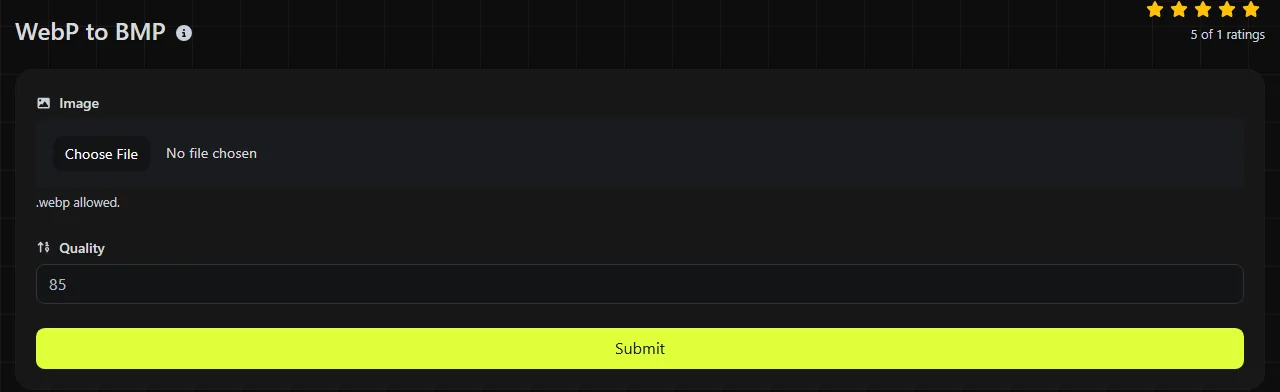
WebP to BMP is a free tool that converts a WebP image into a BMP file entirely in your browser.
Why would you turn a WebP image into a BMP?
You would convert WebP to BMP when a legacy application, device, or production process requires a Windows bitmap file. WebP is intended for compact web images, while BMP is an older raster format commonly associated with Windows software and straightforward pixel storage.
The conversion can make sense for an image editor, industrial system, or older desktop program that does not accept WebP. It is usually a poor choice for publishing an image on a website because BMP files are commonly much larger and compatibility can vary among BMP subtypes.
No, converting a lossy WebP file to BMP will not restore detail removed during WebP compression. The BMP can store the decoded pixels without another typical lossy compression step, but texture, sharpness, and color detail already missing from the WebP cannot be recovered in the BMP.
WebP-to-BMP conversion takes place entirely in your browser. Your WebP image is never uploaded to a server, which is useful when the file contains private artwork, internal screenshots, or unreleased product images.
Inspect the BMP before deleting the source. Pay particular attention to transparent areas, image dimensions, and whether the receiving application accepts the BMP variant that was created.
What happens to transparency, animation, and compression?
The image becomes a single BMP bitmap, and some WebP capabilities may no longer be available in a dependable form. The main differences are shown below.
| Property | WebP | BMP after conversion |
|---|---|---|
| Compression | Supports lossy and lossless compression | Commonly stores pixels without compression, although the BMP specification also includes limited compression methods |
| Transparency | Supports an alpha channel | Some BMP variants can contain alpha data, but application support is inconsistent |
| Animation | Can contain multiple animated frames | A BMP file does not preserve a WebP animation as an animated sequence |
| Typical file size | Usually compact because it is designed for compressed image delivery | Usually larger, sometimes substantially larger |
| Browser use | Supported by modern browsers and suited to web delivery | Major browsers support ordinary BMP files, but BMP is not a practical web-delivery format because of its size; handling can vary among BMP subtypes |
| Desktop compatibility | May fail in older software | Commonly accepted by Windows-oriented and legacy image software |
If the source is animated, a BMP cannot contain the complete motion sequence. For transparent WebP artwork, view the BMP against a contrasting background because transparent pixels may not behave the same way in the destination program.
How much larger will the BMP file be?
The BMP will commonly be larger than the WebP, but its exact size depends mainly on pixel dimensions, color depth, row padding, and the BMP encoding used. The compressed size of the original WebP is not a reliable basis for predicting the result.
A rough estimate for an uncompressed 24-bit bitmap is width multiplied by height multiplied by 3 bytes, plus a small header and padding at the end of each pixel row. A 1,000 by 1,000 image is therefore about 3,000,000 bytes, or roughly 2.86 MiB. At 32 bits per pixel, the same dimensions require roughly 3.81 MiB before considering minor structural overhead.
A tiny WebP can still produce a large BMP if it has high pixel dimensions. Before converting several high-resolution WebP images, check available storage for the larger BMP files and the attachment or upload limits of any downstream service where you plan to use them.
Which WebP files need extra checking?
Animated, transparent, unusually large, and damaged WebP files need extra checking because BMP cannot reproduce every WebP characteristic and large bitmaps consume considerable memory.
- Animated images: BMP has no equivalent animated image structure, so the motion will not survive in one BMP file.
- Transparent logos: Alpha-channel behavior varies among BMP readers. A logo may appear with an unexpected solid background in older software.
- Very large dimensions: Decoding and creating an uncompressed bitmap may require much more memory than the WebP file size suggests.
- Odd image widths: BMP pixel rows are commonly padded to four-byte boundaries. This adds a small amount of size and matters when software reads the bytes directly.
- Empty or corrupted files: An empty file or corrupted WebP data may not decode for WebP-to-BMP conversion.
- Unicode filenames: Accented or non-Latin filename characters are a file-system matter, not an image-format matter. Older software receiving the BMP may still require a simple ASCII filename.
If the destination does not specifically require BMP, WebP to JPG is generally more suitable for a photograph that needs a smaller, widely accepted file. For a Windows favicon or application icon, WebP to ICO matches that task more closely.
Common questions about WebP-to-BMP conversion
Does BMP have a 256-color limit?
No. BMP can store indexed images with limited palettes, but it can also store 24-bit and 32-bit pixel data with millions of possible colors. Do not confuse BMP with GIF, which commonly uses a palette limited to 256 colors per frame.
Why does BMP pixel data sometimes appear upside down?
Many BMP files store pixel rows from the bottom of the image upward. Software that reads raw BMP bytes must account for the signed height value and row order. Regular image viewers handle this detail automatically.
Will every older program accept the converted BMP?
No. BMP has several header types, color depths, and compression variants, and older programs may accept only a subset. Before processing a large batch, open one converted file in the target application and confirm its dimensions, colors, and background appearance.
Can a BMP contain color-management information?
Later BMP header versions can reference or embed color-profile information, but support varies among applications. If accurate print color matters, confirm the result in the software used for final output rather than assuming every BMP reader will interpret profile data consistently.
Similar tools
Popular tools
Create a WhatsApp chat link from a phone number, with an optional prefilled message.