WebP to GIF
Easily convert WEBP image files to GIF.
WebP to GIF is a free tool that converts WebP image files into GIF files entirely in your browser.
Why choose GIF instead of keeping the WebP?
Choose GIF when a website, app, older content system, or messaging workflow does not accept WebP but does accept GIF. GIF has been supported for decades and remains common for short looping animations, reaction images, simple diagrams, and small graphics with limited colors.
Conversion to GIF is less useful when the destination already supports WebP. WebP generally stores photographic images, gradients, transparency, and animation more efficiently. Turning a WebP photo or detailed animation into GIF commonly produces a larger file with fewer colors.
No, converting a lossy WebP into GIF does not restore image quality. GIF uses lossless LZW compression after the image has been reduced to an indexed color palette, but it cannot recreate detail that WebP compression already removed.
How does browser-based conversion keep the file private?
The conversion happens entirely in your browser, and the WebP file is never uploaded to a server. This matters for images containing internal diagrams, unreleased artwork, account details, or other material that should not be sent to a third-party conversion service.
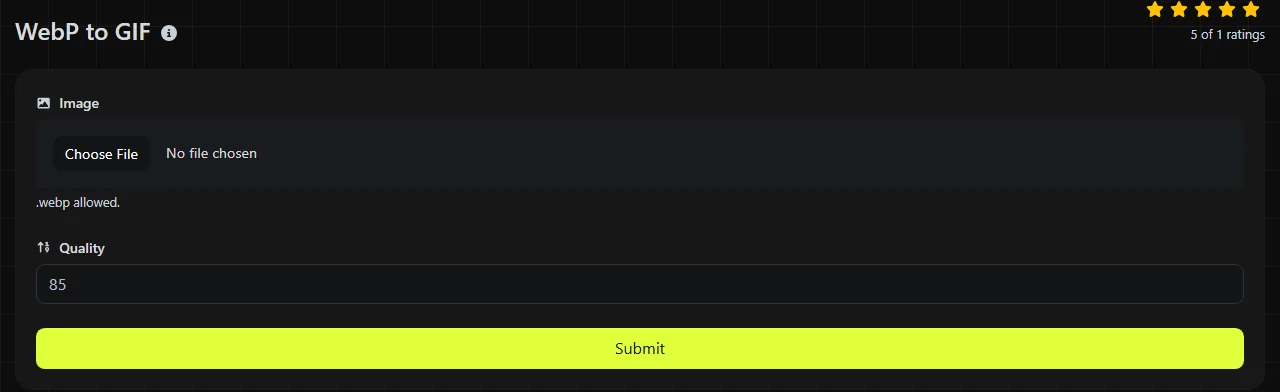
The basic workflow has three steps:
- Provide the WebP image you want to convert to GIF.
- Allow the browser to process the image and create GIF data.
- Save the resulting GIF and open it to check its appearance and animation.
Decoding WebP and encoding GIF still use your device's memory and CPU. A high-resolution animated WebP with many frames can therefore take longer or consume substantially more memory than a small icon.
What exactly changes between WebP and GIF?
The image is re-encoded using GIF's indexed-color model and LZW compression. The two formats can both contain still images, transparency, and animation, but they represent those features differently.
- Color is substantially more limited in GIF. A GIF frame uses a palette of up to 256 colors, while WebP can represent full-color images without reducing each frame to such a small palette.
- Transparency is more limited in GIF. WebP supports partial alpha transparency, such as a soft translucent shadow. GIF commonly treats a palette entry as fully transparent, so smooth translucent edges may become hard, dithered, or matted against a background.
- Animation is supported by both formats. Frame timing, looping, and transitions must be translated during conversion, and complex animations may not look exactly the same after GIF palette reduction.
- Compression differs considerably. WebP supports modern lossy and lossless compression. GIF uses lossless compression on indexed pixels, but reducing a full-color source to a 256-color palette can visibly discard color information.
- Support is broad for both formats in current major browsers. GIF also works in many older applications and publishing systems that predate WebP support.
How large will the converted GIF be?
The GIF will often be larger than the WebP, especially when the source is a photo, a long animation, or an image with gradients and frequent frame-to-frame changes. WebP was designed to compress this type of web imagery more efficiently.
Exact size cannot be predicted from pixel dimensions alone. Frame count, movement, palette complexity, noise, and repeated regions all affect the result. A short animation with flat colors may produce a manageable GIF, while a few seconds of photographic motion can produce a file many times larger than its WebP source.
Consider these typical cases:
- A 300-by-300 animated loading indicator with a few solid colors is a reasonable GIF candidate.
- A product badge with a partially transparent drop shadow can become a GIF, but the shadow cannot retain smooth alpha transparency.
- A 1280-by-720 animated WebP made from video footage is likely to become much larger and may show banding or dithering.
- A detailed still photograph usually belongs in WebP or JPEG rather than GIF unless a receiving system specifically requires GIF.
Source files that need extra checking
Some WebP inputs require a closer look after conversion to GIF because the format's limited palette and transparency can expose problems that are not obvious in the WebP source.
- Animated files should be played from beginning to end. Check the loop point, frame timing, and areas where one frame replaces another.
- Transparent artwork should be viewed against both light and dark backgrounds. Pale halos often come from converting partially transparent edge pixels to GIF's limited transparency model.
- Gradient-heavy images may show color bands. Dithering can disguise bands by mixing palette colors, although it can also add grain and increase file size.
- Misnamed or damaged WebP files may fail to decode for GIF conversion. Changing a filename to end in .webp does not make its underlying data valid WebP input for GIF conversion.
- Large animations can strain browser memory because multiple decoded frames may need to be held during processing.
Spaces, punctuation, numbers, accented letters, and non-Latin characters in a filename do not change the pixels or the GIF encoding. A browser or operating system may sanitize the generated GIF's saved filename, so confirm the name separately if another system expects an exact naming pattern.
WebP-to-GIF questions
Can I create a GIF by changing the file extension?
No. Renaming image.webp to image.gif changes only the name, not the encoded image data. Applications that inspect file signatures or decode the contents may reject the renamed file or continue identifying it as WebP.
What media type should a server use for the converted file?
The standard media type for GIF is image/gif. If a web server sends a different content type, browsers may download the file instead of displaying it or apply content-sniffing behavior.
Why does a GIF look grainy around gradients?
Grain commonly comes from dithering, which places different palette colors next to each other to imitate colors outside the 256-color palette. It can make a gradient appear smoother at normal viewing size, but individual pixels become visible when the image is enlarged.
Is GIF a good format for printing?
Usually not. GIF's indexed color and limited palette are intended for screen graphics rather than high-quality print output. Keep the original WebP or another full-color source, and use a print-oriented format when the printer or design application requires one.
Can I use the converted GIF as a website favicon?
Some browsers can display GIF favicons, but support for animation and sizing behavior is inconsistent across contexts. For a conventional favicon package with standard icon sizes, convert an appropriate source with WebP to ICO instead.
Before publishing, open the saved GIF in the actual browser, messaging app, or content system that will receive it. Check the first and last animation frames, transparent edges, color gradients, pixel dimensions, and final file size.
Similar tools
Popular tools
Create a WhatsApp chat link from a phone number, with an optional prefilled message.