WebP to ICO
Easily convert WEBP image files to ICO.
WebP to ICO is a free tool that converts a WebP image into an ICO file for use as a favicon or other interface icon.
What is an ICO file built for?
An ICO file is a container for one or more typically square icon images, commonly used by web browsers for favicons and by Windows for application, shortcut, and folder icons. Unlike a regular website image, an ICO file can hold several pixel sizes so software can choose an appropriate version for the available space.
WebP is a general-purpose image format designed for efficient web delivery. It supports lossy and lossless compression, transparency, and animation. ICO is designed for small interface graphics rather than photographs, banners, or animated content. An ICO may store its image data using PNG compression or a BMP-style device-independent bitmap, depending on how the file was created.
Keep the WebP file on your device
The conversion takes place entirely in your browser, and your WebP file is never uploaded to a server. This matters for unpublished brand assets, internal application icons, and other images that should not be sent to a third-party conversion service.
- Select the WebP image you want to convert.
- Convert the WebP image to ICO.
- Save the generated ICO file, then inspect it at the small size where it will be used.
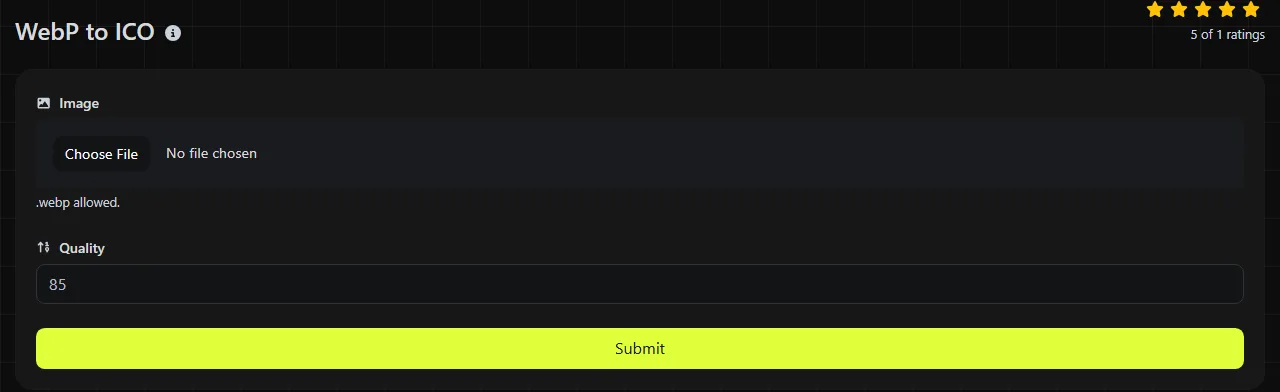
WebP-to-ICO conversion only changes the file format. It does not improve the source artwork or recreate details that were removed by lossy WebP compression.
Is WebP-to-ICO the right choice for this image?
WebP-to-ICO conversion makes sense when the source is a logo, symbol, monogram, or other simple square graphic that needs to become a favicon or Windows-style icon. A source image with clear shapes and enough padding usually remains recognizable when reduced.
- A WebP logo with a transparent background is a practical favicon source. The resulting ICO is static, so inspect its edges and small-size legibility.
- An animated WebP sticker is a poor source because ICO does not preserve WebP animation. Use a deliberately chosen still image instead.
- A 1,920-by-1,080 WebP photograph can be converted, but its wide composition and fine detail usually make it unsuitable as a small square icon.
- A heavily compressed WebP with blockiness or blurred text will keep those visible defects. Converting lossy data to an ICO does not restore the original quality.
If the image is meant to remain a regular website graphic rather than an icon, ICO is usually the wrong destination. WebP to PNG is more appropriate when you need a broadly editable lossless image with transparency, while WebP to JPG fits photographic content that does not need transparency.
Format differences at a glance
| Property | WebP | ICO |
|---|---|---|
| Primary purpose | Web images, including photos and graphics | Favicons and operating-system interface icons |
| Transparency | Supports an alpha channel | Supports transparency through alpha data or a legacy mask |
| Animation | Supported | Not supported as standard icon animation |
| Compression | Lossy or lossless WebP compression | May contain PNG-compressed or BMP-style image data |
| Typical file-size direction | Commonly compact for web delivery | Often larger, particularly when it contains several sizes or bitmap data |
| Support | Widely supported by modern browsers and many image applications | Long-established favicon support and native use in Windows |
There is no fixed size ratio between the input and output. A simple single-image ICO may be small, while a multi-resolution ICO can exceed the source WebP because it stores several raster images. Compression method, pixel dimensions, color depth, and image complexity all affect the result.
What should you check when the source is awkward?
You should check the composition, transparency, dimensions, and validity of the source before relying on the converted icon. WebP-to-ICO conversion cannot correct every source-image problem.
- Non-square images may need cropping or padding. Stretching a wide logo into a square distorts it.
- Tiny images cannot gain real detail through enlargement. Enlarged pixels may look soft or jagged.
- Very large images contain more detail than a favicon can display. Thin lines and small lettering may disappear after reduction.
- Transparent edges can reveal light or dark halos if the original artwork was prepared against a matte background.
- Empty files do not contain WebP image data. Damaged files may not decode, so a converter cannot always produce a dependable icon from them.
- Unusual filenames with accented or non-Latin characters do not change the image format, although some older publishing systems may handle simple ASCII filenames more predictably.
Common questions about WebP and ICO
Can one ICO file contain several resolutions?
Yes. The ICO format can contain multiple versions of the same icon, such as 16-by-16, 32-by-32, and larger images. Do not assume every ICO contains several sizes, since the extension alone does not reveal how many images are inside.
Should I use ICO, PNG, or SVG for a website favicon?
ICO is useful when compatibility with older favicon conventions matters. PNG works well for a fixed raster size, while SVG can remain sharp at different display scales in browsers that support SVG favicons. Sites sometimes provide more than one format through separate favicon declarations.
Will an ICO work as a Windows application icon?
ICO is the standard container used for many Windows application icons, but creating the file is only one part of packaging an application. The development environment, installer, or executable resource settings must also reference the icon correctly.
Why do transparent icon edges sometimes look dark?
Dark or pale outlines often come from partially transparent pixels that were blended against a background before conversion. Review the source on both light and dark backgrounds, and remove any unwanted matte color in an image editor before creating the ICO.
Does converting to ICO preserve color profiles?
You should not depend on ICO consumers to apply embedded color-management information consistently. Prepare icon artwork in sRGB, and judge the saved icon by how it appears in its target browser or operating system.
Before you publish the icon
Open the ICO in an application that recognizes icon files and confirm that it is square, sharp, and readable at small dimensions. Check transparent areas against contrasting backgrounds. When adding it to a site or application, verify that the file path, declared format, and deployment package point to the new ICO rather than the original WebP.
Similar tools
Popular tools
Create a WhatsApp chat link from a phone number, with an optional prefilled message.