MD5 generator
Generate a 32-character MD5 hash from any input string.
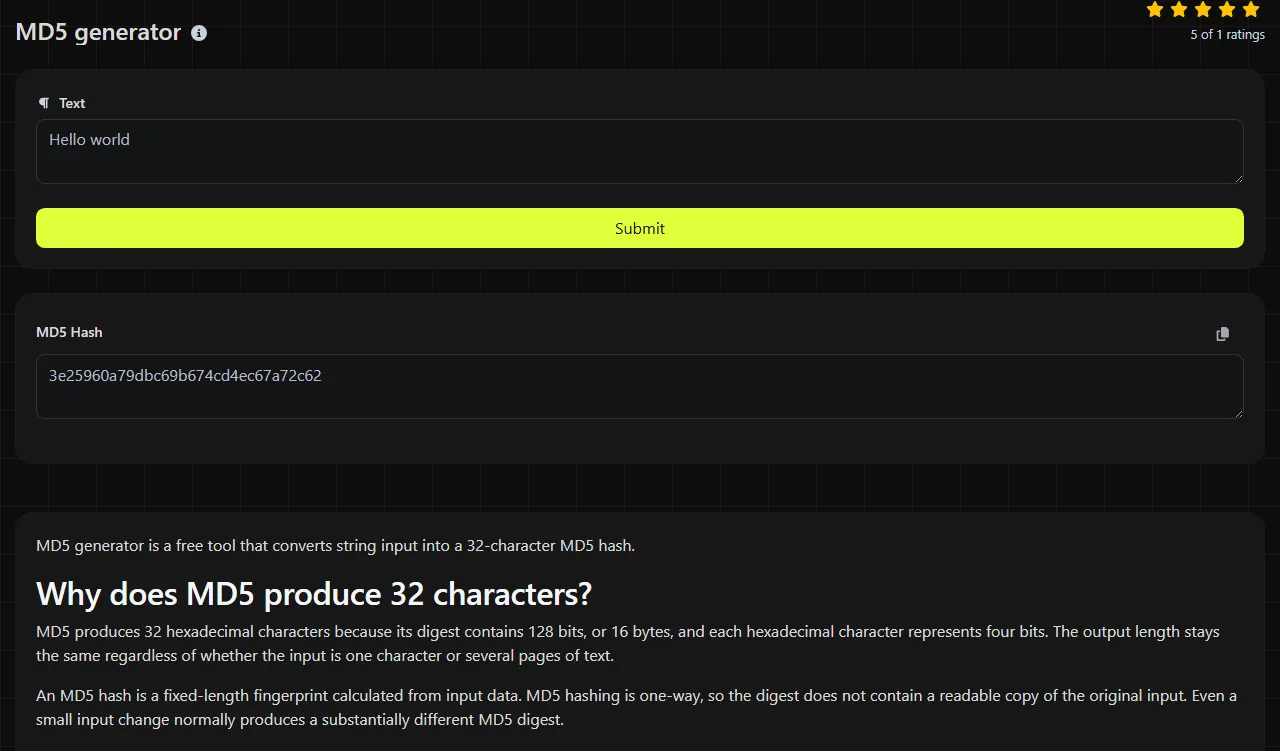
MD5 generator is a free tool that converts string input into a 32-character MD5 hash.
Why does MD5 produce 32 characters?
MD5 produces 32 hexadecimal characters because its digest contains 128 bits, or 16 bytes, and each hexadecimal character represents four bits. The output length stays the same regardless of whether the input is one character or several pages of text.
An MD5 hash is a fixed-length fingerprint calculated from input data. MD5 hashing is one-way, so the digest does not contain a readable copy of the original input. Even a small input change normally produces a substantially different MD5 digest.
Ronald Rivest developed MD5 in 1991 as a successor to MD4, and the algorithm was published in RFC 1321 in 1992. Its compact digest and high processing speed helped it become common in file checksums, software systems, and older authentication designs.
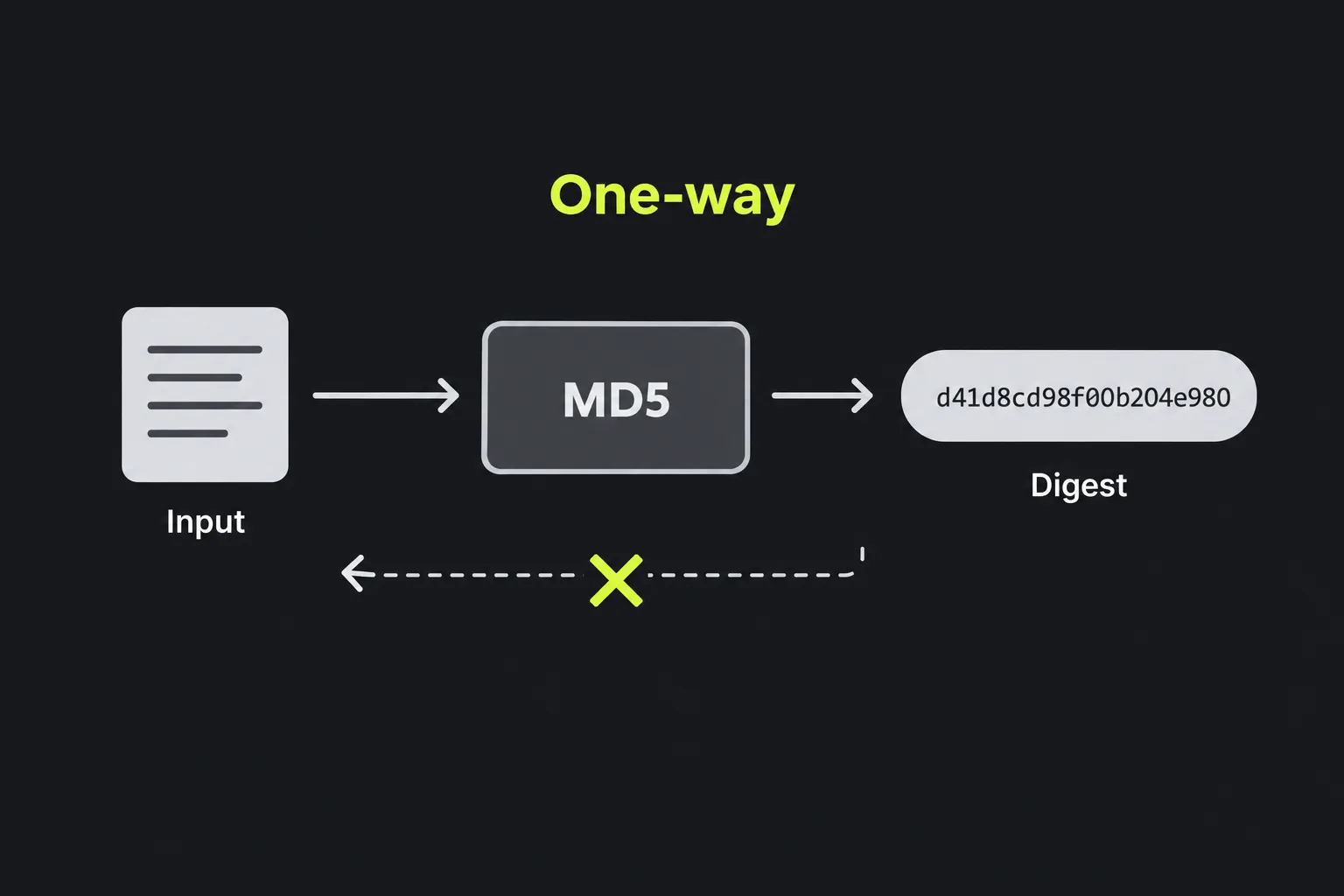
Security boundaries and one-way behavior
MD5 is cryptographically broken and deprecated for security-sensitive work. Researchers can deliberately construct different inputs with the same MD5 digest, which means MD5 no longer provides dependable collision resistance.
No, an MD5 hash cannot be decrypted or directly reversed because hashing is not encryption and has no decryption key. However, MD5's speed allows an attacker to hash likely inputs and compare the results against a known MD5 digest. With MD5, common words, short values, and reused passwords can often be identified through guessing, lookup databases, or brute force.
Do not use MD5 to store passwords, sign software, issue certificates, or prove that data was not maliciously altered. Adding a secret or random value does not fix the algorithm's speed or make a basic MD5 password scheme suitable for modern password storage.
How should I prepare input before generating a hash?
Use the exact characters that the other system expects MD5 to process, including capitalization, spaces, punctuation, and line breaks. The tool returns the digest in the MD5 Hash field as 32 hexadecimal characters.
- Enter the source string exactly as this MD5 generator should hash it.
- Generate the MD5 result and copy all 32 characters.
- Compare the MD5 digest with the expected value without adding spaces or punctuation.
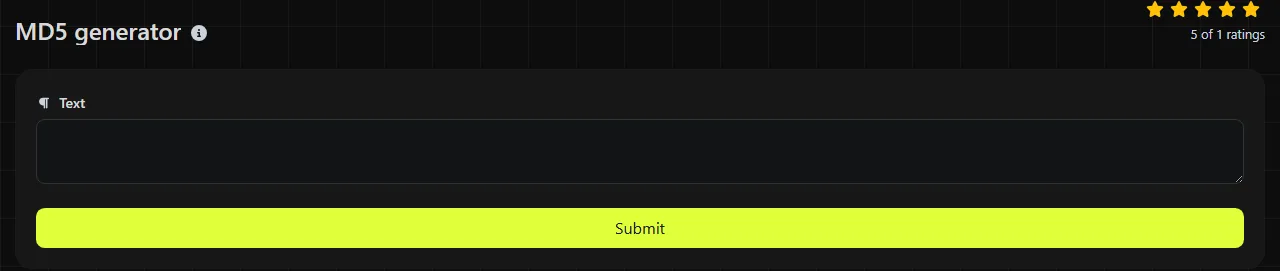
For example, the input invoice-2026-09.pdf produces a 32-character hexadecimal result. Adding a trailing space creates a different MD5 digest. This MD5 generator treats the input 42 as the characters 4 and 2, rather than as an abstract numeric value.
MD5 operates on bytes. Before MD5 processes accented and non-Latin text, the text must have a character encoding, and visually identical Unicode text can have different byte sequences because of normalization. Newline conventions and hidden byte order marks can also change the MD5 result. MD5 itself accepts empty and very long byte sequences, although this page does not state separate input-size limits for the web form.
The calculation runs on the server. Your input travels to the server over HTTPS and is not stored, so avoid submitting secrets that should not leave your device.
Where does MD5 still show up?
MD5 still appears in non-adversarial checksum workflows, duplicate detection, cache identifiers, and systems that require compatibility with an older format. Its continued presence does not mean it is suitable for new security designs.
- Legacy checksum comparison. You may need MD5 when a vendor or archive publishes only an MD5 value.
- Deduplication. A system may use MD5 as a quick first-pass indicator that two files could be identical, followed by a byte-for-byte comparison.
- Legacy integration. Older databases, import formats, and APIs may require a 32-character MD5 field.
- Accidental corruption checks. MD5 can detect many transmission or storage errors when no attacker controls the data.
MD2 generator and MD4 generator can help with compatibility checks involving even older Rivest algorithms, but neither is a security upgrade from MD5.
Which algorithm should replace MD5?
SHA-256 is a common replacement when you need a general-purpose digest with current collision resistance. Use HMAC-SHA-256 when a secret key must authenticate a message, and use a dedicated password-hashing function such as Argon2id, scrypt, or bcrypt for stored passwords.
A published legacy checksum may force you to calculate MD5, while a new download manifest should use a modern hash. Changing algorithms may also require a larger database column because a SHA-256 digest commonly uses 64 hexadecimal characters.
Questions people ask about MD5
How many different MD5 values are possible?
MD5 has 2^128 possible digest values because its output is 128 bits long. That large number does not restore collision security, since practical attacks exploit weaknesses in the algorithm rather than checking every possible digest.
Can MD5 process a binary file?
The MD5 algorithm can hash any sequence of bytes, including images, archives, and executable files. This particular tool is described as accepting string input, so it should not be assumed to provide file upload or raw binary handling.
Does MD5 use a secret key?
Standard MD5 does not use a key. HMAC-MD5 combines MD5 with a secret key using the HMAC construction, but new authenticated systems commonly choose HMAC-SHA-256 instead.
What happens if an MD5 digest is shortened?
Truncating an MD5 digest reduces the number of possible values and makes accidental matches more likely. It can also break compatibility with systems that require the standard 32-character MD5 representation, so retain the full digest unless a fixed legacy specification says otherwise.
Checks before relying on the result
Before using this MD5 generator, confirm the source encoding, capitalization, line endings, and any leading or trailing whitespace. If the digest protects against a hostile change rather than an ordinary transfer error, do not rely on MD5 alone. Use MD5 only when compatibility requires it, and keep the original data available for a direct comparison when using MD5 to deduplicate files.
Similar tools
Popular tools
Create a WhatsApp chat link from a phone number, with an optional prefilled message.