WebP to PNG
Easily convert WEBP image files to PNG.
WebP to PNG is a free tool that converts a WebP image into a PNG file entirely in your browser.
Why would a PNG work better than WebP?
PNG works better when an app, publishing system, or older image editor does not accept WebP. PNG has wider support across legacy software, document workflows, and operating systems, while current major browsers commonly support both formats.
Conversion is often useful for logos, interface graphics, diagrams, and screenshots that need transparency or lossless storage. For example, an older PowerPoint installation may reject a WebP image even though a browser displays it correctly. Converting the image to PNG provides a more broadly recognized file, and PNG supports transparency.
PNG is usually a poor choice for photographic web content when page weight matters. WebP commonly stores photos in fewer bytes, so retaining the WebP version is often better for a website.
Private, browser-based conversion
WebP-to-PNG conversion is performed entirely in your browser. Your WebP image is never uploaded to a server, which matters when the file contains an unpublished design, an internal screenshot, or other material you do not want transferred to a conversion service.
- Add the WebP file to the converter on this page.
- Run the conversion and save the resulting PNG file to your device.
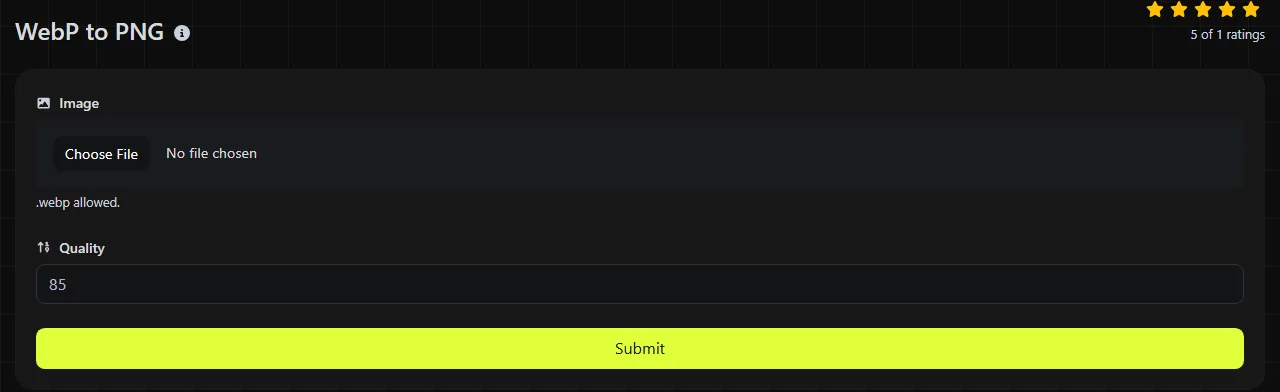
Because the browser decodes the WebP and encodes the PNG, unusually large images can require substantial memory on your device. This page does not claim a specific image-size limit. If decoding a very large WebP or encoding the resulting PNG causes the browser tab to slow down or stop responding, close other memory-heavy tabs and try again.
Can PNG preserve every WebP feature?
PNG cannot retain WebP's lossy compression mode because PNG uses lossless compression. Both formats can store transparency and animation.
| Property | WebP | PNG |
|---|---|---|
| Transparency | Supports an alpha channel | Supports an alpha channel |
| Animation | Can contain multiple animated frames | Can contain multiple animated frames |
| Compression | Supports lossy and lossless compression | Uses lossless compression |
| Typical file size | Commonly smaller for web delivery | Commonly larger, especially for photos |
| Software support | Supported by current major browsers and many newer apps | Supported by a wider range of older and current software |
Transparency can remain representable in PNG, but conversion cannot invent transparent areas that were not present in the source. Animation needs extra care. A static PNG file represents one static image, while an animated PNG can represent multiple frames. This page does not specify how the converter handles animated WebP files.
An empty, damaged, or incorrectly labeled file is not valid WebP image data and may be impossible to decode. Changing a filename or its extension to .webp does not make the underlying bytes valid WebP image data.
File-size planning and worked cases
A converted PNG will often be larger than its WebP source, but there is no reliable fixed ratio. Dimensions, color variation, transparency, and the source WebP compression mode all affect the result. Simple graphics with repeated colors tend to compress more efficiently as PNG than detailed photographs do.
- Transparent app icon. The input is a lossless WebP containing an icon and transparent corners. The output PNG can represent the same type of full alpha transparency, though its byte size may increase.
- Vacation photo. The input is a lossy WebP created for a website. The PNG output stores the decoded pixels losslessly, but it may be much larger and will still contain any blur, ringing, or block artifacts already introduced by the WebP encoding.
- Animated reaction image. The input contains several WebP frames. PNG supports animation, but this page does not specify how this converter handles animated WebP files.
Converting a lossy WebP to lossless PNG does not restore discarded detail. It only prevents the PNG encoder from introducing another lossy compression stage. For a photograph that needs a smaller, widely recognized file, WebP to JPG may fit better, but JPG does not support transparency and adds lossy compression.
Which format should you keep in your workflow?
Keep WebP for modern web delivery, and choose PNG when compatibility, transparency, or lossless editing matters more than download size. It can be sensible to retain both files rather than discard the original.
- Use WebP for product photos, article images, and other website assets where fewer transferred bytes can improve loading performance.
- Use PNG for transparent logos, screenshots with sharp interface text, diagrams, and files being handed to software that rejects WebP.
- Keep the original WebP if it is animated or if you may need to produce another format later.
- Avoid PNG for large photographic galleries unless a receiving system specifically requires it.
PNG filenames can contain spaces, punctuation, accented letters, and non-Latin characters when the operating system permits them. Those characters do not change the image encoding. For files intended for a website, simpler ASCII filenames can avoid URL-encoding and server-compatibility problems.
Common questions about WebP and PNG
Does PNG support partial transparency?
Yes. PNG can store an alpha channel with partially transparent pixels, so soft shadows and antialiased edges do not have to become fully opaque or fully transparent. Some older applications may display alpha blending incorrectly even though the PNG itself is valid.
Will conversion remove compression artifacts from a WebP photo?
No. Once lossy compression has removed detail or introduced artifacts, writing the decoded image as PNG cannot reconstruct the original pixels. Start from the camera file or another higher-quality source if one is available.
Are color profiles and metadata guaranteed to carry over?
No. PNG can contain color-profile and metadata information, but a format conversion does not inherently guarantee that every metadata field will be copied. Check color-sensitive output in the application where it will be used, and keep the source file if metadata matters.
Can browser extensions access an image during conversion?
The converter does not upload the image to a server, but browser-side processing does not protect against malicious software or extensions that already have permission to read page content. For sensitive WebP files processed on this page, use a trusted browser profile with only necessary extensions enabled.
Should I delete the WebP after saving the PNG?
Keep the WebP until you have opened the PNG and checked transparency, dimensions, orientation, and visual appearance. Retaining the source is especially useful when the PNG is larger than expected or when you later need a web-optimized copy.
Similar tools
Popular tools
Create a WhatsApp chat link from a phone number, with an optional prefilled message.