JPG to GIF
Easily convert JPG image files to GIF.
JPG to GIF is a free tool that converts a JPG image into a GIF file entirely in your browser.
How can I make a GIF file from a JPG?
You can convert a JPG to GIF in three steps.
- Provide the JPG file you want to convert.
- Run the conversion in the browser.
- Save the resulting GIF and open it to check the colors, dimensions, and file size.
The image is never uploaded to a server. All processing happens in your browser, which is useful when the file contains private material such as an unreleased product photo, an internal diagram, or a scanned document.
A decodable JPG image is required. An empty file, a damaged JPG, or a different file type that merely has a .jpg extension may not decode correctly. Long filenames, spaces, numbers, accented letters, and non-Latin characters affect the filename rather than the pixels.
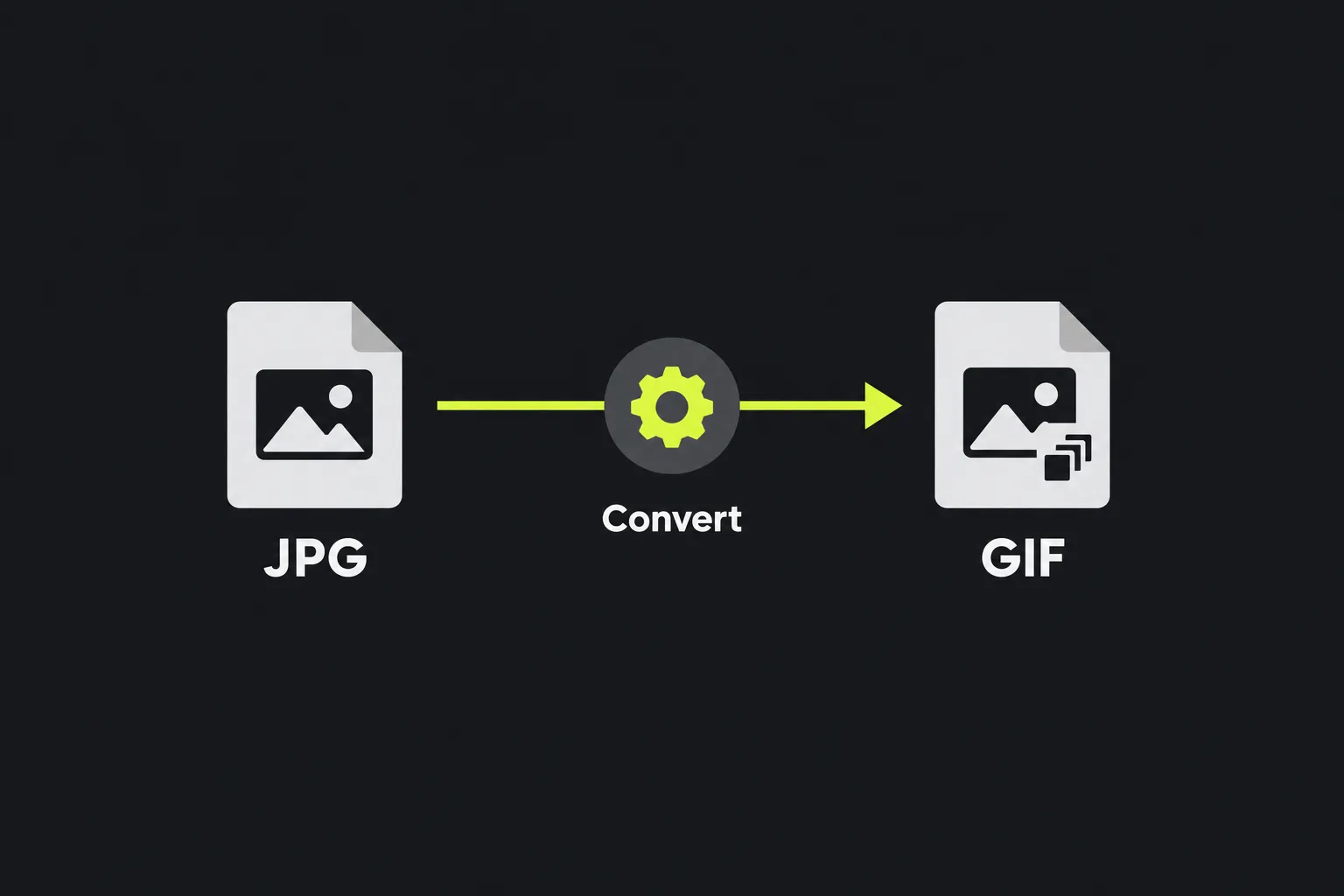
JPG and GIF store images differently
JPG is designed mainly for photographs, while GIF is an indexed-color format commonly used for simple graphics and animation. Converting between them changes how the image data is represented.
| Property | JPG | GIF |
|---|---|---|
| Color | Commonly stores millions of colors | Limited to a palette of up to 256 colors per encoded image block |
| Compression | Lossy compression removes image detail | LZW compression preserves the indexed pixels without further loss |
| Transparency | No transparency channel | Supports a single transparent palette entry, without partial alpha transparency |
| Animation | Does not support animation | Can contain multiple timed frames |
| Typical strength | Photographs and images with smooth color changes | Small graphics with limited colors, hard edges, or repeated areas |
| Support | Supported by browsers, operating systems, and image editors | Supported by major browsers and widely recognized on older platforms |
A conversion cannot restore detail already removed by JPG compression. GIF uses lossless compression for its indexed pixels, but placing a lossy JPG inside a lossless format does not recover the original image quality.
Should I use GIF for this image?
Use GIF when compatibility or the GIF file type itself matters and the source image can tolerate a limited color palette. A JPG logo on a plain background, a small badge, or a screenshot with a few solid colors may convert acceptably.
GIF is usually a poor destination for a photograph. Skin tones, skies, shadows, and gradients contain many colors, so reducing them to a 256-color palette can produce visible bands, grainy dithering, or abrupt color changes. Keeping the JPG is often the better choice for those images.
Converting one still JPG also does not create motion by itself. GIF supports animation, but an animated file needs multiple frames and timing information. A single source image contains neither. If the goal is web performance rather than GIF compatibility, JPG to WebP may be a more suitable conversion for photographic content.
Transparency is another reason to check the source. Because JPG cannot store transparent pixels, conversion cannot determine which background area was originally meant to be transparent. GIF supports transparency as a format feature, but it cannot reconstruct missing transparency information from a flattened JPG.
What file size should I expect after conversion?
Expect many photographic GIFs to be larger than the original JPG, although the exact result depends on the image dimensions, color distribution, and compression settings used to create the JPG. JPG compresses continuous-tone photographs efficiently, while GIF works better with repeated runs of the same palette colors.
For example, a 1,200-by-800 JPG of a sunset may become a larger GIF and show banding in the sky. A 300-by-120 JPG containing a few flat colors and simple lettering may produce a reasonably compact GIF. Existing JPG artifacts can also create extra color variation, making the GIF palette less efficient.
Image dimensions matter as much as the change from JPG to GIF. Converting a large image without reducing its width and height leaves the GIF responsible for the same number of pixels. If a site has an upload limit, inspect the saved file size rather than assuming that a format change made it smaller.
Where can the resulting GIF be used or opened?
The resulting GIF should open in major web browsers and in applications that support the long-established GIF format. GIF is often accepted by website editors, forum software, chat platforms, and older content-management systems, but each service may impose its own limits on dimensions, file size, or animation.
No JPG-to-GIF conversion can guarantee that a particular platform will accept the output. A service may recompress images, strip animation, generate a thumbnail, or reject files above its upload limit. Check the destination's GIF requirements before deleting the original JPG. For Windows icon work, JPG to ICO is more appropriate, while JPG to BMP can help with software that specifically requires a legacy bitmap file.
Frequently asked questions
Can a GIF display more than 256 colors?
Each encoded GIF image block uses one color table with no more than 256 entries. Animated GIFs can use different local palettes for different image blocks, and a rendered animation canvas can retain colors from earlier image blocks. Photographs may use dithering to simulate additional shades, which can look grainy.
Why does my converted GIF have a solid background?
The JPG source already has a solid background because JPG cannot store transparency. A converter cannot reliably tell whether white, black, or another color represents a background that should be removed. Background removal must happen as a separate editing step using an image format that preserves transparency.
Can I combine several JPG files into one animated GIF?
The GIF format can hold several frames, but that requires an animation workflow that accepts multiple images and assigns frame timing and looping behavior. Converting one JPG produces only the image information available in that file. Check for explicit multi-file and animation controls when choosing a tool for that task.
Does GIF support smooth transparent edges?
No. Traditional GIF transparency is binary, so a palette entry is either transparent or visible. Soft shadows and anti-aliased edges generally work better in PNG or WebP because those formats can store partial alpha transparency.
Should I keep the original JPG after converting it?
Yes, keep the JPG until the GIF has been checked in its intended browser or platform. The original retains its broader color range and may be smaller for photographic content. Store the two files with clear names so a later edit starts from the better source rather than from the reduced GIF palette.
Similar tools
Popular tools
Create a WhatsApp chat link from a phone number, with an optional prefilled message.