JPG to PNG
Easily convert JPG image files to PNG.
JPG to PNG is a free tool that converts a JPEG image into a PNG file entirely in your browser.
Why would PNG be a better fit than JPG?
PNG is a better fit when an image contains text, interface elements, diagrams, logos, or other areas with hard edges and flat colors. PNG uses lossless compression, so saving the converted file again does not introduce another round of JPEG compression artifacts.
JPG is usually the more practical format for photographs because conventional JPG compression can produce much smaller files. Converting a photo to PNG may make it easier to use in a PNG-only workflow, but it rarely improves how the photo looks.
- Use PNG for screenshots, charts, line art, and graphics that need lossless storage.
- Keep JPG for camera photos, website hero images, and other detailed scenes where download size matters.
- Convert when a website, application, or document template specifically requires a .png file.
- Do not convert solely to repair a blurry or heavily compressed JPG. Lost detail cannot be recovered.
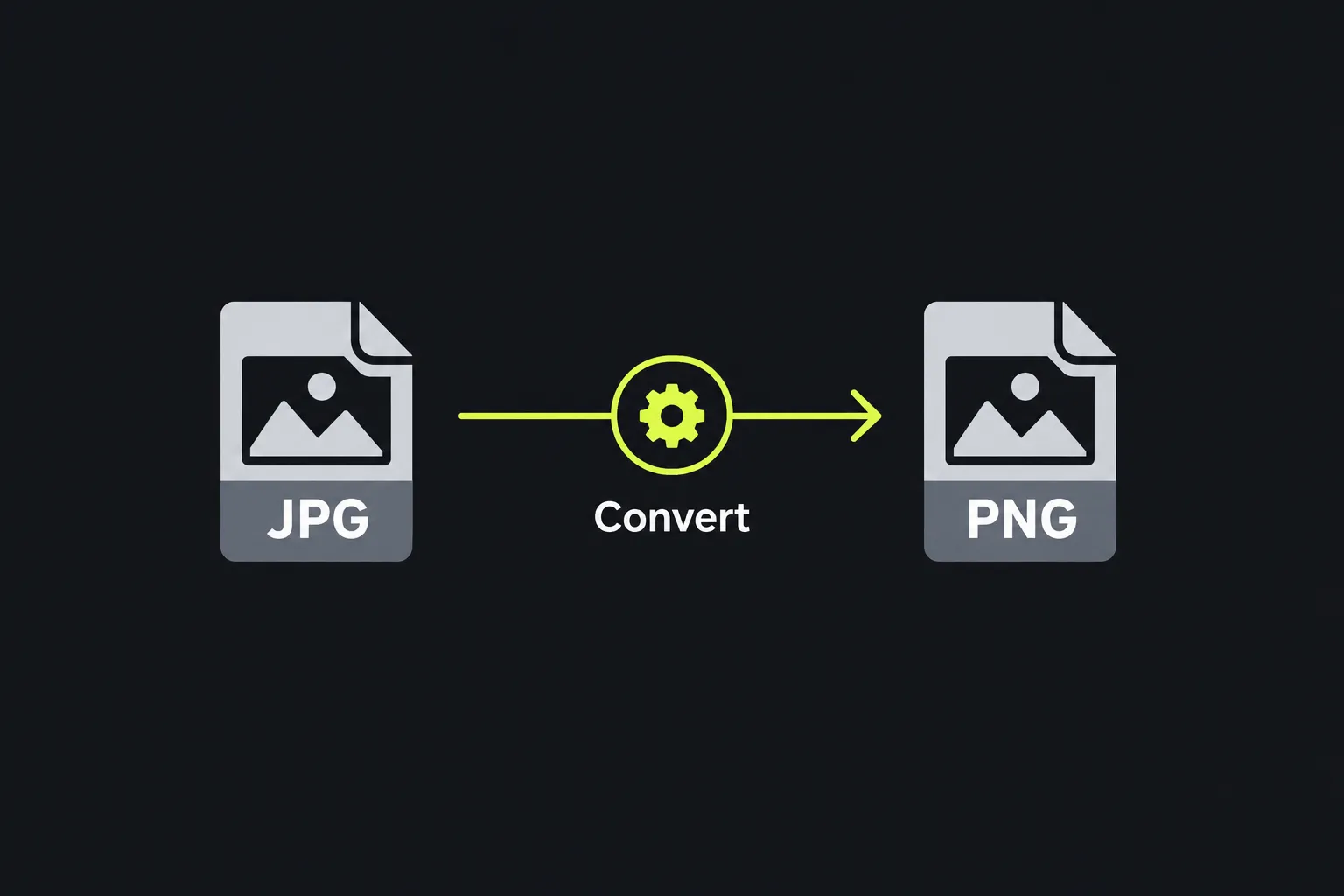
A quick conversion workflow
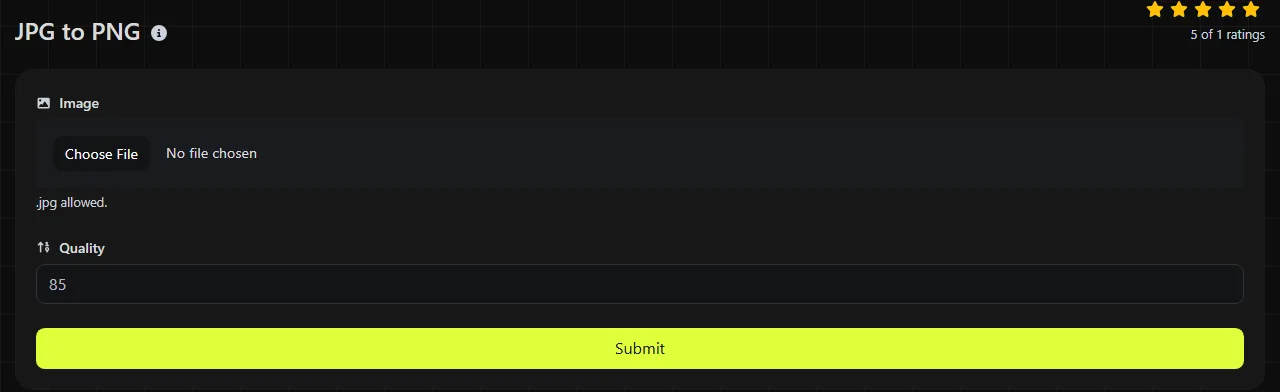
- Provide the JPG image you want to convert.
- After the browser processes it, save the resulting PNG file to your device.
The conversion happens entirely in your browser. Your JPG is never uploaded to a server. This is useful for images containing private screenshots, internal diagrams, personal photos, or other material you do not want sent to a third-party conversion service.
Open the saved PNG before deleting the original. Check its colors and orientation, and confirm that existing JPEG artifacts and opaque backgrounds remain acceptable in the application where you plan to use it.
What happens to transparency, animation, and compression?
The file receives PNG encoding, but conversion cannot create visual information that was missing from the JPG.
- Transparency: PNG supports full alpha transparency, while JPG does not. However, an opaque white background in a JPG remains part of the image.
- Animation: A JPG contains a single still image, so it has no animation frames to transfer. The current PNG specification supports both still and animated PNG images, but converting one JPG cannot create an animation.
- Compression: Typical JPG files use lossy compression. PNG uses lossless compression, so it does not add another round of JPEG compression, but existing blockiness, ringing, color banding, and softness remain visible.
- Support: Current major browsers can display both formats. PNG also works in common image editors, office applications, content management systems, and presentation software, although an individual upload form may impose its own format rules.
For example, converting product-photo.jpg with a white background produces a PNG that still has a white background. Converting dashboard-capture.jpg preserves any fuzzy text or halos already caused by JPEG compression. The operation changes the file format, not the subject or the quality of the original capture.
How large should the converted PNG be?
The PNG will often be larger than the JPG, sometimes substantially larger, because PNG stores image data losslessly. There is no fixed size multiplier. The result depends on pixel dimensions, color variation, noise, and how strongly the original JPG was compressed.
A simple graphic with broad areas of one color may compress efficiently as PNG. A detailed photo containing foliage, fabric, skin texture, or camera noise usually produces a much larger PNG. Converting a small JPG does not guarantee a small PNG.
If the file is intended for a website, compare download size before publishing it. JPG may remain the better choice for a photograph. JPG to WebP is another option when the goal is modern web delivery rather than a PNG-only requirement.
Browser privacy and file handling
Your input remains on your device because all processing takes place in the browser. The image is never uploaded to a server for conversion.
Very large JPG images require browser memory to decode and PNG images require browser memory to encode, and an empty, truncated, or corrupt file may not decode as a valid JPG. Long filenames, spaces, punctuation, accented characters, and non-Latin characters are separate from the image encoding, but some older applications and upload systems may handle unusual filenames poorly. A short descriptive filename can prevent problems when the PNG is shared.
Frequently asked questions
Will websites compress the PNG again after I upload it?
Some publishing platforms generate their own resized or recompressed copies of an uploaded PNG. Check the published image rather than assuming it matches the local PNG exactly.
Does the converted PNG keep camera location and EXIF details?
Do not assume metadata will be preserved during a format conversion. If location, capture time, copyright information, or camera settings matter, inspect the saved PNG with a trusted metadata viewer before sharing or archiving it.
Can I convert a very large camera image?
Large image dimensions and browser or process memory limits can prevent a JPG from being decoded or a PNG from being encoded. If device-wide memory pressure is the cause, closing memory-heavy tabs may help. Otherwise, resize a copy in an image editor before converting it.
Can I use the PNG as a website favicon?
Many browsers accept PNG favicon files, but some projects still use ICO because one ICO file can contain several favicon sizes. If an ICO package is required, convert the image to PNG first and then use PNG to ICO.
Will converting to PNG make OCR more accurate?
Conversion alone does not sharpen letters or restore missing edges, so it usually does not improve text recognition in an already compressed screenshot. OCR may benefit from a cleaner original capture, higher resolution, or preprocessing such as contrast adjustment.
Checks before publishing the file
- Confirm that the destination accepts PNG and does not require JPG.
- Compare the PNG file size with the original, especially for web pages or email attachments.
- Inspect white backgrounds instead of assuming they became transparent.
- Keep the original JPG if it is the only source copy.
- Give the PNG a name that distinguishes it from its source JPG.
If the PNG is unexpectedly large and the image is mainly photographic, retaining the JPG or choosing a web-focused format may be the more practical result.
Similar tools
Popular tools
Create a WhatsApp chat link from a phone number, with an optional prefilled message.