ICO to GIF
Easily convert ICO image files to GIF.
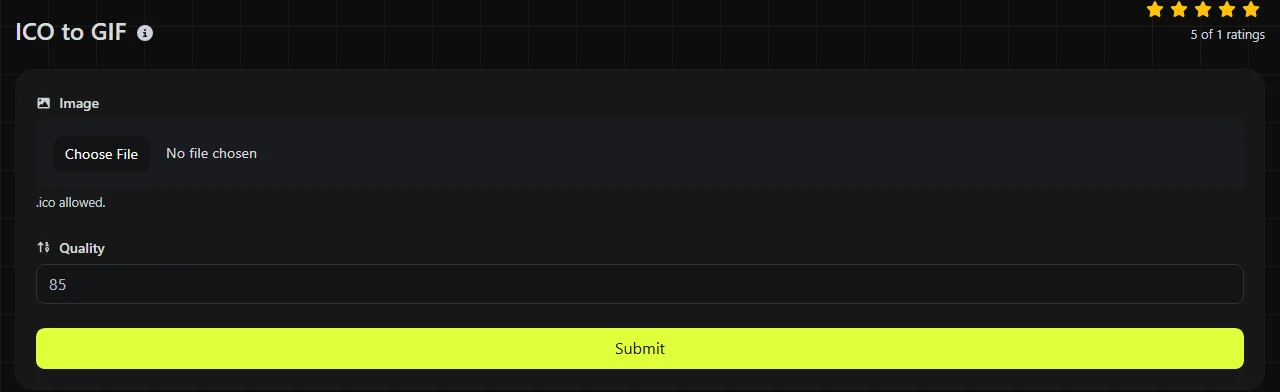
ICO to GIF is a free tool that converts an ICO icon file into a GIF image entirely in your browser.
Can I convert an ICO without sending the file to a server?
Yes. The conversion happens entirely in your browser, and the ICO file is never uploaded to a server. This matters for unreleased app icons, internal branding, and other files you may not want transferred to a third-party conversion service.
Decoding a large embedded ICO image and encoding it into GIF's indexed-color format can use more of your device's memory and computing resources than converting a small favicon. An empty, damaged, or incomplete file may not contain a decodable icon, so conversion cannot be guaranteed for invalid input.
ICO and GIF are built for different jobs
ICO is an icon container commonly used by Windows applications and website favicons, while GIF is a general-purpose web image format with indexed color and optional animation. Converting between them changes more than the filename.
| Property | ICO | GIF |
|---|---|---|
| Typical purpose | Application icons, shortcuts, and favicons | Small web graphics and simple animation |
| Image contents | Can contain several sizes and color depths in one file | Contains one canvas, with one or more animation frames |
| Compression | May contain BMP-style pixel data or PNG-compressed images | Uses lossless LZW compression after colors are placed in an indexed palette |
| Color | Can retain full-color imagery, depending on the embedded image | Each global or local color table has at most 256 entries; a composited animation frame can retain colors from earlier images that used other local color tables |
| Transparency | Modern icons can use partial alpha transparency | Identifies one color-table index as transparent for the relevant graphic; the other entries are opaque, with no smooth partial alpha |
| Platform support | Widely recognized for Windows icons and browser favicons | Widely displayed by browsers, messaging apps, and image editors |
The file-size direction is not fixed. A flat icon with few colors often compresses efficiently as GIF. A detailed ICO containing a PNG-compressed image may produce a GIF that is similar in size or larger because GIF's compression is less suitable for complex, photo-like detail. Conversely, a GIF representing only one image from an ICO container may be smaller than an ICO that stores several icon sizes.
Does GIF animation come from the ICO file?
No, an ICO file does not normally contain a timed animation. It may hold several versions of the same icon, such as 16-by-16, 32-by-32, and 256-by-256 images, but those are alternatives for different display sizes rather than animation frames.
GIF supports animation as a format, but converting one static icon does not create meaningful movement by itself. If your goal is an animated badge or loading indicator, you generally need multiple intentionally designed frames and timing information. To animate the static GIF produced from the ICO, you need separate animation software to add frames and timing.
Conversion makes sense when a site, editor, document system, or messaging platform accepts GIF but does not accept ICO. It is less suitable when the file must remain a Windows application icon or favicon package. In those cases, retaining ICO preserves the format's ability to carry several purpose-built sizes.
Which icon artwork converts cleanly?
Simple, opaque artwork with no more than 256 colors is the most predictable candidate for GIF. Flat symbols, pixel art, and small interface marks generally fit GIF's indexed-color model better than shaded icons with soft shadows.
- Opaque 32-by-32 icon with 12 solid colors: All source colors can fit within a GIF palette, so palette reduction does not need to remove colors.
- Icon with a soft transparent glow: GIF cannot store partially transparent edge pixels. Those pixels must become opaque, transparent, or blended against a chosen background.
- Detailed icon with gradients: Reducing the image to 256 colors can introduce banding or dithering, especially in smooth highlights and shadows.
- ICO containing several resolutions: Check the GIF's pixel dimensions afterward. A multi-image ICO has no single inherent display size.
Saving an image with GIF's lossless LZW compression does not recover information already lost earlier. If the icon artwork came from a heavily compressed JPG or another lossy source, existing blocks, ringing, and blurred detail remain visible. The palette conversion may add further color reduction.
For modern web graphics that need full-color detail and partial transparency, ICO to WebP may fit better. If you specifically need a legacy bitmap for an older workflow, ICO to BMP is the relevant alternative.
Common questions about ICO and GIF files
Why does Windows reject a GIF as an application icon?
Windows application resources and many shortcut workflows expect ICO rather than GIF. A GIF may display correctly in an image viewer while still being invalid for an executable, shortcut, or installer icon field. Keep an ICO copy for software packaging.
Does converting an icon preserve its DPI setting?
Do not rely on ICO-to-GIF conversion to preserve a physical print resolution. Icons are mainly defined by pixel dimensions, and GIF is intended for screen graphics rather than print layout. For print use, place the image at a chosen physical size in an editor and verify the effective pixels per inch there.
Can I put the resulting GIF in an email signature?
Usually, but email-client behavior varies. Corporate security settings may block externally hosted images. If you subsequently create an animated GIF, some clients display the animation, while others show only the first frame. In that case, use a clear first frame so the signature still makes sense when animation is unavailable.
Why might a valid ICO still be difficult to convert?
Conversion commonly fails because the file is empty, damaged, or malformed; inconsistent directory records indicate invalid input. A valid ICO may also fail if a particular decoder does not support its bit depth, embedded image encoding, or dimensions. A file may work in one icon-aware application yet fail in another decoder. If conversion does not complete, open the ICO in an image editor and export a standard PNG.
Should I keep the original ICO after making a GIF?
Yes. The original may contain additional resolutions, full-color pixels, and smoother alpha transparency that the GIF cannot represent. Keep it as the source file, and inspect the GIF at its actual pixel size before placing it in a web page, email, or document.
Similar tools
Popular tools
Create a WhatsApp chat link from a phone number, with an optional prefilled message.