ICO to JPG
Easily convert ICO image files to JPG.

ICO to JPG is a free tool that converts Windows icon files into JPG images entirely in your browser.
Why turn an icon into a regular image?
You may need a JPG copy when a website, document editor, email system, or publishing platform does not accept ICO files. ICO is mainly associated with Windows icons and website favicons, while JPG is a general-purpose image format supported by browsers, office applications, social platforms, and most image editors.
Conversion makes sense when you need to place icon artwork in a Word document, PowerPoint presentation, product listing, or content management system that expects a standard image. It is less suitable when the icon has a transparent background or must remain usable as an application icon.
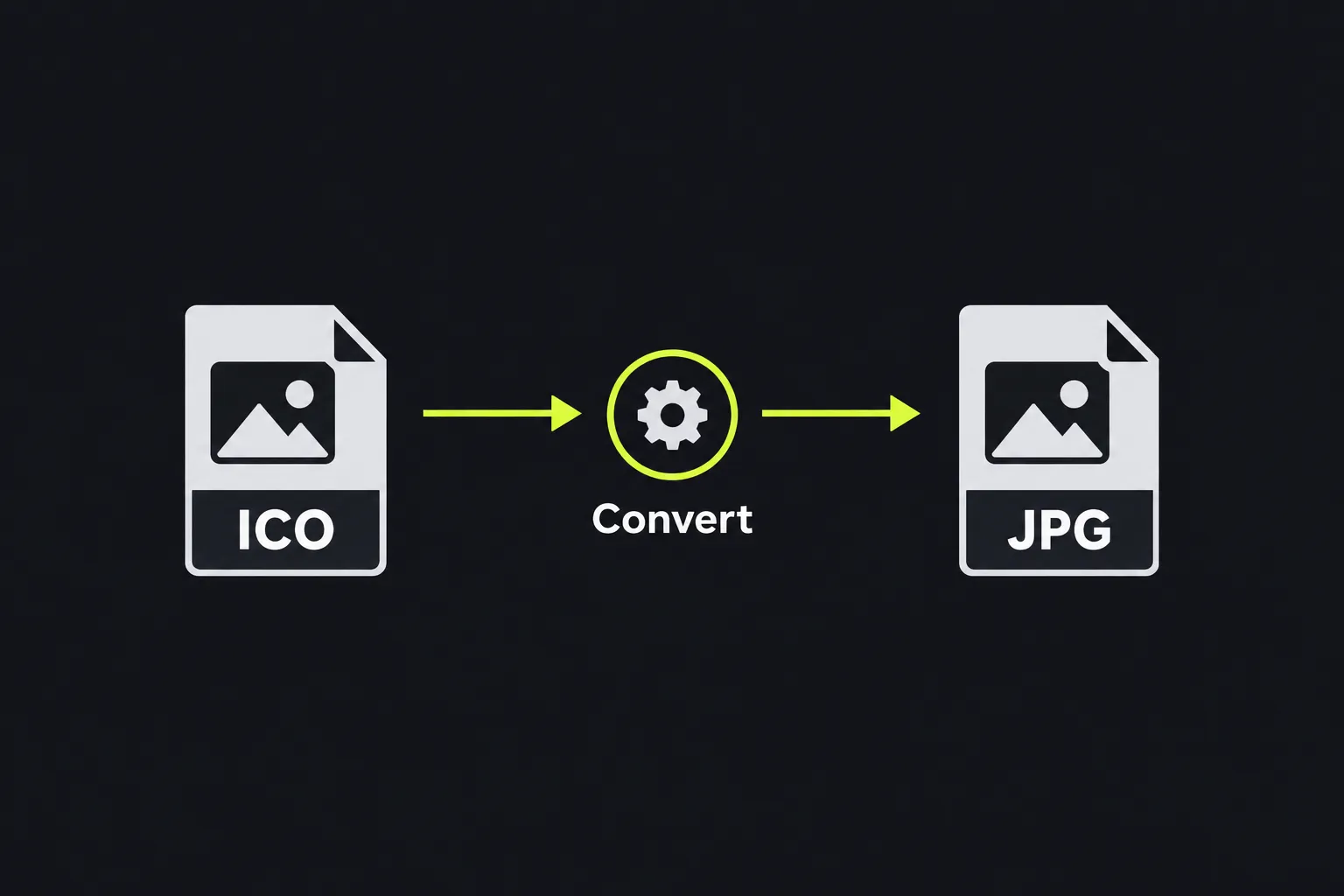
Conversion workflow and local processing
- Add the ICO file you want to convert.
- Save the resulting JPG and inspect it at its intended display size.
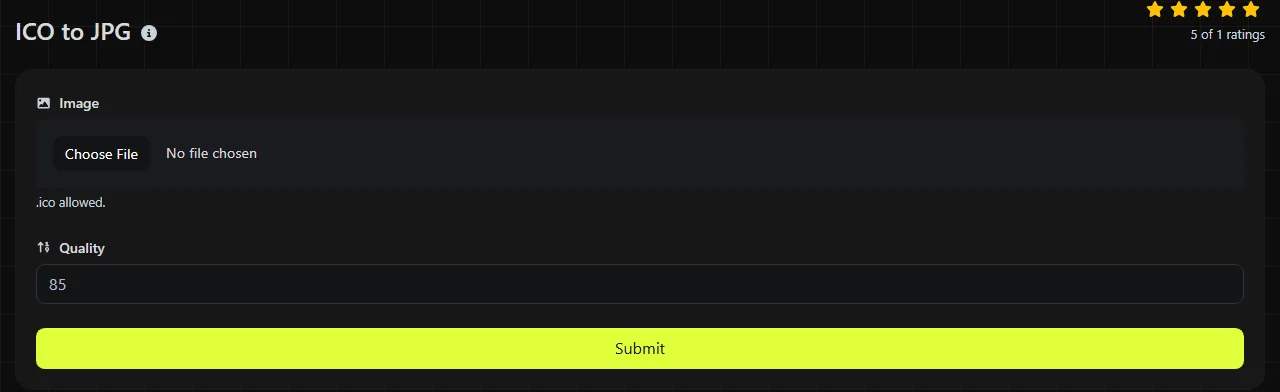
The work is done entirely in your browser. Your ICO file is never uploaded to a server. This matters for unpublished logos, internal interface artwork, and other files that you do not want transferred to a third-party conversion service.
For example, an ICO containing a small folder symbol becomes a JPG copy that can be inserted into a document. Because JPG cannot store transparent pixels, transparent areas must become opaque in the converted image. Check the background and edges before using the result.
ICO and JPG are built for different jobs
An ICO file is a container designed for icons. It can hold several raster images at different pixel dimensions and color depths so software can select an appropriate version. A single file might contain 16-by-16, 32-by-32, 48-by-48, and 256-by-256 images.
- Transparency is supported by modern ICO images, but JPG has no alpha channel. Transparent edges and empty areas must be flattened onto an opaque background.
- Animation is not supported by standard ICO or JPG files. Converting to JPG does not create animation.
- Compression differs significantly. ICO commonly stores PNG-compressed or bitmap-style image data, while JPG uses lossy compression that discards image detail.
- File size may go up or down. JPG often reduces the size of photographic images, but a tiny icon with flat colors may produce a JPG larger than the corresponding image inside the ICO.
- Support also differs. Windows and web browsers recognize ICO for icons and favicons. JPG is broadly supported as ordinary image content across Windows, macOS, mobile platforms, browsers, and document applications.
Converting a lossy or low-resolution source to JPG cannot restore missing detail. It may introduce additional compression artifacts around sharp lines, text, and high-contrast edges.
Which format belongs in the final destination?
Use JPG for an opaque image that must work in a system expecting a common photo-style format, and keep ICO for icon-specific uses. JPG is often a practical choice for a screenshot, catalog entry, or document where transparency is unnecessary.
PNG is usually a better destination for logos, interface symbols, and artwork with transparent backgrounds. Its lossless compression preserves crisp edges and flat color areas without JPG ringing or block artifacts. If transparency matters, ICO to PNG is the more appropriate conversion route.
Do not replace a website's favicon.ico with a JPG unless the site configuration explicitly supports the new file and points to it correctly. Browsers commonly support several favicon formats, but existing software or templates may still expect an ICO file.
What happens with multi-size icons and awkward files?
A multi-size ICO contains several candidate images, while a JPG represents one raster image, so the result cannot retain the ICO's full set of icon sizes. Inspect the JPG dimensions afterward to confirm that the selected image has enough pixels for your intended use. Enlarging a 16-by-16 icon for a presentation will reveal square pixels and will not add real detail.
A zero-byte file or a different format renamed with an .ico extension is not a valid ICO image and may fail to decode. Renaming an extension does not convert the underlying image data.
Common questions about ICO and JPG
Does an ICO file contain vector artwork?
Usually no. ICO files generally contain raster images at one or more fixed pixel dimensions, even if the original icon was designed as a vector. Converting to JPG does not recover the source paths or make the artwork resolution-independent.
Is JPG suitable for printing an icon?
It can be, but pixel dimensions matter more than the file extension. A small icon intended for a toolbar may not contain enough pixels for a sharp print result. Use the original high-resolution artwork when available rather than enlarging a small ICO image.
Will the JPG keep the ICO file's transparency?
No. JPG has no alpha channel, so transparent areas must become opaque in the converted image.
Before using the JPG
Open the saved file and check its pixel dimensions, background color, edge quality, and file size. View it against the same background and at roughly the same size it will have in the final document or page. If transparent edges became distracting or fine lines look smeared, use ICO to PNG instead or return to the original source artwork.
Similar tools
Popular tools
Create a WhatsApp chat link from a phone number, with an optional prefilled message.