ICO to PNG
Easily convert ICO image files to PNG.
ICO to PNG is a free tool that converts a Windows icon file into a PNG image entirely in your browser.
Why are ICO and PNG files different?
ICO is a container for icons, while PNG is a general-purpose image format. A single ICO file can hold several versions of the same icon at different pixel dimensions and color depths, allowing Windows or a browser to select an appropriate size. A PNG normally contains one image at one set of dimensions.
- Transparency is supported by both formats. ICO files may use an alpha channel, a legacy transparency mask, or both. PNG represents transparency through an alpha channel or a tRNS chunk, which can provide palette alpha values or designate a transparent grayscale or RGB value.
- Animation is not part of the conventional ICO format. PNG is normally static, although the current PNG specification supports animation through APNG chunks. Converting an ICO does not create animation.
- Compression varies inside ICO files. Older icon frames commonly use DIB bitmap data, while newer high-resolution frames may already use PNG compression. PNG uses lossless DEFLATE compression.
- Support differs by purpose. ICO remains associated with Windows icons and website favicons. PNG opens in current browsers, image editors, presentation software, content management systems, and common desktop and mobile platforms.
PNG is usually easier to place in a document or upload as a regular image. It does not retain the multi-resolution container structure that makes ICO useful for operating system icons.
Browser-only conversion and file privacy
The conversion happens entirely in your browser, and the ICO file is never uploaded to a server. This matters when an icon contains an unreleased logo, internal application artwork, or another image that should remain on your device.
Your browser still needs enough memory to decode the file and create the PNG. ICO files are usually small, but an unusually large or malformed file may fail to decode.
How can you turn an icon file into a regular image?
- Choose the ICO file that you want to convert.
- The browser decodes the ICO data and encodes the image data in PNG format.
- Review the resulting PNG's dimensions and transparency.
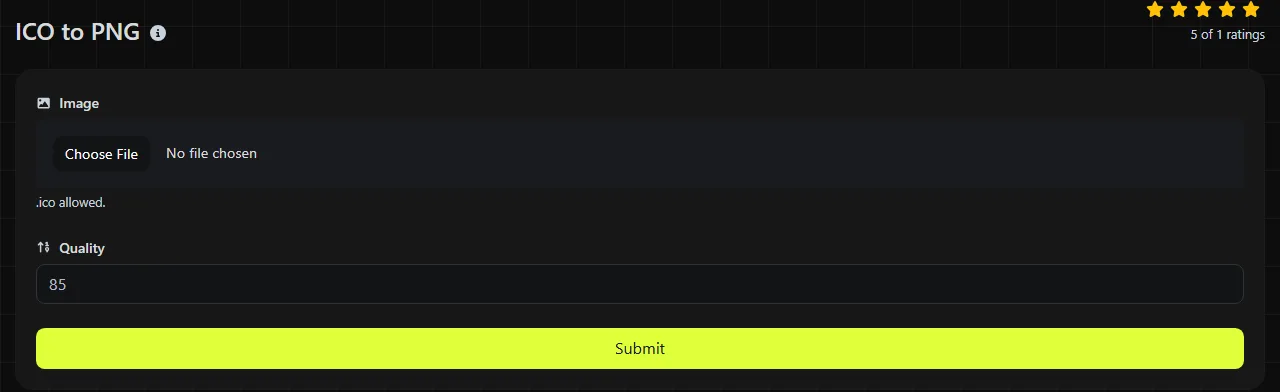
The final check is especially useful for a multi-size ICO. An icon might contain 16 by 16, 32 by 32, 48 by 48, and 256 by 256 pixel frames, but an ordinary PNG represents one image rather than that full set.
What affects PNG file size?
If the ICO used uncompressed DIB data, PNG compression may reduce the byte size. If the ICO frame already contained PNG-compressed data, the converted file may be similar in size, although re-encoding can still change the exact byte count.
A multi-resolution ICO often has a larger total size than a PNG because the ICO can contain several images while a PNG normally contains one. However, a detailed 256 by 256 PNG can be larger than a simple low-resolution ICO frame. Transparent areas do not guarantee a small file because PNG compression is also affected by color variation and fine detail.
When is PNG the wrong replacement for ICO?
PNG is the wrong replacement when the destination specifically requires an ICO container with several icon sizes. Windows shortcuts, some desktop application resources, and older favicon workflows may expect an .ico file rather than a general image.
Conversion makes sense when you need to edit the artwork in an image editor, place it in a slide deck, upload it to a system that rejects ICO files, or use it as a normal web image. PNG is also a suitable choice when transparent edges and sharp interface graphics need lossless storage.
Converting to PNG cannot restore missing detail. If the icon was created from a low-resolution image or artwork that had already been damaged by lossy JPEG compression, PNG preserves the decoded pixels but does not reconstruct the original quality. For an opaque photographic image where transparency is irrelevant, ICO to JPG may produce a smaller file, although JPEG can soften sharp icon edges and introduce compression artifacts.
Frequently asked questions
Why does my converted icon have a colored outline?
A colored, dark, or pale fringe can come from pixels around a transparent edge. Older ICO files may combine an alpha channel with a separate transparency mask, and image decoders do not always interpret those edge pixels identically. View the PNG against both light and dark backgrounds before publishing it.
Can I edit the converted PNG in Photoshop or GIMP?
Yes, both applications commonly support PNG files, including alpha transparency. Editing and saving the image will not recreate the ICO file's collection of separate sizes. If you later need an ICO, export the required icon dimensions and assemble them with software that supports multi-frame icon creation.
Is an ICO file an executable Windows program?
No, an ICO file is an image container rather than an executable program.
Why does a small icon look blurry after conversion?
A low-resolution source does not contain enough pixels for large display sizes. Enlarging a 16 by 16 PNG to 128 by 128 requires interpolation, which can produce soft edges or blocky shapes. Use the largest available frame from the original ICO when the result will be displayed beyond favicon size.
Will the PNG work on macOS, Linux, Android, and iOS?
PNG has broad support across those platforms and in current web browsers. Application-specific icon systems may still require particular filenames, dimensions, directory structures, or platform formats. Confirm those requirements before replacing an app icon, and keep the original ICO in case you need its embedded size variants later.
Similar tools
Popular tools
Create a WhatsApp chat link from a phone number, with an optional prefilled message.