BMP to GIF
Easily convert BMP image files to GIF.
BMP to GIF is a free tool that converts BMP image files into GIF files entirely in your browser.
Why do BMP and GIF produce different results?
BMP and GIF store raster images differently, so a converted GIF may have fewer colors, different transparency, and a much smaller file size. BMP is a legacy bitmap format associated with Windows. It commonly stores pixels without compression, although some BMP variants use run-length encoding.
GIF uses LZW compression and indexed color. Each GIF image block uses either the global color table or its own local color table, each limited to 256 entries. This works well for logos, diagrams, interface graphics, and simple illustrations, but it is restrictive for photographs and smooth gradients.
- Transparency BMP transparency depends on the BMP variant and the software reading it. GIF supports one fully transparent palette entry, not partial transparency.
- Animation GIF can contain multiple timed frames. BMP does not provide the animation structure normally associated with GIF.
- Compression BMP files are commonly uncompressed, while GIF uses lossless compression on its indexed pixel data.
- Compatibility GIF has broad support in web browsers, messaging software, presentation programs, and image editors. BMP is still widely recognized, but it is less commonly used for web delivery.
Browser-only conversion steps
- Choose the BMP image in the BMP to GIF tool.
- Save the GIF generated by the tool.
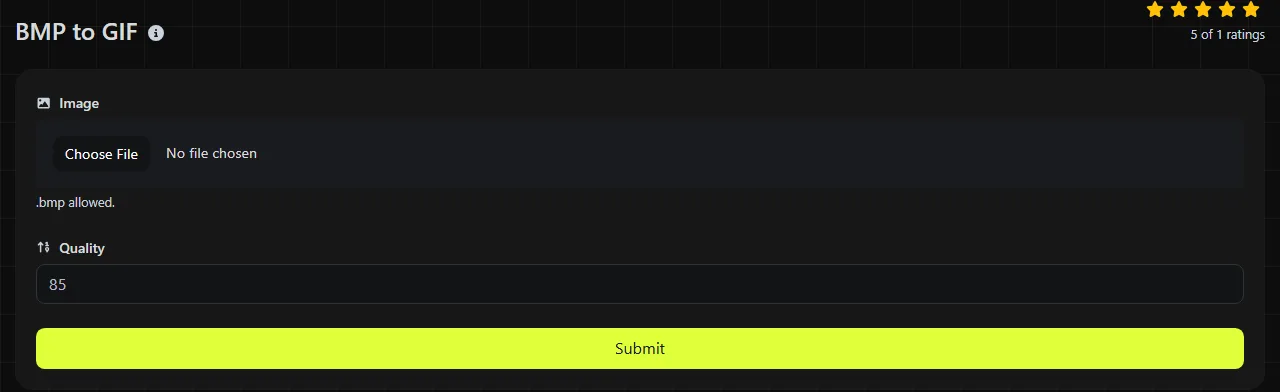
The work is done entirely in your browser. Your BMP image is never uploaded to a server. This matters when the file contains an internal diagram, an unreleased interface, or other material that should not be sent to a third-party conversion service.
Keep the original BMP until you have opened the GIF and checked it. Format conversion can reduce the available color palette, and saving the GIF again cannot recover colors discarded during the first conversion.
Will GIF preserve every color and transparent edge?
No, GIF cannot preserve every BMP color or a partially transparent edge. A high-color BMP may contain thousands or millions of distinct colors, while each GIF image block indexes a global or local color table with no more than 256 entries. The conversion process must select a smaller palette and may use dithering, which arranges different colored pixels to imitate shades that are not in that palette.
Soft shadows and antialiased edges can also change. GIF transparency is binary, so a pixel is either transparent or visible. A BMP with usable alpha-channel data can contain partial transparency, but GIF cannot represent the same smooth transition. A pale halo around a logo often indicates that the edge was prepared against a different background color.
Is GIF the right destination for this BMP?
GIF is a reasonable destination when the image has flat colors, hard edges, or needs compatibility with software that specifically expects GIF. It is often suitable for a small status icon, a basic chart, a line drawing, or an older website asset.
Choose another format when color accuracy, photographic detail, or smooth transparency matters. BMP to WebP is generally more appropriate for a photographic BMP intended for a modern website because WebP supports full-color imagery and efficient compression. If the BMP is intended to become a Windows application icon or favicon with multiple icon sizes, BMP to ICO fits that task more directly.
Converting an image that originally came from a lossy JPEG into BMP and then GIF does not restore the original detail. GIF's compression is lossless after palette creation, but the conversion can still discard colors. Existing JPEG blocks, ringing, and blur remain visible.
File-size outcomes in real files
A GIF is commonly smaller than an uncompressed BMP with the same pixel dimensions, especially when large areas repeat the same few colors. There is no fixed reduction ratio because GIF compression depends on image content, dimensions, palette complexity, and pixel patterns.
- A 32-color software icon saved as an uncompressed BMP will often become substantially smaller as a GIF, with little visible change.
- A screenshot containing solid panels and repeated interface elements usually compresses well, although small text may gain dithered colors around its edges.
- A BMP photograph of a sunset may produce a smaller GIF, but gradients can show bands or speckled dithering. JPG or WebP is usually a better delivery format for that image.
- A noisy scan may not compress efficiently because neighboring pixels change frequently. The GIF can remain larger than expected while still losing color detail.
Very large BMP files can also require substantial browser memory because the browser must decode the pixels before encoding the GIF.
Questions people ask about BMP and GIF
Does converting a BMP to GIF create animation?
GIF supports animation as a format, but changing a still BMP into GIF does not create meaningful movement by itself. Animation requires multiple frames, frame timing, and usually loop settings.
Does GIF keep the BMP's print resolution?
Do not rely on GIF to preserve print-resolution metadata such as an intended DPI value. GIF has no standard DPI field. Check the pixel dimensions and set the print size in the destination application.
Can I convert the GIF back to BMP later?
Yes, software can decode a GIF and save its displayed pixels as BMP. However, colors and partial transparency removed during the first conversion cannot be reconstructed. Keep the source BMP when you may need to edit or export the image again.
Is a converted GIF suitable for a favicon?
Some browsers can display GIF favicons, but animation behavior and platform treatment are inconsistent. ICO or PNG is more conventional for favicon work, especially when several icon sizes are required. BMP to ICO is the more direct route for a BMP favicon source.
Will image metadata remain in the GIF?
Do not assume that BMP resolution, color-space, profile, or other metadata fields will survive a format conversion. GIF has different metadata structures, and many image workflows retain only the visible pixels. Store the original BMP separately if its resolution, color-space, or profile fields matter.
Final file check
Compare the saved GIF with the source BMP, and open the GIF in the browser or application where it will be used. Inspect gradients, small lettering, transparent edges, and the background around the image. Confirm that the file opens correctly and that the size reduction is worth any color changes before replacing the BMP.
Similar tools
Popular tools
Create a WhatsApp chat link from a phone number, with an optional prefilled message.