BMP to PNG
Easily convert BMP image files to PNG.
BMP to PNG is a free tool that converts Bitmap image files into PNG files entirely in your browser.
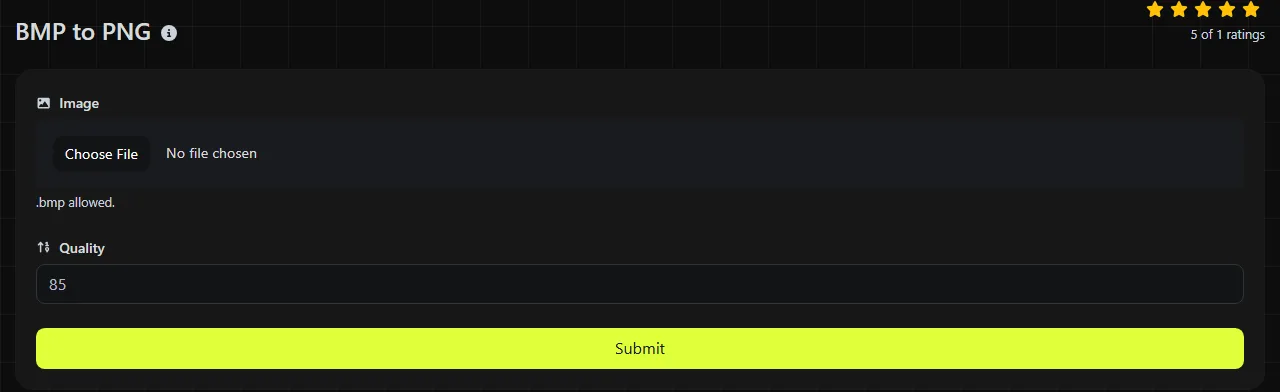
Browser-based conversion steps
- Choose the BMP image you want to convert.
- Run the conversion and wait for the browser to create the PNG.
- Save the resulting PNG file and open it to confirm that it looks correct.
The BMP is never uploaded to a server. All processing happens in your browser, which is useful for private screenshots, scanned forms, internal diagrams, and other images that you do not want sent to a third-party conversion service.
Browser processing also means that your device supplies the memory needed to decode the BMP and encode the PNG. A very large BMP can consume substantial memory because the browser may need to hold the uncompressed pixel data while creating the PNG.
Why does PNG often take less space than BMP?
PNG often takes less space because it uses lossless DEFLATE compression, while traditional BMP files commonly store pixel data with little or no compression.
A 24-bit BMP generally needs about three bytes per pixel before row padding and header data. A 2,000 × 1,000 image can therefore contain roughly 6 MB of raw pixel data. PNG compresses patterns within those pixels, so screenshots, logos, diagrams, and images with broad areas of one color commonly shrink substantially.
The exact PNG size cannot be predicted from the BMP dimensions alone. A detailed photograph or noisy scan has fewer repeating patterns and may produce a much larger PNG than a simple interface screenshot of the same dimensions. The PNG will often be smaller than an uncompressed BMP, but it may still be larger than a JPG version of a photograph.
- A flat-color software screenshot usually compresses well as PNG.
- A scanned signature on a plain background may become much smaller.
- A camera photo converted from BMP may remain fairly large because PNG preserves every decoded pixel without lossy compression.
- An already compressed or unusual BMP may show a smaller reduction than expected.
Is PNG the right replacement for a BMP file?
PNG is usually the better choice for web graphics, screenshots, diagrams, and files that need broad application support.
PNG works in current web browsers and is accepted by common publishing and collaboration systems, including WordPress, GitHub, Microsoft Office, and many messaging platforms. BMP is still recognized by Windows and many image editors, but it is a legacy choice for websites because its files are commonly large and browser handling of less common BMP variants can vary.
Conversion makes sense when an older Windows application exported a BMP, a website rejects BMP uploads, or you need a smaller lossless copy. PNG also fits graphics with sharp text and hard edges because it does not introduce the block artifacts associated with JPG compression.
No, converting a low-quality or previously lossy image to PNG does not restore detail. PNG prevents additional compression loss when the new file is saved, but it cannot reconstruct pixels already discarded by an earlier JPG save, resizing operation, or poor scan. For photographic images where download size matters more than exact pixel preservation, BMP to JPG may be a more practical route.
What happens to transparency, animation, and browser support?
PNG has well-supported transparency, remains lossless, and works more consistently on the web, but converting a BMP does not automatically add transparency or animation.
PNG can store full alpha transparency, including partially transparent edges. Some BMP variants can also contain alpha information, although software support for it is inconsistent. A BMP with a solid white background still contains white pixels, so conversion alone does not identify and remove that background. Inspect the PNG in an editor that displays transparency as a checkerboard if transparency matters.
Standard BMP is a single-image format and does not contain animation. The current PNG standard includes animation, commonly called APNG, but a one-frame BMP does not provide additional frames from which to create an animation.
Both formats are lossless in their usual forms. PNG changes the storage and compression method rather than intentionally reducing image quality. In a normal conversion without resizing, a 1,280 × 720 BMP produces a 1,280 × 720 raster image encoded as PNG. The visible pixels should remain the same, subject to how the source BMP and its color information are decoded.
BMP files that need extra care
Older or unusual BMP files may use indexed color, RLE compression, uncommon bit depths, bit masks, or legacy OS/2 headers. Support for these variants differs among browsers and image libraries.
An empty file, a damaged header, or a non-BMP file merely given a .bmp extension is not valid BMP input. If a file does not convert, open it in an image editor that recognizes it and save a standard 24-bit or 32-bit BMP before trying again.
During BMP-to-PNG conversion, spaces, punctuation, numbers, accented letters, and non-Latin characters in the filename do not change the image pixels. However, browsers and operating systems may sanitize or shorten a filename when saving the PNG. Very long BMP filenames can also run into file-system limits when saving the converted PNG even when the image data itself is valid.
Common questions about BMP-to-PNG conversion
Can I make a PNG by changing .bmp to .png?
No. Renaming the extension changes only the filename, not the bytes or compression format inside the file. Software may reject the renamed file or continue to identify it as BMP data.
Does PNG support CMYK color for commercial printing?
PNG does not support native CMYK color. It is primarily an RGB format, so a print workflow that requires a CMYK file may call for TIFF, PDF, or another format accepted by the printer. Ask the print provider which color profile and file type it expects before converting.
Can a PNG be converted back to BMP without quality loss?
The pixel values can generally be moved between lossless PNG and a compatible BMP representation without JPG-style compression damage. Transparency is less dependable because many BMP readers do not handle alpha channels consistently. A program may flatten transparent areas against a solid color when saving BMP.
Why might the colors look different after conversion?
Color differences can occur when software interprets color profiles, gamma information, or older BMP color data differently. Compare the BMP source and converted PNG in the same color-managed application rather than in two unrelated viewers. If accurate color is required, keep the original BMP until the PNG has been checked on the target browser, application, or display.
Similar tools
Popular tools
Create a WhatsApp chat link from a phone number, with an optional prefilled message.