BMP to ICO
Easily convert BMP image files to ICO.
BMP to ICO is a free tool that converts BMP image files into ICO files for Windows icons and website favicons.
Which source image produces a usable icon?
A square BMP with a simple subject, clear edges, and enough space around the artwork is usually the most practical source. Icons are displayed at small sizes, so fine text, thin lines, and photographic backgrounds can become hard to recognize.
- Use a square canvas to follow conventional icon proportions.
- Keep the main shape near the center so it remains visible when displayed at 16 × 16 or 32 × 32 pixels.
- Start with the cleanest available source for the ICO. Repeated resizing to small icon sizes can soften edges.
- Check the background before conversion. ICO supports transparency, but converting an opaque BMP does not automatically identify which pixels should become transparent.
For example, a 64 × 64 BMP containing a centered company initial is a reasonable favicon source. An 800 × 600 BMP screenshot can be converted, but its rectangular composition and small details make it a poor icon.
Conversion steps and browser privacy
BMP-to-ICO conversion takes place entirely in your browser, and the BMP file is never uploaded to a server. This matters when the source contains an internal logo, unreleased artwork, or another image that should remain on your device.
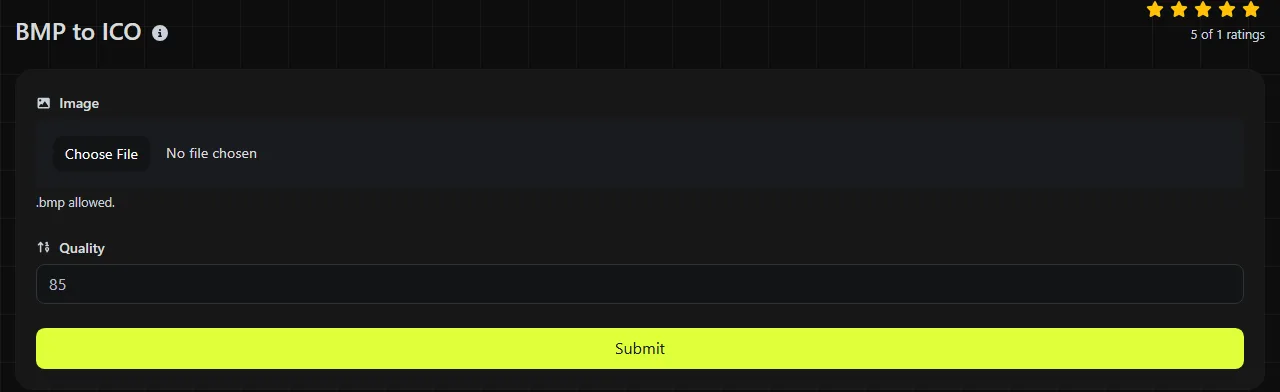
- Add the BMP file to the BMP to ICO converter.
- Allow the browser to process the image and create the ICO data.
- Save the resulting ICO file, then inspect it at the size where it will actually appear.
Do not judge the result only from a large preview. A mark that looks clear at 256 × 256 pixels may be unreadable in a browser tab or a compact Windows file view.
Can the conversion add transparency or recover detail?
No, changing BMP to ICO cannot recover missing detail or reliably create transparency that was not defined in the source image. The ICO format supports transparent pixels through alpha channels or legacy transparency masks, while many BMP files are fully opaque or have alpha data that software interprets inconsistently.
BMP is commonly an uncompressed raster format. ICO is a container for one or more static icon images, which may use BMP-like device-independent bitmap data or PNG compression. Neither standard BMP nor ICO is an animation format. Multiple images inside an ICO represent sizes or color depths, not animation frames.
Storing pixels in an ICO entry also cannot reverse earlier quality loss. If a photograph was first saved as a lossy JPG and later exported as BMP, putting those pixels into a lossless ICO entry preserves the existing defects. It does not restore detail removed by the JPG compression.
File size and compression expectations
An ICO will often be smaller than a large uncompressed BMP, but there is no fixed size ratio. The result depends on the pixel dimensions, color depth, transparency, compression method, and number of image entries stored in the icon.
A single small icon can require far fewer bytes than its BMP source, especially when the ICO entry uses PNG compression. An ICO containing several representations, such as 16 × 16, 32 × 32, 48 × 48, and 256 × 256, may be larger than a one-size file because each representation adds image data. An uncompressed ICO entry can also remain close to the equivalent bitmap size, plus container overhead.
For a favicon, file size matters because browsers may request it during a page visit. Check the saved file rather than assuming that ICO encoding means stronger compression. If the goal is a regular website image rather than an icon, BMP to WebP or BMP to PNG is usually a better fit.
Where can you use the resulting ICO?
Use the resulting ICO mainly for Windows icons and browser favicons, not as a general replacement for BMP images. Windows has long used ICO for application, shortcut, and file-type icons. Web browsers commonly recognize ICO in favicon contexts, including the familiar favicon.ico filename.
ICO is a practical choice when a site must support older favicon conventions or a Windows project expects an .ico resource. It is less suitable for photographs, page illustrations, social media images, and responsive website graphics. PNG has broad support for lossless images and transparency, while WebP is commonly chosen for compressed web graphics and photographs.
BMP itself has broad support in desktop image software and Windows, but it is rarely preferred for web delivery because uncompressed files can be large. Uncompressed BMP files can be larger than compressed PNG, JPG, or WebP images used as ordinary page content. ICO support is also specialized. Browsers recognize it primarily as icon data rather than a normal content-image format.
Frequently asked questions
Does macOS use ICO files for application icons?
No, native macOS application bundles generally use the ICNS format rather than ICO. An ICO file may open in some Mac image applications, but converting to ICO does not make it the standard format for a macOS app icon.
Can an ICO file contain SVG artwork?
No, conventional ICO files contain raster image entries, commonly BMP-like data or PNG-compressed images. Keep an SVG as a separate file if a website or application supports vector icons, and provide an ICO when a client specifically expects that format.
Why does my browser still show the old favicon?
Browsers often cache favicons separately from other page resources. Confirm that the new ICO is deployed at the expected path, then clear the relevant browser cache or test in a fresh browser profile. A changed filename referenced from the page can also help during deployment.
Does a favicon have to be named favicon.ico?
No, a page can reference an ICO file with another name and location through its HTML icon declaration. However, some browsers, feed readers, and automated clients may still request favicon.ico from the site root, so keeping that conventional file can improve compatibility.
Should I keep the original BMP after conversion?
Yes, keep the source if you may need to edit it or regenerate ICO sizes or entries. ICO is a delivery format for small raster representations, and editing a larger source is usually easier than enlarging an existing icon. Before deployment, verify the smallest display size, transparency, filename, and path.
Similar tools
Popular tools
Create a WhatsApp chat link from a phone number, with an optional prefilled message.