PNG to ICO
Easily convert PNG image files to ICO.
PNG to ICO is a free tool that converts a PNG image into an ICO icon file entirely in your browser.
Why use ICO instead of keeping the PNG?
Use ICO when a website, Windows shortcut, or desktop application specifically expects an icon file with the .ico extension. ICO is closely associated with Windows icons and the traditional favicon.ico file placed at a website's root.
Keeping the PNG often makes more sense for ordinary website images, social graphics, mobile app assets, and macOS workflows. Modern browsers commonly accept PNG favicons, but ICO remains useful for older software and systems that explicitly request favicon.ico.
PNG-to-ICO conversion is not a quality upgrade. If the PNG came from a low-quality JPEG or was enlarged from a tiny image, putting those pixels into an ICO container will not restore sharp edges or missing detail.
What actually changes inside an ICO file?
A standalone PNG image is converted into an ICO file, which is designed to hold icon images and related size information. The formats differ in several practical ways.
- Transparency. PNG supports full alpha transparency. Modern ICO images can also use alpha transparency, while older icon implementations may rely on a one-bit transparency mask.
- Animation. PNG supports both static and animated images through APNG animation chunks. ICO is a static icon format and is not an appropriate destination for animated artwork.
- Compression. PNG uses lossless DEFLATE compression. ICO is a container rather than one compression method, and its entries may use PNG-compressed image data or bitmap-style DIB data, depending on how the file was encoded.
- Platform support. PNG is widely supported across browsers, operating systems, and image editors. ICO has more specialized support, particularly in Windows and browser favicon handling.
- Image sizes. An ICO file can contain separate renditions for common icon dimensions. This lets software choose an appropriate image instead of scaling one source for every location.
The converter's output is an ICO file, but its internal ICO encoding and set of dimensions are unspecified. Do not assume that every converter produces the same internal structure merely because the files share the .ico extension.
Private, browser-based conversion
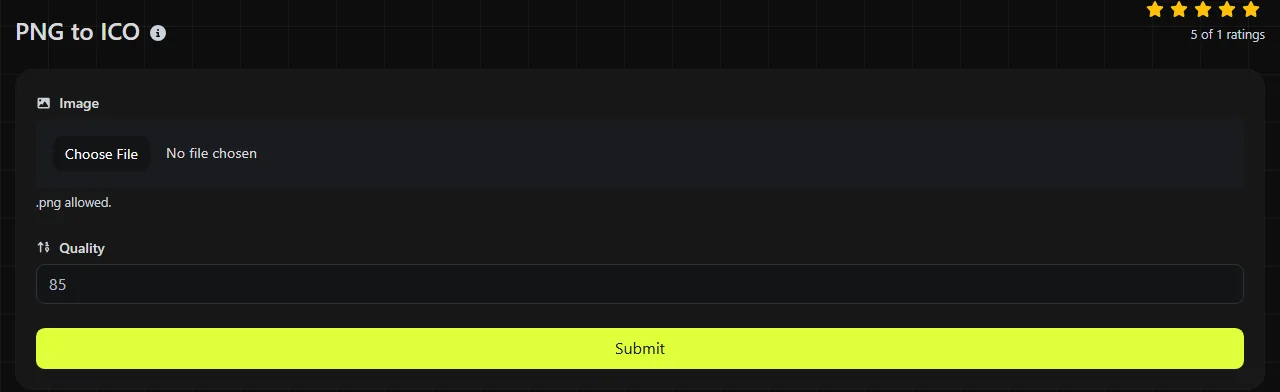
The PNG-to-ICO conversion happens entirely in your browser. Your PNG is never uploaded to a server, which matters when the source contains an unreleased logo, an internal application icon, or other material you do not want sent to a third-party conversion service.
Because PNG-to-ICO processing happens in your browser, very large source images use memory on your device. A multi-megapixel photograph provides little benefit for a favicon and may require more processing than a purpose-built square icon.
What source image works well for a favicon?
A square PNG with a simple subject, clean edges, and transparent padding usually works well for a favicon. Common icon dimensions include 16 by 16, 32 by 32, 48 by 48, and 256 by 256 pixels, although the dimensions a particular browser or application requests can vary.
Start with a source large enough to preserve smooth curves, then inspect the design at small sizes. Thin lettering, detailed illustrations, and subtle gradients often become unreadable at 16 by 16 pixels. A simplified symbol usually survives reduction better than a full company name.
Spaces, punctuation, accented letters, and non-Latin characters in the filename do not change the image pixels. They can still cause awkward URLs or deployment problems in older systems, so a plain filename such as favicon.ico is often the practical choice.
File-size expectations and worked example
There is no fixed PNG-to-ICO size ratio. A multi-size ICO is commonly larger than a single optimized PNG because it stores several renditions, while an ICO containing one small compressed image may be smaller than a large source PNG. Bitmap-style entries can also increase the file size compared with PNG-compressed entries.
Example 1. The input is a 256-by-256 transparent PNG containing a simple two-color logo. The output is an ICO file suitable for testing as a favicon or Windows icon. Its exact byte size cannot be calculated from the dimensions alone because color complexity, compression, and the ICO entries all affect the result.
If the destination only needs a normal raster image, conversion may be unnecessary. PNG to GIF is relevant when a 256-color GIF is required, while PNG to BMP creates a legacy bitmap file rather than an icon container.
Common questions about PNG and ICO
Which MIME type should I use for an ICO favicon?
image/vnd.microsoft.icon is the registered ICO media type, while image/x-icon remains common in existing website configurations. Browsers can often identify the format from the file itself, but a correctly configured server header avoids ambiguity.
Can an ICO image be rectangular?
The ICO format can describe width and height separately, but operating-system icons and favicons are generally designed as squares. A rectangular source may be scaled, padded, or displayed poorly by the consuming software, so prepare a square composition before conversion.
Will PNG metadata remain in the ICO file?
Do not rely on PNG metadata such as textual comments, creation details, or color-profile information surviving a format conversion. ICO consumers primarily care about the image entries, dimensions, color depth, and transparency. Keep the original PNG if its metadata needs to be preserved.
Why does my browser still show the previous favicon?
Browsers often cache favicons separately from other page assets. Confirm that the HTML points to the intended file, check the deployed path and filename, then clear the relevant browser cache or test in a fresh browser profile. Changing the favicon URL can also force a new request.
Can I use the converted file as a Windows cursor?
No. Windows cursor files use the CUR format, which is related to ICO but includes cursor hotspot coordinates. Renaming an ICO file to .cur does not add that information.
After conversion, inspect the file at small icon sizes and test it in the actual browser, shortcut, or application that will display it. Keep the original PNG so you can revise the artwork without working backward from the ICO.
Similar tools
Popular tools
Create a WhatsApp chat link from a phone number, with an optional prefilled message.