PNG to GIF
Easily convert PNG image files to GIF.
PNG to GIF is a free tool that converts PNG image files into GIF files entirely in your browser.
What should you know before choosing GIF?
Choose GIF when you need its broad compatibility or a simple image with no more than 256 colors. PNG can be a better format than GIF for detailed graphics, screenshots, gradients, and images that need partial transparency.
- Color: PNG can store millions of colors. A GIF image's active color table is limited to 256 entries, so converting photographs or complex artwork may introduce banding or dithering.
- Transparency: PNG supports alpha transparency, including partially transparent pixels. GIF supports a single transparent palette entry, so each pixel is either transparent or opaque.
- Animation: GIF supports multiple timed frames. PNG supports both ordinary single-image files and animated PNG files. Converting one still PNG does not create motion because the source contains only one image.
- Compression: PNG uses lossless DEFLATE compression. GIF uses lossless LZW compression on its indexed-color data, but reducing a full-color PNG to a 256-color GIF discards color information.
- Support: Major browsers and common desktop and mobile platforms display both formats. GIF remains useful for older publishing systems that specifically request it.
Converting a lossy or low-quality image to GIF cannot restore missing detail.
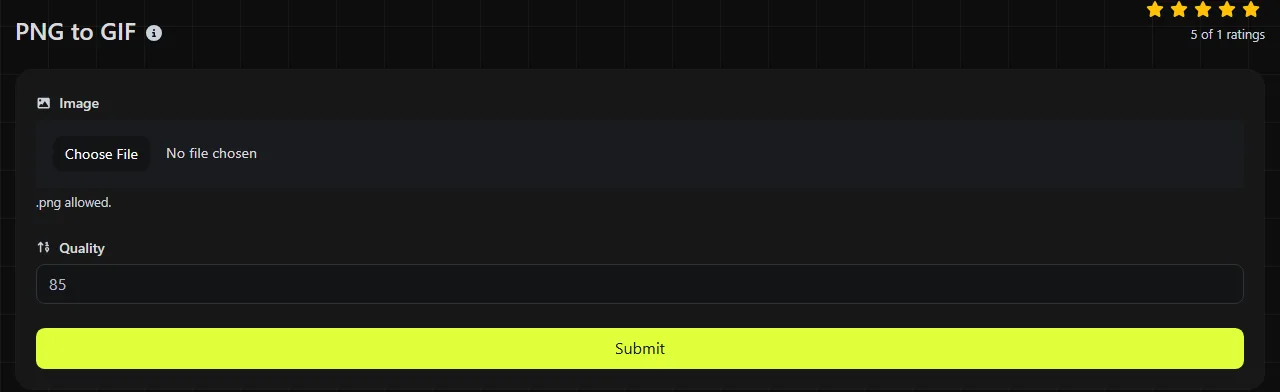
Convert PNG to GIF in your browser
The conversion happens entirely in your browser. Your PNG is never uploaded to a server. This matters for private diagrams, unreleased artwork, internal screenshots, and other files that should not be sent to an external conversion service.
Before publishing the result, open the GIF and inspect fine text, curved edges, gradients, and transparent areas. A file can convert successfully while still being a poor visual match for the PNG.
How large will the GIF be?
The GIF may be smaller or larger than the PNG because file size depends on the image content and how efficiently the source PNG was encoded. There is no dependable size ratio for this conversion.
A flat logo with a small color palette may produce a compact GIF, especially if the PNG was stored as a full-color image. An already optimized indexed PNG can be as small as or smaller than an equivalent GIF because PNG compression handles many image patterns efficiently.
For a worked example, consider status-icon.png, a 32-by-32 image using black, white, and green. Its GIF output can represent those colors within one 256-entry palette. By contrast, sunset-photo.png may contain thousands of shades. The GIF must map them to 256 colors or fewer, and the result may still be relatively large despite losing color detail.
GIF is rarely the right format when the main goal is reducing the size of a photographic image. JPEG is commonly suitable for photographs, while PNG to WebP is a more relevant option for modern web delivery when the receiving platform supports WebP.
Transparency, gradients, and detailed artwork
Partially transparent PNG pixels need special attention because GIF cannot store their alpha levels. Soft shadows, translucent overlays, antialiased lettering, and feathered cutouts may acquire hard edges after conversion. A colored fringe can also appear if an image prepared for one background is placed over another.
Gradients and photographs present a different constraint. The converter must represent the image with a limited palette, which can produce visible color steps. Dithering can simulate additional shades by arranging different-colored pixels near one another, but it adds a grain-like pattern and may increase the file size.
Very large PNGs can also consume substantial browser memory while they are decoded and re-encoded. Available memory for PNG decoding and GIF encoding varies by device and browser, so an unusually large image may be more practical to resize before conversion. Empty, damaged, or mislabeled files may not contain valid PNG image data and cannot be made valid merely by changing the filename extension.
Where does GIF fit in a publishing workflow?
GIF fits workflows that explicitly require the format, use a tightly limited palette, or depend on compatibility with an older system. Confirm that the destination requires GIF before converting.
- Use GIF for a small static badge when a content management system or legacy application accepts GIF but not PNG.
- Keep PNG for interface screenshots, diagrams with small text, and logos that require smooth transparency.
- Use PNG to ICO when preparing favicon files that need icon-specific sizes and packaging.
- Do not choose GIF merely because GIF supports animation. Creating an animation requires multiple frames, frame timing, and often loop settings, none of which exist in an ordinary still PNG.
If a platform accepts both PNG and GIF for a still image, compare the actual files and inspect them at normal display size. The smaller file is not the better choice if transparency breaks or text becomes harder to read.
Common questions about PNG-to-GIF conversion
Does renaming .png to .gif convert the image?
No. Changing the extension does not rewrite the encoded image data. Software may reject the renamed file or detect that its internal PNG signature does not match the GIF extension.
Can a GIF contain more than 256 colors across an entire animation?
Yes, an animated GIF can use a different active color table for each image, so the complete animation may contain more than 256 distinct colors. Each GIF image's active color table is limited to a maximum of 256 entries.
Does GIF store camera color profiles?
GIF has no standard embedded ICC color-profile field comparable to formats designed for managed color workflows. If accurate color reproduction across print and calibrated displays matters, keep an archival source in PNG or another suitable format.
Can I use the converted GIF for printing?
You can place a GIF in many print layouts, but its limited palette makes it a weak choice for photographs, gradients, and color-critical material. Keep the higher-quality PNG source and use the file format requested by the printer or layout application.
Why can transparent edges show a halo on a dark background?
The original PNG may contain partially transparent edge pixels blended for a light background. GIF cannot retain those intermediate alpha values, so the converted edge may carry light-colored pixels that become visible against dark content. Preparing the image against its final background before conversion can reduce this effect.
Similar tools
Popular tools
Create a WhatsApp chat link from a phone number, with an optional prefilled message.