PNG to JPG
Convert a PNG image to JPG and choose the output quality.
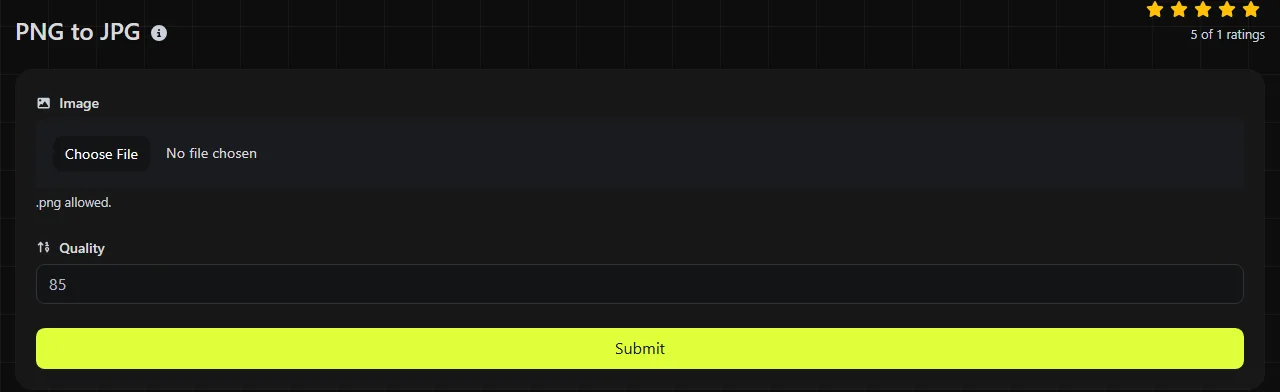
PNG to JPG converts PNG image files into JPG format entirely in your browser.
PNG-to-JPG conversion in your browser
The file must contain valid PNG image data. A file with a .png extension may still fail if it is empty, corrupted, or another format with the wrong extension.
The image is processed entirely in your browser, and the input file is never uploaded to a server.
Inspect the resulting JPG before replacing the original PNG, particularly where the PNG contains transparent areas, sharp text, thin lines, or color gradients.
Keep the source PNG until you confirm that the JPG is suitable. JPG compression permanently discards some image information, so converting the result back to PNG later will not recover the original pixels.
PNG and JPG at a glance
| Property | PNG | JPG |
|---|---|---|
| Compression | Lossless compression preserves pixel data. | Lossy compression reduces data by approximating image detail. |
| Transparency | Supports alpha transparency, including partially transparent pixels. | Does not support transparency. Every pixel must be opaque. |
| Animation | PNG can be static or animated. PNG animation uses APNG chunks defined by the current PNG specification. | Static only. It cannot store animated frames. |
| Typical use | Logos, interface graphics, diagrams, screenshots, and images that need transparency. | Photographs and other images with many colors and gradual tonal changes. |
| Typical file-size direction | Often larger for photographs, but efficient for simple graphics and flat-color screenshots. | Often smaller for photographs. It may be larger or less suitable for simple graphics at a quality level that keeps edges clean. |
| Support | Widely supported by current browsers, operating systems, and common image applications. | Widely supported across browsers, websites, email clients, office software, and photo services. |
A PNG may also use a limited color palette, grayscale data, or higher color precision. JPG commonly uses 8 bits per sample and is designed around photographic content rather than exact pixel preservation.
Should you replace a PNG with a JPG?
Replace a PNG with a JPG when the image is an opaque photograph and a smaller file is more useful than exact pixel preservation. This commonly applies to product photos, real estate images, event photos, and pictures prepared for email or a website that expects JPG uploads.
Keep the PNG when the image contains transparency, small text, line art, a logo, a QR code, or a software interface. JPG compression can create ringing, block patterns, or blurred edges around high-contrast details. A transparent logo also cannot remain transparent in a JPG.
Conversion is also a poor choice when a JPEG photo was previously saved as PNG. That PNG may preserve the already-compressed pixels without adding further loss, but it does not restore detail removed by the earlier JPEG encoding. Converting it to JPG again can introduce another generation of compression artifacts.
Why can the output be larger than expected?
A JPG can be larger than expected when the source PNG contains simple shapes, repeated colors, or large uniform areas that PNG compresses efficiently. File size depends on pixel dimensions, image complexity, chroma subsampling, metadata, and the JPEG quality chosen by the encoder.
For a 3000-by-2000-pixel photograph, JPG will commonly be smaller than PNG because photographic noise and gradual color changes are expensive for PNG to store. For a 900-by-300 screenshot with a white background and a few solid-color controls, PNG may already be compact. Producing a clean-looking JPG of that screenshot can require enough data that the size advantage is small or nonexistent.
No exact output size can be promised. If the JPG is still too large, an Image optimizer may help after you inspect the converted image.
How private is this conversion?
The conversion is done entirely in your browser, and your PNG is never uploaded to a server.
Browser processing keeps private PNG photos, internal diagrams, and unpublished graphics on your device during conversion.
Practical conversion cases
- Transparent brand mark A PNG logo with a transparent background cannot produce a transparent JPG. The resulting JPEG must be opaque, so verify the background treatment in the saved JPG.
- Photo exported from an editor An opaque PNG photograph can be a reasonable JPG candidate. Expect lossy compression and usually a smaller file, but compare hair, foliage, fabric, and shadow gradients for visible artifacts.
- Application screenshot A PNG screenshot with 12-point text and thin borders often benefits from staying PNG. JPG may soften character edges or add halos around controls.
- Animated PNG JPG has no animation support. Verify whether the animated PNG input is accepted and which frame appears in the JPG.
- Archive copy Do not discard a lossless PNG master after making a JPG delivery copy. Future edits and exports should begin with the PNG to avoid repeated lossy encoding.
Questions people ask about PNG and JPG
Does conversion resize the image?
Verify the JPG's width and height against the source PNG if exact dimensions matter.
Can a 16-bit PNG keep all of its color precision in JPG?
Usually no. A 16-bit PNG ordinarily uses 16 bits per sample, while common JPEG workflows use 8 bits per sample, so the PNG may lose tonal precision during conversion. Keep the 16-bit PNG source for substantial color grading or archival work.
Why does a valid-looking .png file fail to open?
The extension may be wrong, or the file data may be incomplete or damaged. Try opening the PNG in a regular image viewer first. If the viewer cannot decode it, converting it to JPG will not repair the missing image data.
Is JPG suitable for a commercial printer?
Sometimes, but the printer's specifications decide. A high-resolution JPG may be accepted for photographs, while artwork requiring transparency, spot colors, or a particular color profile may need another format. Confirm the JPG's pixel dimensions, color requirements, and bleed before sending it to the printer.
Would WebP be a better choice for a website?
WebP can retain transparency and often provides useful web compression, so PNG to WebP may fit a transparent web image better than JPG. JPG remains practical when a publishing system, email workflow, or image library specifically expects it. Keep the original PNG until the chosen format has been checked in its final destination.
Similar tools
Popular tools
Create a WhatsApp chat link from a phone number, with an optional prefilled message.