MD4 generator
Generate an MD4 hash for any string input.
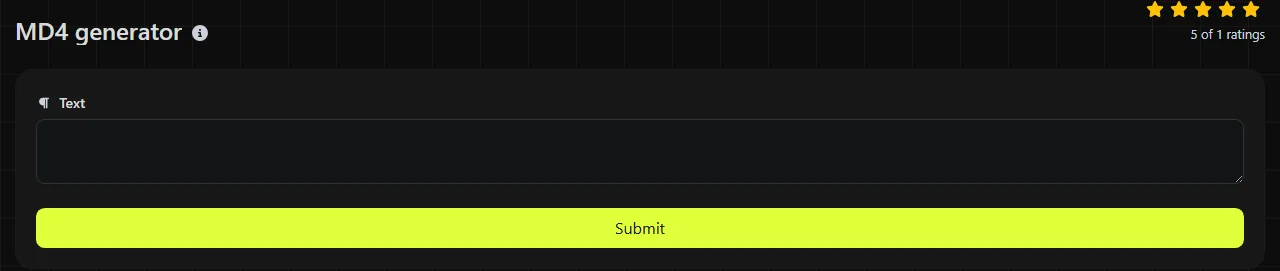
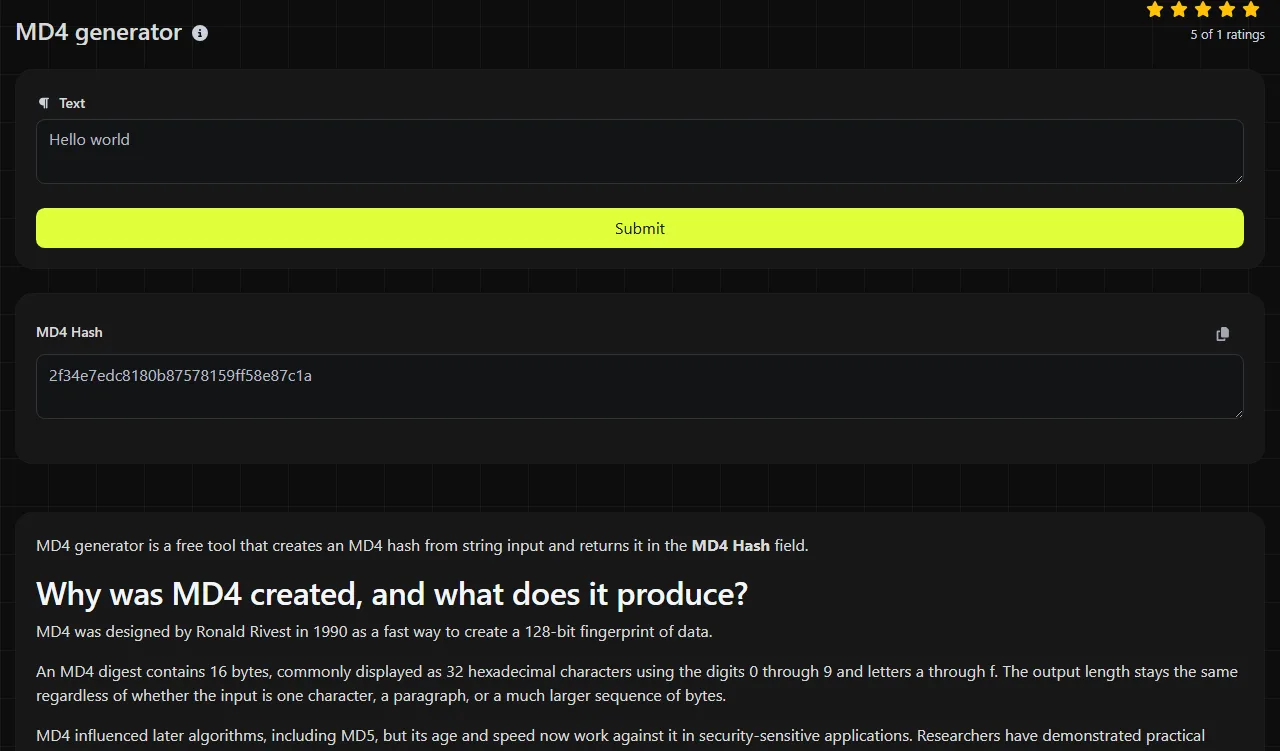
MD4 generator is a free tool that creates an MD4 hash from string input and returns it in the MD4 Hash field.
Why was MD4 created, and what does it produce?
MD4 was designed by Ronald Rivest in 1990 as a fast way to create a 128-bit fingerprint of data.
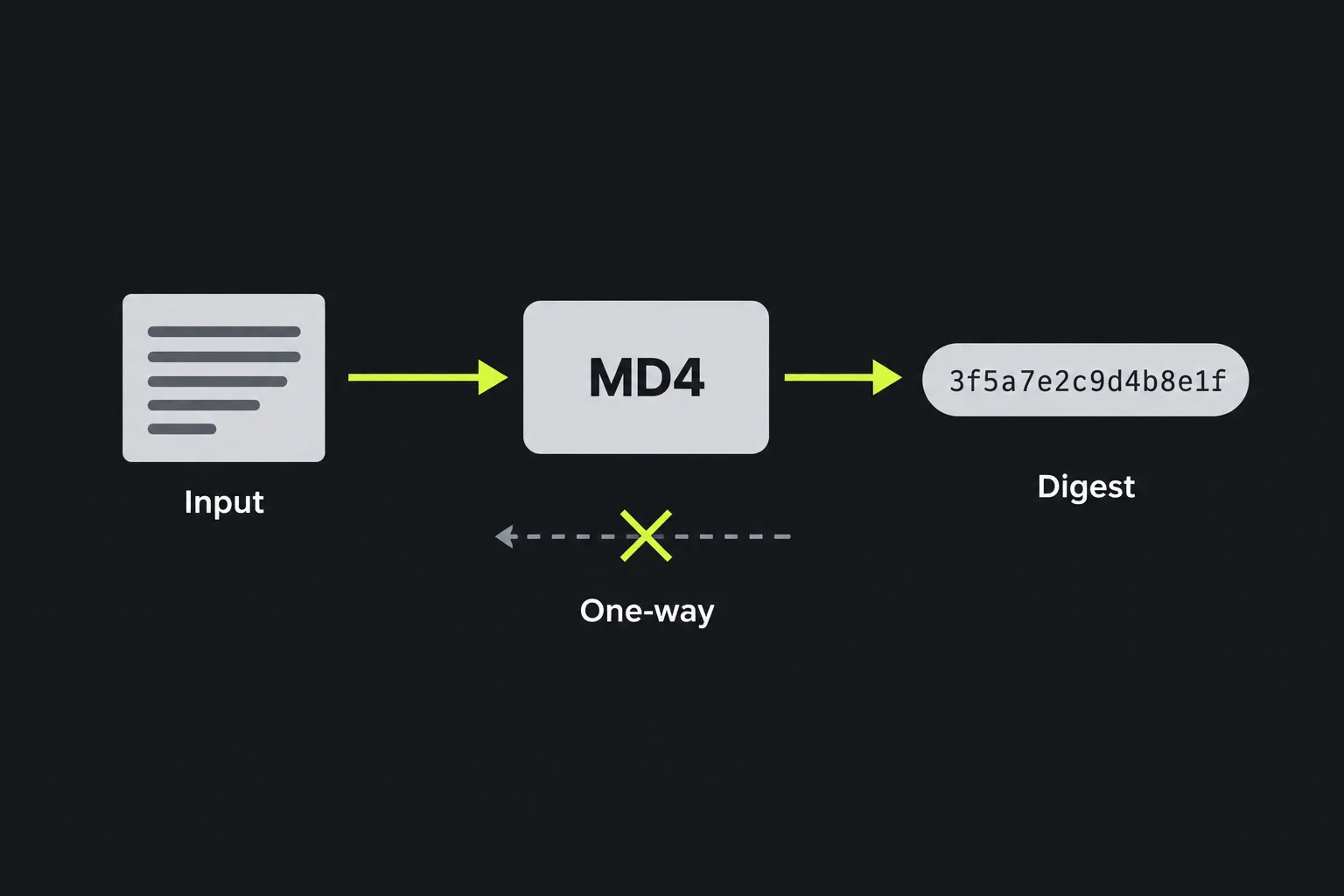
An MD4 digest contains 16 bytes, commonly displayed as 32 hexadecimal characters using the digits 0 through 9 and letters a through f. The output length stays the same regardless of whether the input is one character, a paragraph, or a much larger sequence of bytes.
MD4 influenced later algorithms, including MD5, but its age and speed now work against it in security-sensitive applications. Researchers have demonstrated practical collision attacks, so MD4 is considered cryptographically broken and deprecated.
What output should I expect from the generator?
You should expect one 128-bit MD4 digest represented by 32 hexadecimal characters.
- Empty input: The standard MD4 digest is 31d6cfe0d16ae931b73c59d7e0c089c0.
- Verified MD4 example: The MD4 digest of a is bde52cb31de33e46245e05fbdbd6fb24.
- Input with punctuation: release-2.1 and release_2.1 produce different 32-character digests.
- Verified MD4 example: The MD4 digest of abc is a448017aaf21d8525fc10ae87aa6729d.
The work is performed on the server. Your input travels to the server over HTTPS and is not stored. Avoid submitting confidential material if your policies prohibit sending it to an external server, even over an encrypted connection.
Can an MD4 hash be used for security?
No, MD4 should not be used where an attacker could benefit from forging or substituting data. Its collision resistance is broken, meaning an attacker can construct different inputs that share the same digest. That makes MD4 unsuitable for digital signatures, software authenticity checks, certificates, or other adversarial integrity controls.
An MD4 digest also cannot be decrypted or directly reversed because hashing does not use an encryption key. However, that does not make an MD4 digest private. An attacker can hash likely inputs and compare the results, and MD4 is fast enough to make large guessing attacks practical for short or predictable values.
Do not use MD4 to store passwords. Adding a salt prevents simple reuse of precomputed tables, but it does not fix MD4's speed or collision weaknesses. Because MD4 is fast and unsuitable for password storage, use a dedicated password-hashing function such as Argon2id, bcrypt, scrypt, or PBKDF2 with parameters chosen for the application.
Appropriate uses for a deprecated algorithm
MD4 still has limited uses when compatibility matters more than resistance to deliberate attack. It can help reproduce a value required by an older system, inspect historical records, or compare data in a legacy format that explicitly specifies MD4.
- Checking non-adversarial data for accidental changes in a controlled archive
- Matching identifiers stored by older applications or protocols
- Finding possible duplicates in an existing collection that already uses MD4
- Reproducing historical test vectors during software maintenance
For deduplication, treat matching MD4 values as candidates rather than proof that two files are identical. Compare the actual bytes or use a modern second hash before deleting data. For new checksum designs, SHA-256, SHA-3, or BLAKE2 is a more appropriate choice. The MD5 generator may help with another legacy format, but MD5 also has broken collision resistance. The Whirlpool generator produces a much longer digest, though compatibility requirements should determine the algorithm.
How does MD4 handle unusual input?
MD4 hashes bytes, so every byte in the input affects the digest, including whitespace, punctuation, line endings, and encoded non-ASCII characters. The algorithm does not understand words, numbers, or visually equivalent characters.
MD4 hashes the encoded bytes exactly as supplied. For example, a precomposed é and an e followed by a combining accent can look identical while producing different byte sequences and different MD4 hashes. Text copied from Windows may also produce a different MD4 hash from text created on Linux or macOS because of different line-ending bytes.
MD4 can process long input while continuing to return a 32-character hexadecimal representation. The tool's specific request-size limits are not stated, so it should not be assumed to accept files or arbitrarily large pasted content. It returns a hash for string input and does not claim to normalize whitespace, Unicode, or line endings before hashing.
Questions people ask about MD4
Is an MD4 checksum safe for verifying a download?
It may detect accidental corruption, but it is not suitable when an attacker could replace both the download and its checksum. Because MD4's collision resistance is broken, use the publisher's authenticated signature or a modern hash delivered through a trusted channel.
How should an MD4 digest be stored in a database?
A hexadecimal MD4 value fits in a 32-character ASCII field. Applications can instead store the raw 16 bytes in a binary column, but every component must agree on whether values are binary or hexadecimal before comparison.
Why might MD4 be unavailable in software that restricts deprecated cryptographic algorithms?
Some cryptographic libraries and compliance-oriented environments disable MD4 because it is deprecated. If an integration requires MD4, confirm that the runtime supports it before committing to the migration plan, and keep its use isolated to the legacy compatibility step.
Final checks
To reproduce an MD4 value, preserve exact spaces, character encoding, capitalization, and line endings. Use MD4 only when an existing format requires it, and record that requirement so a future maintainer does not mistake the digest for a current security control.
Similar tools
Popular tools
Create a WhatsApp chat link from a phone number, with an optional prefilled message.