GIF to WebP
Easily convert GIF image files to WEBP.
GIF to WebP is a free tool that converts GIF image files into WebP files entirely in your browser.
What should you expect from a GIF-to-WebP conversion?
The converted file uses WebP compression instead of GIF's palette-based compression. GIF supports no more than 256 colors per frame, while WebP can represent full-color images and use either lossy or lossless compression.
- Transparency: GIF transparency is limited to fully transparent or fully opaque pixels. WebP supports alpha transparency with partially transparent edges, although conversion cannot create smoother transparency that was absent from the original GIF.
- Compression: GIF uses lossless LZW compression on indexed-color frames. WebP supports more efficient compression methods designed for full-color web images.
- Typical size: A WebP is often smaller than the equivalent GIF, especially for photographic content. The result is not guaranteed to be smaller because dimensions, image complexity, and encoder settings all affect size.
- Support: Current major browsers support WebP. Older software, some email workflows, and legacy content-management systems may still expect GIF.
Converting a GIF does not recover colors or detail discarded when the GIF was created. Putting a limited-color, already compressed image into a more capable format changes its encoding, not its original visual information.
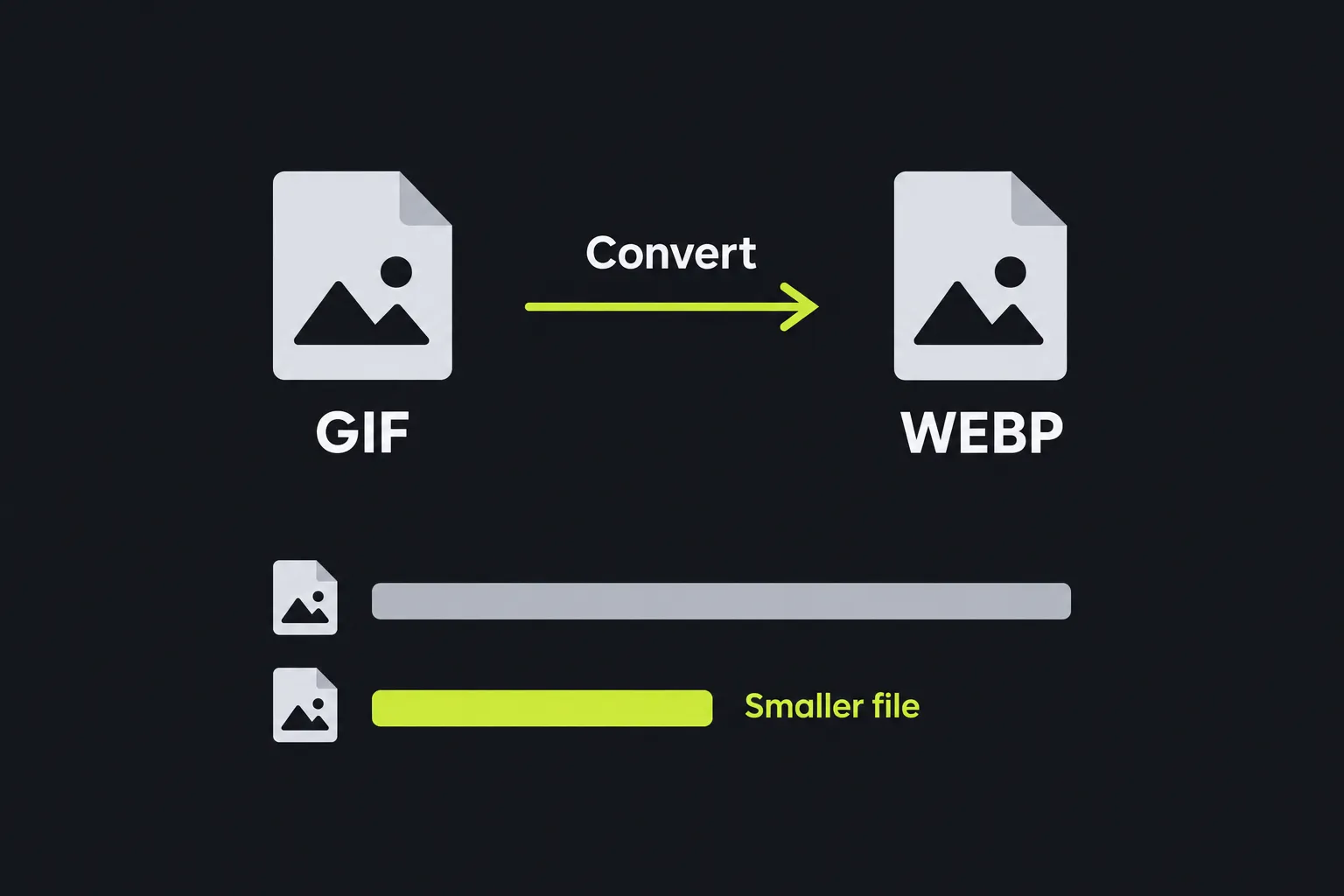
A quick conversion workflow
- Use GIF to WebP in your browser to convert the file.
- Open the resulting WebP in its intended browser, app, or publishing system.
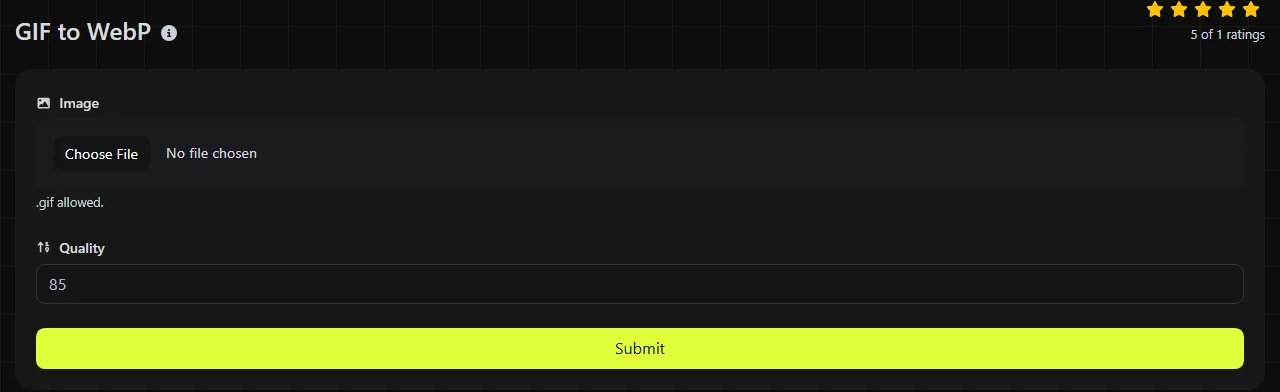
For example, you might name a WebP converted from checkout-loading.gif as checkout-loading.webp.
Does the file stay private during conversion?
Yes. The work is done entirely in your browser, and the GIF is never uploaded to a server.
This matters for unreleased interface graphics, internal diagrams, and images containing customer or company information. Because GIF-to-WebP processing happens in your browser, your device performs the conversion. A large GIF can therefore require more memory and processing time than a small image.
Is WebP a suitable replacement for this GIF?
WebP is a sensible replacement when the destination supports it and reduced web asset size is more useful than legacy compatibility. It commonly fits website images, product interface graphics, stickers delivered through a web app, and large GIFs embedded in articles.
Keep the GIF when a specific publishing system, older desktop application, or distribution channel explicitly requires that format. GIF may also be the safer interchange file when recipients must open the image in software with uncertain WebP support.
Conversion is a poor choice when the goal is to improve a low-quality source. A grainy GIF with banding, missing colors, or jagged transparent edges will still contain those defects after conversion. WebP can encode the available pixels efficiently, but it cannot reconstruct the original artwork.
If you need a static output for a system that does not accept WebP, GIF to JPG may fit a photograph without transparency. GIF to ICO is intended for favicon or Windows icon workflows, where multiple icon sizes may be needed.
How large will the WebP output file be?
Expect WebP to be smaller in many common cases, but plan for variation rather than a fixed percentage. GIF image data uses indices into an active global or local color table. File size depends on dimensions and image complexity and, for animated GIFs, frame count and the size of changed regions. WebP has compression methods that often represent the same image with fewer bytes.
A small flat-color graphic may show only a modest reduction because the GIF is already simple. A large image with gradients, shadows, or photographic areas may shrink more substantially. Conversely, a lossless WebP made from a tiny, highly optimized GIF could be similar in size or even larger.
Compare file size only after checking visual quality. A smaller image is not useful if text becomes blurry or transparent edges develop artifacts.
What can cause trouble with an unusual GIF?
Malformed GIF data, extreme dimensions, and GIFs with many frames can prevent reliable conversion or strain browser memory.
- An empty file contains no image frames and cannot produce a meaningful WebP image.
- A GIF with many frames may take more time and memory because every frame must be decoded and processed.
- GIF frame disposal rules can produce unexpected trails or missing areas if a decoding or conversion component interprets a complicated animation differently.
- Text, numbers, accented characters, and non-Latin characters in the filename do not change the pixels, but some older systems may handle such filenames poorly. A short ASCII filename is safer when sending the WebP result to a legacy platform.
- Transparent GIF edges may show a colored fringe because GIF cannot store partial alpha. Conversion cannot reliably remove a matte color already baked into those edge pixels.
Frequently asked questions
Why is there a colored outline around transparent areas?
The outline may come from matte pixels stored in the GIF around the transparent subject. Those pixels often become visible when the background changes. Removing the fringe generally requires image editing or access to the original artwork with full alpha transparency.
Should I keep the original GIF after converting it?
Keep it until the WebP has been checked in every required destination. The GIF remains useful as a fallback for legacy systems and as a reference if the WebP appears different. Store both files with clear extensions so they are not confused during publishing.
Can a WebP file be used as a favicon?
Some browsers and site configurations can display WebP assets, but ICO and PNG remain common favicon choices because icon tooling often expects them. Confirm the requirements of the website framework, manifest, and browser targets before using WebP for that purpose.
Similar tools
Popular tools
Create a WhatsApp chat link from a phone number, with an optional prefilled message.