GIF to ICO
Easily convert GIF image files to ICO.
GIF to ICO is a free tool that converts GIF image files into ICO files for favicons, Windows icons, and other icon-specific uses.
Does the GIF leave your browser during conversion?
No. The conversion happens entirely in your browser, and the GIF is never uploaded to a server. This keeps private, unreleased, or internal GIF artwork off a server while you create the ICO.
Your browser still needs access to the source GIF on your device to create the ICO. If you are using a shared computer, remember that the converted ICO may remain in the downloads folder after you finish.
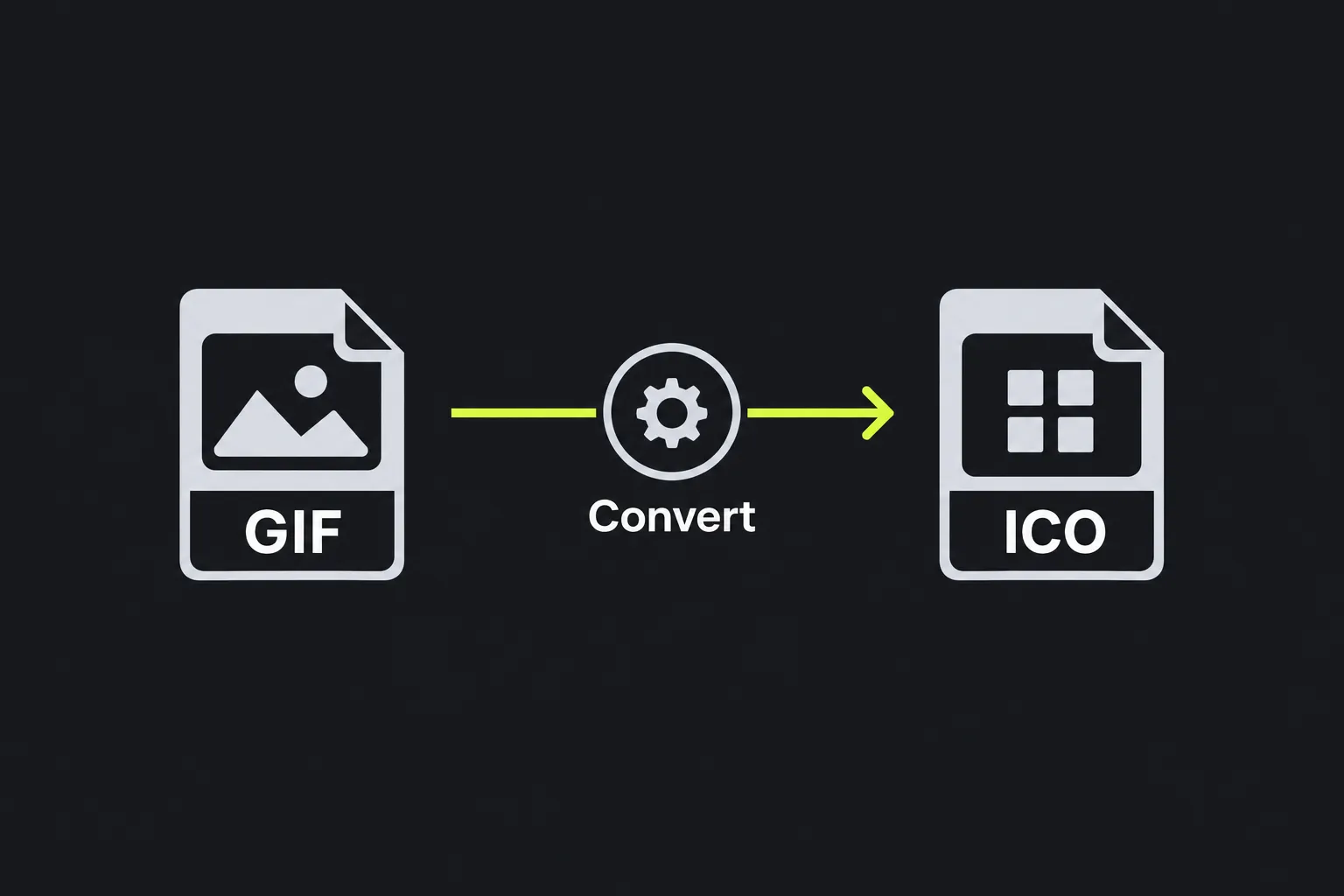
A three-step browser workflow
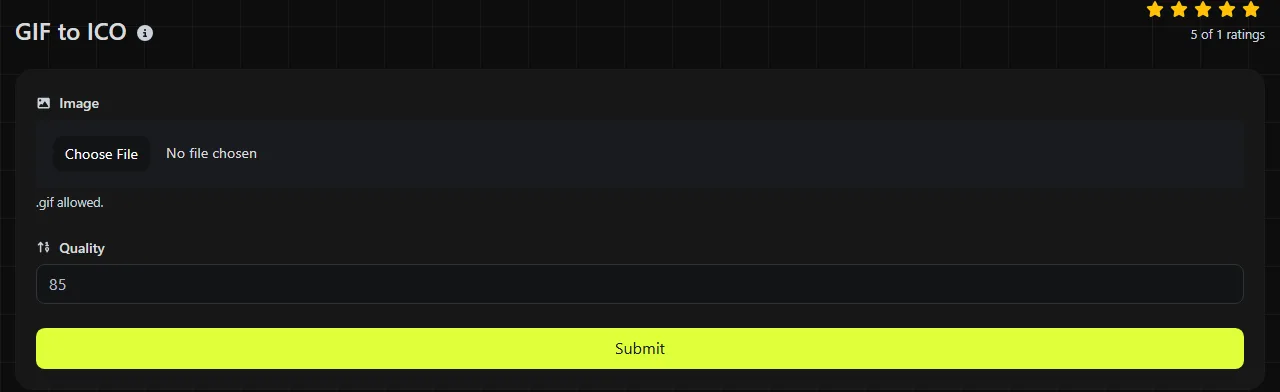
- Add the GIF file you want to convert to ICO.
- Run the conversion. Your browser processes the image locally and creates ICO data from it.
- Save the resulting ICO file, then test it in the browser or application where you plan to use it.
Check the saved icon at its actual display size. A design that looks clear when enlarged can become unreadable at 16 by 16 or 32 by 32 pixels. For a favicon, simple shapes, strong contrast, and limited fine detail generally work better than text or a full-size logo.
GIF and ICO are built for different jobs
| Property | GIF | ICO |
|---|---|---|
| Primary use | Web images and short animations | Favicons and Windows-style icons |
| Color | Up to 256 indexed colors per frame | Can contain images with higher color depth |
| Transparency | GIF89a can designate one transparent color index through the Graphic Control Extension | Can support full alpha transparency, depending on the stored image data |
| Animation | Supports multiple timed frames | Does not provide normal GIF-style animation |
| Compression | Uses lossless LZW compression for indexed pixels | A container that may hold BMP-style or PNG-compressed image data |
| Support | Widely supported as an image in browsers and many apps | Commonly supported for browser favicons and by Windows, but not intended as a general web image format |
The fact that both formats can use lossless compression does not mean conversion improves the source. A GIF has already been limited to its indexed palette. If it was created from a low-quality JPEG or heavily reduced artwork, placing it in an ICO container cannot restore missing colors, sharp edges, or photographic detail.
Is ICO the right destination for your GIF?
ICO is a sensible destination when you need a favicon or an icon for software that specifically expects an .ico file. One ICO container can support icon-oriented uses that a plain GIF may not handle reliably.
- Convert a small, static logo when a website template requests favicon.ico.
- Use ICO for a Windows shortcut, installer, or desktop application that requires the format.
- Do not choose ICO for an animated banner, reaction image, or loading indicator. ICO cannot preserve the animation.
- Do not use ICO as a replacement for regular page graphics. PNG, WebP, or another browser image format is usually more appropriate.
If the goal is a modern web image rather than an icon, GIF to WebP may be the more suitable conversion. WebP supports web-focused compression and can support animation, while ICO is designed around small icon assets.
What file size and visual changes should you expect?
The ICO will often be small when it contains only icon-sized artwork, but there is no fixed rule that it will be smaller than the GIF. An animated or large GIF may shrink substantially when represented as a static icon. A tiny, efficiently compressed GIF may produce a larger ICO because of container overhead, higher color depth, or the way image data is stored.
File extension alone does not reveal the ICO's internal compression. ICO files can contain BMP-style image data or PNG-compressed data, and which encoding this converter writes is unspecified. Compare the saved ICO's file size with the original GIF because their storage structures differ.
Transparency also deserves a visual check. GIF transparency is effectively on or off for each pixel, so soft translucent edges may already have been lost before conversion. An ICO can represent smoother alpha transparency, but conversion cannot reconstruct edge information that the GIF does not contain.
How do unusual GIF inputs behave?
Animation, non-square dimensions, limited palettes, and very large artwork can all produce an ICO that needs review because icon displays have different expectations from ordinary GIF viewers.
- If the converter accepts an animated 120-by-120-pixel spinner, the resulting ICO will be static. The GIF frame used is unspecified, so inspect the result.
- A 32-by-32-pixel GIF with a transparent background is a natural favicon candidate. Check the edge against both light and dark browser themes.
- A 600-by-400-pixel photographic GIF is a poor icon source. Cropping and redesigning it as a square image before conversion will usually give a clearer result.
- A malformed, incomplete, or empty file may not contain decodable GIF image data. Conversion cannot repair GIF corruption that prevents the browser from decoding the image.
Questions people ask about GIF and ICO files
Can I create an ICO by changing the .gif extension?
No. Renaming the file changes only its name, not its internal structure. Software expecting ICO data may reject a renamed GIF or display it incorrectly.
Why does my new favicon still show the old image?
Browsers often cache favicons separately from page content. Reloading may not replace the cached copy immediately, so try a private browsing window, clear the site's cached data, or publish the icon under a new filename and update the page reference.
Does GIF-to-ICO conversion preserve image metadata?
Do not rely on GIF comments or other application-specific extensions surviving in the ICO output. ICO workflows generally focus on pixel data, dimensions, color depth, and transparency rather than comments or application-specific GIF metadata. Keep the original GIF if that information matters.
Can an ICO file be used as a macOS application icon?
ICO is associated mainly with Windows and browser favicons. macOS application bundles normally use ICNS assets instead, although browsers on macOS can still display ICO favicons on websites.
Is it safe to open the converted ICO?
An ICO is an image container, but the browser must decode the source GIF during this workflow, so use GIF files from sources you trust. This converter processes the source in your browser without uploading it, though local processing does not confirm that an unknown input file is trustworthy. Keep the original GIF until you have checked the ICO in its intended application.
Similar tools
Popular tools
Create a WhatsApp chat link from a phone number, with an optional prefilled message.