Reverse list
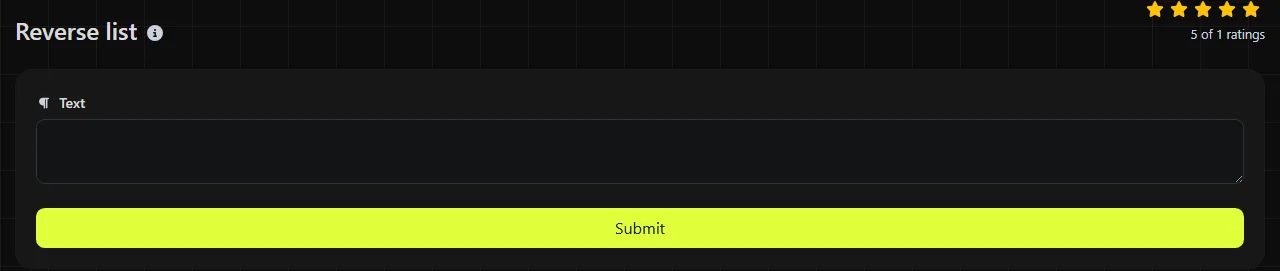
Reverse a list of given text lines.

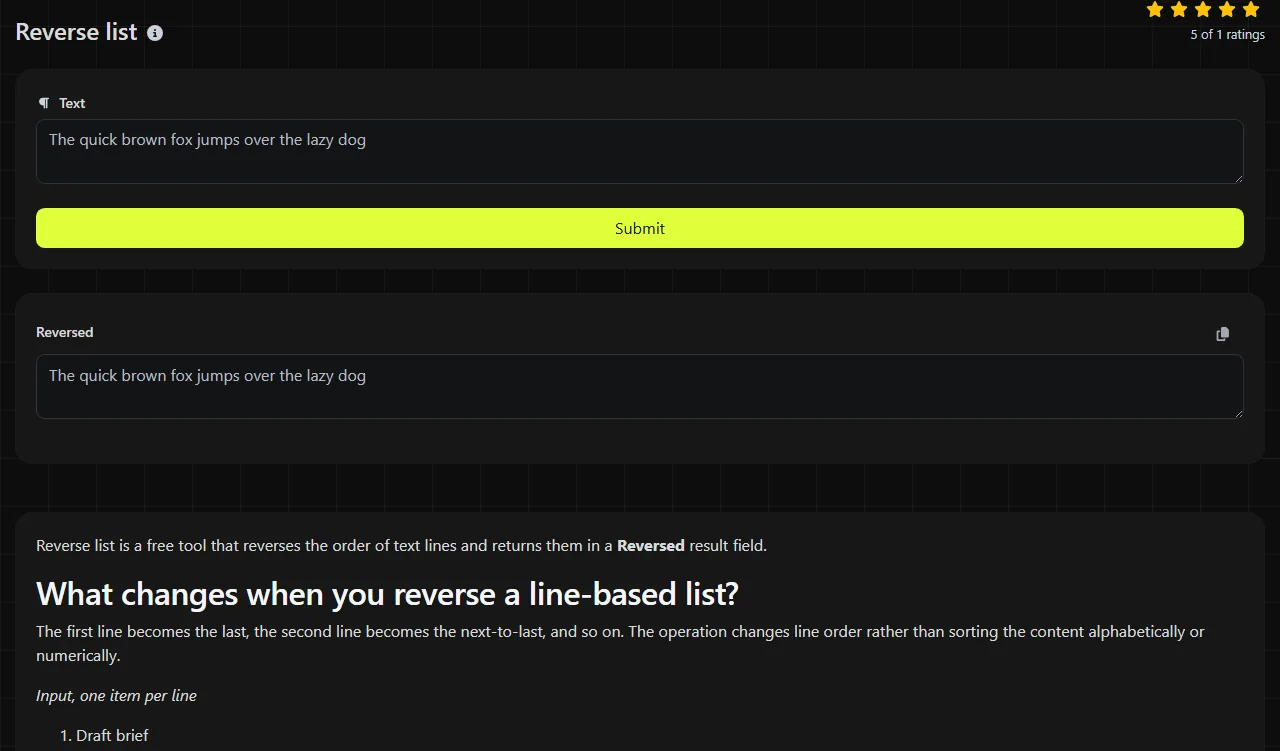
Reverse list is a free tool that reverses the order of text lines and returns them in a Reversed result field.
What changes when you reverse a line-based list?
The first line becomes the last, the second line becomes the next-to-last, and so on. The operation changes line order rather than sorting the content alphabetically or numerically.
Input, one item per line
- Draft brief
- Editorial review
- Publish article
Reversed
- Publish article
- Editorial review
- Draft brief
Numbers, punctuation, spaces, and accented characters are content within a line. For example, reversing lines labeled "Step 1," "Step 2," and "Step 10" changes their positions without treating the numbers as values to sort. It also does not reverse letters inside each item. Reverse letters or Reverse words fit those separate operations.
A quick workflow
- Place each list item on its own line in the input.
- Run the tool to reverse the line order.
- Copy the content from the Reversed field and paste it into its destination.
Keep each complete record on one line. If a mailing record contains a name, email address, and account number, combine those fields on the same line before reversing so they move together.
A useful check is to add temporary sequence numbers before reversing a list with repeated or similar-looking entries. The numbers make it easier to confirm that the last item moved to the top and that nothing was omitted. Remove the temporary numbers after checking the result.
Where can reversing a list save time?
Reversing is useful when the existing order is correct but runs in the wrong direction. It avoids manually cutting and pasting items one by one into reverse line order.
- Google Sheets or Microsoft Excel: Reverse a copied single-column list when the bottom entry needs to appear first. For tables with several columns, keep each row together or use a spreadsheet method instead.
- GitHub: Turn release notes or issue references copied in newest-first order into a chronological reading list.
- Trello: Reorder copied card titles when a board export or manual copy places the latest task first.
- Mail merge preparation: Reverse a one-record-per-line recipient list before placing it into a Microsoft Word merge source. Confirm that the merge system actually respects source order.
- Content scheduling: Flip a list of post titles copied from a Buffer or social media planning sheet when the intended publishing sequence is backward.
What should you check before using the result?
Check the first line, last line, record boundaries, and any blank-looking entries before using the reversed list. Blank lines can be difficult to notice, and different text systems may handle trailing line breaks differently.
- Remove unintended empty lines before reversing.
- Check leading and trailing spaces if the result will become usernames, email addresses, product handles, or database keys.
- Keep commas inside a record on the same line so the record stays intact during reversal.
- Save the original when working with a long list so you can verify that its first and last lines became the reversed list's last and first lines.
No, reversing a list does not validate email addresses, fix malformed records, remove duplicates, or sort values. It only changes the order of text lines. For structured spreadsheet data, a helper column with descending sequence numbers is often safer because it keeps all cells in each row associated.
Questions people ask about reversed lists
Is reverse order the same as sorting Z to A?
No. Reversal uses the list's current positions, while a Z-to-A sort compares the values in each item. Using commas as sequence notation, reversing "Pear, Apple, Orange" produces "Orange, Apple, Pear," not "Pear, Orange, Apple."
Can I reverse the same list twice?
Yes. Mathematically, reversing the same unchanged sequence twice restores its original order. This is also a practical way to verify a short list, provided no lines were edited between operations.
Can I paste formatted JSON or XML into a line reverser?
Usually, you should not reverse formatted JSON or XML by line. Moving brackets, tags, and nested values can produce invalid data even when the document looks like a list. Parse the file and reverse the intended array or collection instead.
Will emoji and non-Latin text affect the ordering?
Characters such as emoji, Japanese text, and accented names can be part of line-based text, and reversal concerns the position of each line rather than linguistic order. After importing the reversed output, check that the destination application preserved the line breaks and line order.
Where is the list processed?
The work is done on the server. Your input travels to the server over HTTPS and is not stored, so avoid submitting data when your organization's policy prohibits server-side processing.
Popular tools
Create a WhatsApp chat link from a phone number, with an optional prefilled message.