Reverse letters
Reverse the letters in a given sentence or paragraph with ease.
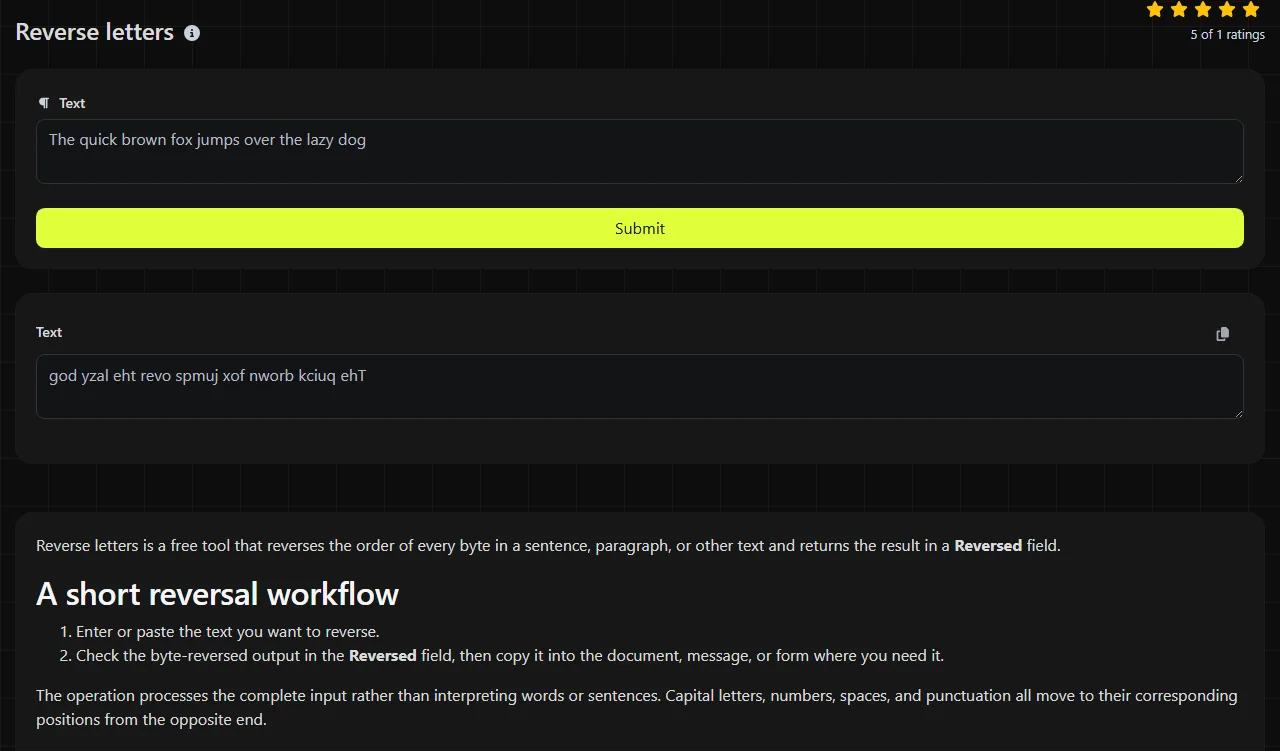
Reverse letters is a free tool that reverses the order of every byte in a sentence, paragraph, or other text and returns the result in a Reversed field.
A short reversal workflow
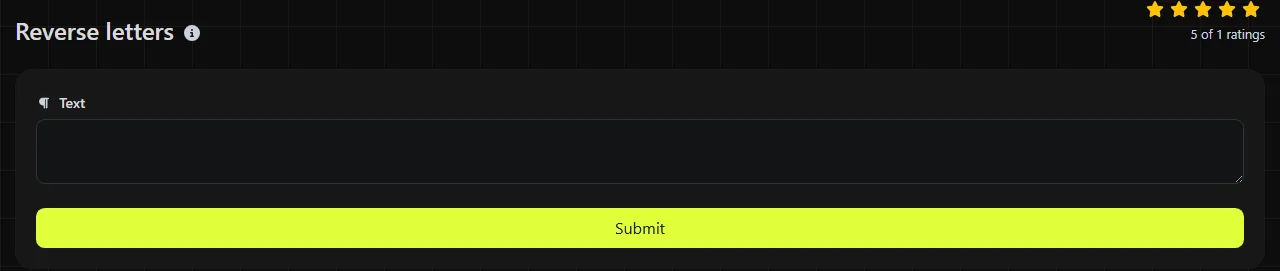
- Enter or paste the text you want to reverse.
- Check the byte-reversed output in the Reversed field, then copy it into the document, message, or form where you need it.
The operation processes the complete input rather than interpreting words or sentences. Capital letters, numbers, spaces, and punctuation all move to their corresponding positions from the opposite end.
- Order #482 ready! becomes !ydaer 284# redrO.
- Meet at 5:30. becomes .03:5 ta teeM.
- red, amber, green becomes neerg ,rebma ,der.
A practical habit is to include punctuation in the pasted text before reversing it. Adding a period or quotation mark afterward places it according to normal writing order rather than the reversed sequence.
Where can backward lettering save manual work?
Backward lettering saves time when a task requires an exact byte-by-byte reversal that would be tedious and error-prone to type manually.
- Create a short word puzzle or clue for a Discord channel, Slack message, classroom worksheet, or party game.
- Prepare mirrored-looking Latin text for a Canva graphic or presentation mockup. Actual physical mirroring requires a graphical or rendering transformation rather than letter reversal.
- Generate predictable test data for a website field, search box, or text-processing script.
- Reverse serial numbers and short identifiers when checking whether an internal process preserves character order.
- Inspect a copied spreadsheet value from the opposite end, such as a suffix embedded in a product code.
Reversal does not shorten text to fit an X post, Instagram bio, Slack profile field, or another platform limit. For ordinary ASCII text, the same characters remain, so the character count stays the same.
Character order, delimiters, and Unicode
The underlying PHP strrev operation reverses bytes, including bytes that represent spaces, punctuation, tabs, and line breaks. A comma that originally followed a word may appear before the reversed word, and multiple spaces change sides along with the surrounding text. Numbers reverse like other characters, so 12045 becomes 54021. Empty input produces no reversed content.
There is a significant limitation with accented letters, emoji, and non-Latin writing systems. UTF-8 commonly stores one visible character as multiple bytes, and byte reversal can split those sequences. A UTF-8 decoder may produce replacement characters, and the displayed result may be unreadable. This tool is therefore most predictable with basic ASCII characters such as unaccented English letters, digits, and common punctuation.
Very long or multiline input can also be hard to review because the entire byte sequence is reversed. If line structure matters, reverse one line at a time rather than pasting a full document.
Which reversal operation matches the job?
Choose letter reversal only when every byte should move into opposite order. Use Reverse words when the words should change order while their internal spelling remains intact. For example, reversing the words in blue car parked would produce parked car blue, while reversing its letters produces dekrap rac eulb.
Use Reverse list when rows or list items need to move from bottom to top. Letter reversal is usually the wrong choice for CSV exports, mailing lists, or mail-merge columns because it also reverses delimiters and the contents of every field.
What should you check before pasting the result?
Check that the destination accepts ordinary reversed text and that the result still communicates what you intend. Search engines generally will not treat reversed spelling as the original word, and screen readers may pronounce it as unfamiliar text or a sequence of letters. Reversal is also not encryption and should not be used to conceal private information.
The work is done on the server. Your input travels to the server over HTTPS and is not stored. Even with that handling, avoid submitting passwords, access tokens, private keys, or other live credentials for this server-side reverse-letters operation.
Common questions about reversing letters
Does capitalization move with each letter?
For basic ASCII text, yes. The case of each character remains unchanged while its position moves. For example, AbC becomes CbA.
Can a website reject reversed text?
Yes. A field that expects a valid email address, URL, ZIP code, phone number, or account identifier may reject the result because reversal changes the required structure. Plain comment and message fields are less likely to apply those format rules.
What happens to tabs in reversed input?
Tabs move with the rest of the byte sequence. This can change apparent column alignment when the result is pasted into a text editor, terminal, or spreadsheet cell, so replace tabs with visible separators first if alignment matters.
Can I reverse text without an online tool?
Yes. PHP provides strrev for byte-based reversal, and many programming languages support slicing or character iteration. Be careful when choosing a programming method for emoji or accented text because code points, UTF-8 bytes, and user-perceived characters are different units.
Will backward text work in usernames?
Only if the service accepts every character in the result and the username is still available. Reversing an existing username does not preserve mentions, profile links, or account identity, and some services restrict punctuation or spacing.
Popular tools
Create a WhatsApp chat link from a phone number, with an optional prefilled message.