HTML tags remover
Easily remove all HTML tags from a block of text.
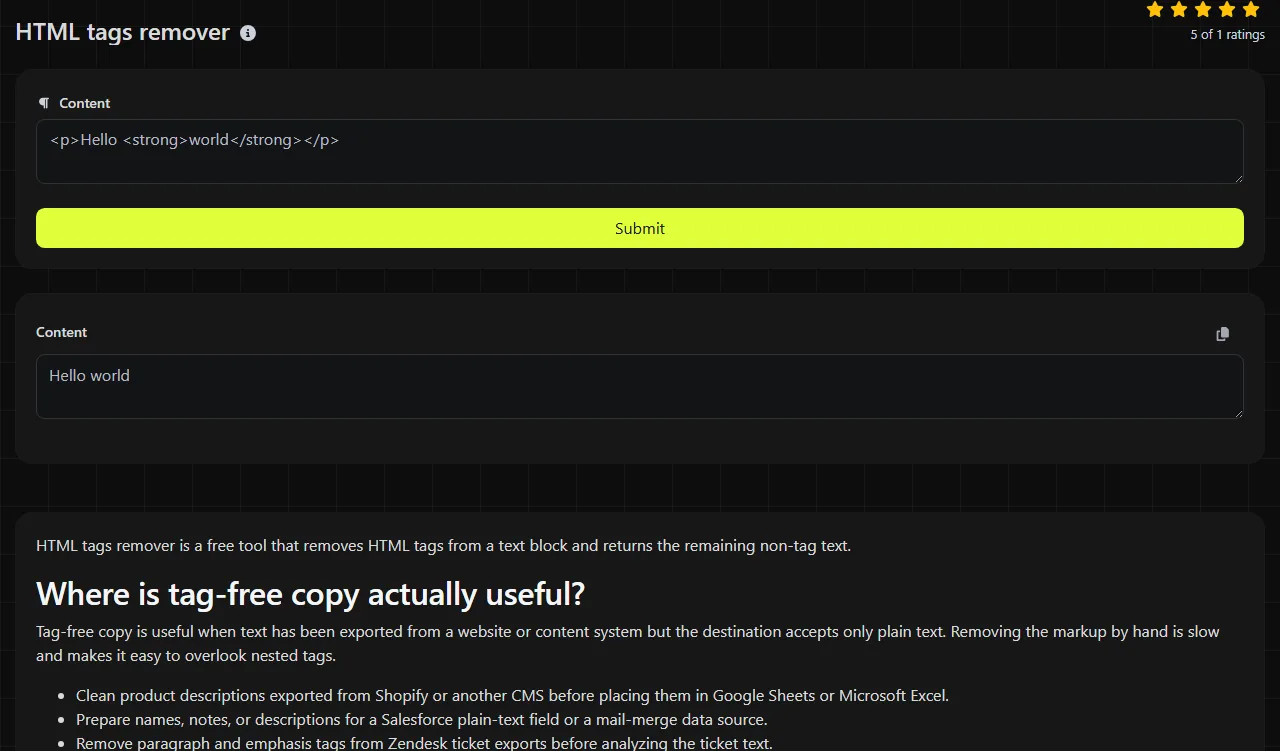
HTML tags remover is a free tool that removes HTML tags from a text block and returns the remaining non-tag text.
Where is tag-free copy actually useful?
Tag-free copy is useful when text has been exported from a website or content system but the destination accepts only plain text. Removing the markup by hand is slow and makes it easy to overlook nested tags.
- Clean product descriptions exported from Shopify or another CMS before placing them in Google Sheets or Microsoft Excel.
- Prepare names, notes, or descriptions for a Salesforce plain-text field or a mail-merge data source.
- Remove paragraph and emphasis tags from Zendesk ticket exports before analyzing the ticket text.
- Check visible copy for a character-limited field, such as a Google Ads headline or an X post, without counting the markup itself.
- Turn an HTML email excerpt into a plain-text draft for Mailchimp or another email platform.
Tag removal also discards attributes, including the destination in an anchor tag. If you need the links, run the original content through URL extractor before removing its tags.
A short cleanup workflow
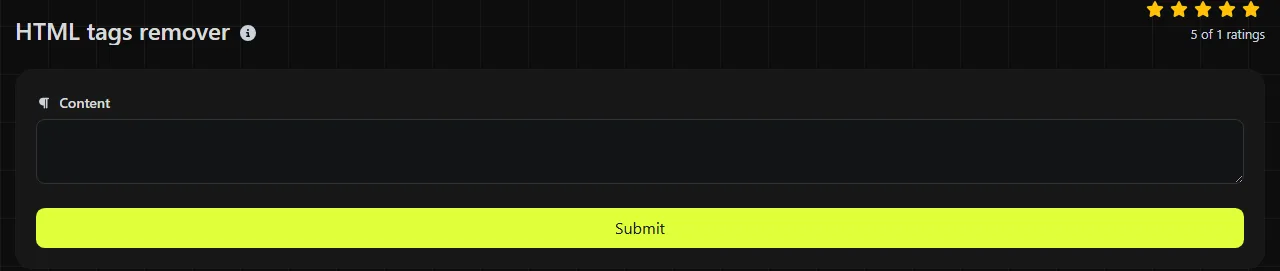
- Paste the block containing HTML into the input area.
- Remove the HTML tags from the submitted text. Content submitted to HTML tags remover travels to the server over HTTPS for processing.
- Review the returned text for joined words, character references, and content that came from script or style elements.
A useful habit is to deal with line-breaking tags before stripping them. If a source uses <br> between addresses or list items, replace those tags with actual line breaks first. Tag stripping removes the tag itself and does not automatically insert a space or newline in its place.
How will nested and awkward markup come out?
Nested tags are removed while ordinary content, numbers, punctuation, and whitespace already present outside the tags remain. The operation uses PHP's strip_tags function.
The input is <article><p>Pickup <em>Friday</em> at 4:30 p.m.</p></article>. The output is Pickup Friday at 4:30 p.m.
The input is Red<br>Blue. The output is RedBlue because the removed break tag is not replaced with whitespace.
The input is <a href="https://example.com/orders">View order 4821</a>. The output is View order 4821. The URL in the attribute is discarded.
Accented letters and non-Latin writing remain when they are text content rather than part of a tag. Malformed markup can produce surprising results because an unmatched angle bracket may make the boundary between markup and content unclear. Check any source that contains mathematical notation, template syntax, or literal angle brackets.
Can stripped copy be treated as safe or fully decoded?
No. Removing tags is a text-cleanup step. It does not provide complete HTML parsing, character-reference decoding, or security sanitization.
For example, an ampersand written as the named character reference & remains a character reference rather than becoming an ampersand. The same issue applies to named character references such as , which represents a nonbreaking space. Script and style tags are removed, but the text between those tags may remain in the result. This can leave JavaScript or CSS content mixed into the visible copy.
Do not use tag stripping by itself as protection against cross-site scripting. Applications that accept untrusted HTML need context-appropriate escaping or a maintained HTML sanitization library. If the immediate goal is only to measure the cleaned copy, Text size calculator can help after you have reviewed the result.
Questions people ask about stripping HTML
Will emoji survive tag removal?
Emoji are text characters, so tag removal does not target them. Their appearance still depends on the destination platform, operating system, and available emoji support.
Is the submitted content stored?
HTML tags remover does the work on the server, and the submitted content travels there over HTTPS. The submitted content is not stored. Avoid submitting sensitive material when organizational policy prohibits sending it to an external server.
Why does the cleaned result still exceed a field limit?
Character references, line breaks, nonbreaking spaces, other invisible characters, and multi-code-point grapheme clusters can affect a platform's count. Review the cleaned text in the destination itself before publishing, since each platform applies its own counting and validation rules.
Popular tools
Create a WhatsApp chat link from a phone number, with an optional prefilled message.