Text to speech
Use the Google Translate API to convert text to speech.
Text to speech is a free tool that sends text and a language code to a server and returns generated speech audio you can listen to.
What does speech synthesis produce?
Speech synthesis produces an audio rendering of the submitted text rather than a translation or rewritten version. The language code tells the speech service which language rules to apply when pronouncing the text.
For example, submitting "Your appointment is Tuesday at 10:15 AM" with an English language code should produce audio that reads that sentence aloud in English. If you submit the same English sentence with a Spanish language code, the service may apply Spanish pronunciation rules to the English words. It does not automatically translate the sentence into Spanish.
The result is intended for listening. Do not assume that the page creates a downloadable audio file or provides editing controls unless those options appear with the generated result.
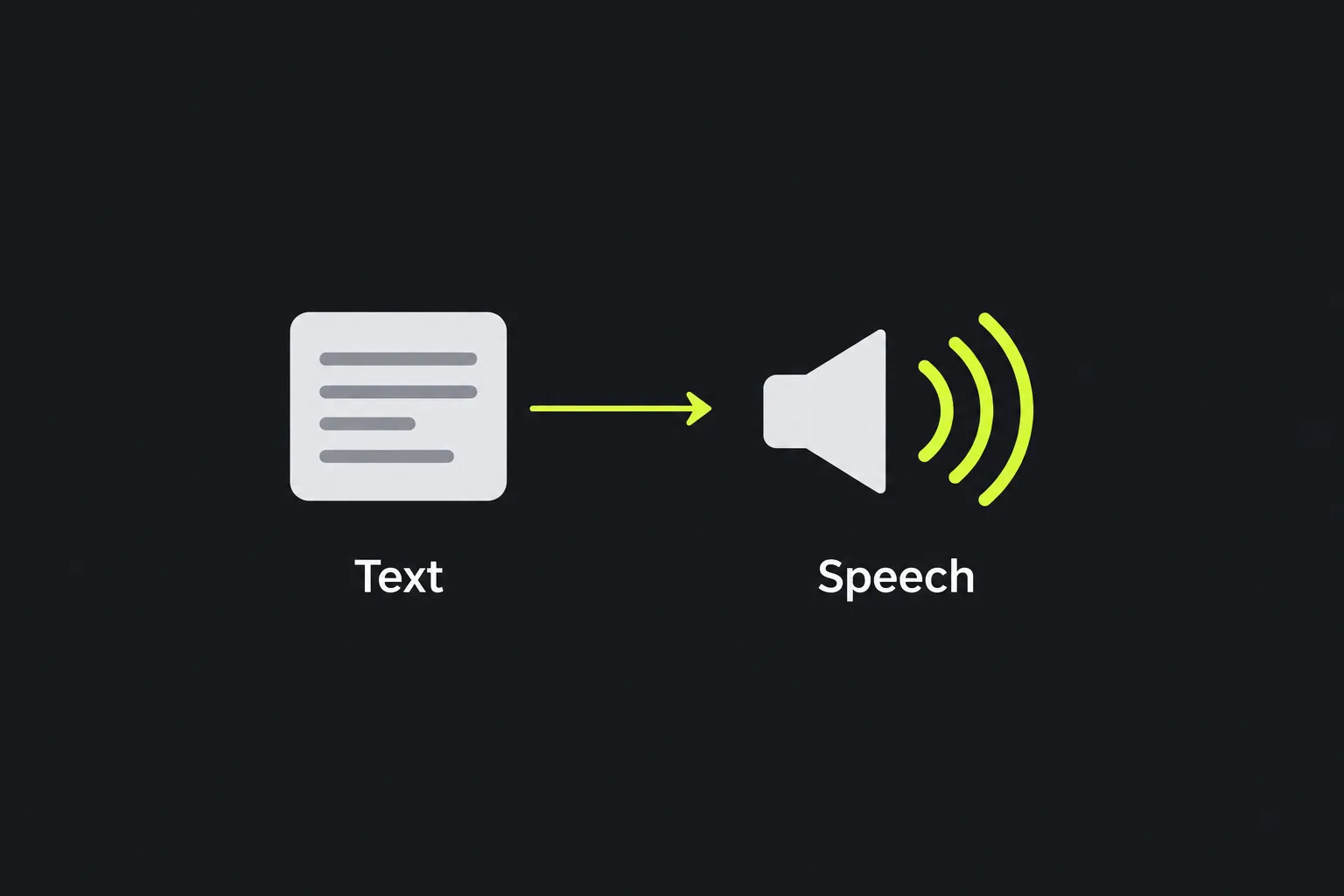
A practical conversion workflow
- Set the Language code to match the language of the text. Common language codes include forms such as en for English, es for Spanish, and fr for French, though accepted codes depend on the speech service.
- Generate the speech and listen to the result.
- Check names, numbers, abbreviations, and mixed-language phrases before using the audio in another project.
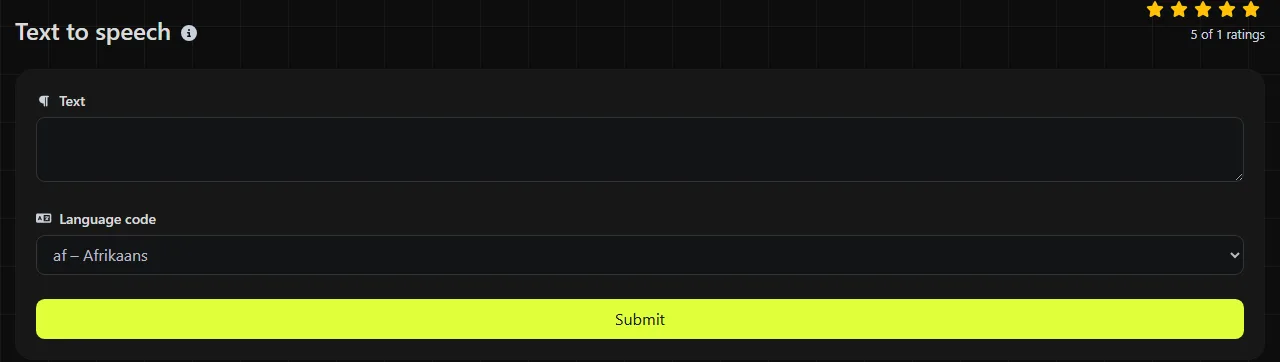
The server calls the PHP functions htmlspecialchars, rawurlencode, and strlen.
The text travels to the server over HTTPS, and it is not stored. Speech generation uses the Google translator API, so avoid submitting confidential material that should not be processed through an external speech service.
How can I make synthesized speech easier to understand?
You can usually make synthesized speech easier to understand by writing for the ear and checking how ambiguous text is interpreted. A sentence that looks clear on a screen may sound confusing when punctuation, capitalization, or visual formatting is removed.
- Write unusual abbreviations in full when their pronunciation matters. "Estimated arrival time" is less ambiguous than "ETA."
- Add punctuation where a speaker would naturally pause. Compare "After lunch call Jordan" with "After lunch, call Jordan."
- Write dates in an unambiguous form. "October 6, 2026" is clearer for a U.S. audience than "10/6/26."
- Spell out symbols when needed. "Five percent" is more predictable than "5%," especially in a dense sentence.
- Separate long passages into shorter sections. This makes pronunciation errors easier to find.
Numbers can be read as quantities, years, times, phone numbers, or individual digits depending on context. A sequence such as "2026" may be spoken as a year, while an account number may need spaces between digits. URLs, email addresses, product codes, and mathematical notation are also likely to need rewriting for spoken delivery.
Where does generated narration fit into a real task?
Generated narration fits tasks that need a quick spoken reference, pronunciation check, or audio version of a short passage. It is especially useful before recording a human voice, when changing the script is still inexpensive.
- Read a YouTube narration draft aloud to find sentences that are too long or awkward to say.
- Check how an event announcement may sound before reading it during a Zoom meeting or webinar.
- Create a listening reference for vocabulary, travel phrases, or short language-learning exercises.
- Proofread website copy by listening for missing words that are easy to overlook on the screen.
Generated speech can also provide a rough audio alternative while drafting accessible content. It is not a substitute for proper accessibility testing, accurate transcripts, captions, or screen-reader checks. A speech engine reading one block of text does not reproduce the navigation and semantic information that assistive technology uses on a web page.
What should I check when the voice sounds wrong?
Check the language code first, then simplify the part of the text that was pronounced incorrectly. A valid code should match the actual language, and a regional form may not be accepted if the service expects a shorter code.
Punctuation can influence pauses, but speech engines do not interpret every comma, dash, quotation mark, or line break in the same way a human narrator would. Accented and non-Latin characters can be URL-encoded for transmission, but correct pronunciation still depends on language support and the selected code. Text containing several languages may sound inconsistent because one language setting cannot reliably supply the pronunciation rules for every phrase.
Empty input cannot provide meaningful speech, while whitespace-only input may produce no useful result.
Questions people ask about speech synthesis
Can text-to-speech audio reproduce a particular person's voice?
No. This tool generates speech through the Google translator API and does not state that it can clone, upload, or imitate a chosen person's voice. Voice cloning is a separate process that generally requires voice samples, and users should obtain explicit permission from the speaker.
Why does a regional accent sound different from what I expected?
A language code does not necessarily provide detailed control over accent, speaker, pitch, or speaking style. Some speech services distinguish regional variants, while others map several codes to the same available voice. If regional pronunciation matters, verify the audio rather than relying on the code alone.
Will copied text from a PDF read correctly?
It may contain hidden line breaks, repeated headers, or words split with hyphens at the ends of lines. Paste the text into a plain-text editor first and remove those artifacts. Otherwise, the speech engine may pause in odd places or pronounce each half of a split word separately.
Can I submit HTML or other markup?
Do not assume markup will be interpreted as speech instructions. The implementation calls htmlspecialchars, but the available tool information does not say that it supports HTML, XML, or specialized speech markup. Submit ordinary readable text unless the interface explicitly documents another format.
What text should I avoid entering?
Because input is sent over HTTPS to the server and generation relies on an external speech API, avoid passwords, private messages, medical details, financial account information, unpublished business material, and other sensitive content. The input is not stored. Use a local, offline speech engine when the text must remain entirely on your own device.
Popular tools
Create a WhatsApp chat link from a phone number, with an optional prefilled message.