Text separator
Change how text is separated using line breaks, commas, periods, or other separators.

Text separator is a free tool that replaces the delimiter between text items with a new line, a space, or another separator you specify.
What does a separator do to a list?
A separator marks where one item ends and the next begins. Common separators include commas, periods, spaces, line breaks, pipes, and semicolons.
Changing the separator can make the same data suitable for a different field or application. A pipe-delimited inventory list can become comma-separated text, while a comma-separated list can become one item per line for easier review.
A quick separator change
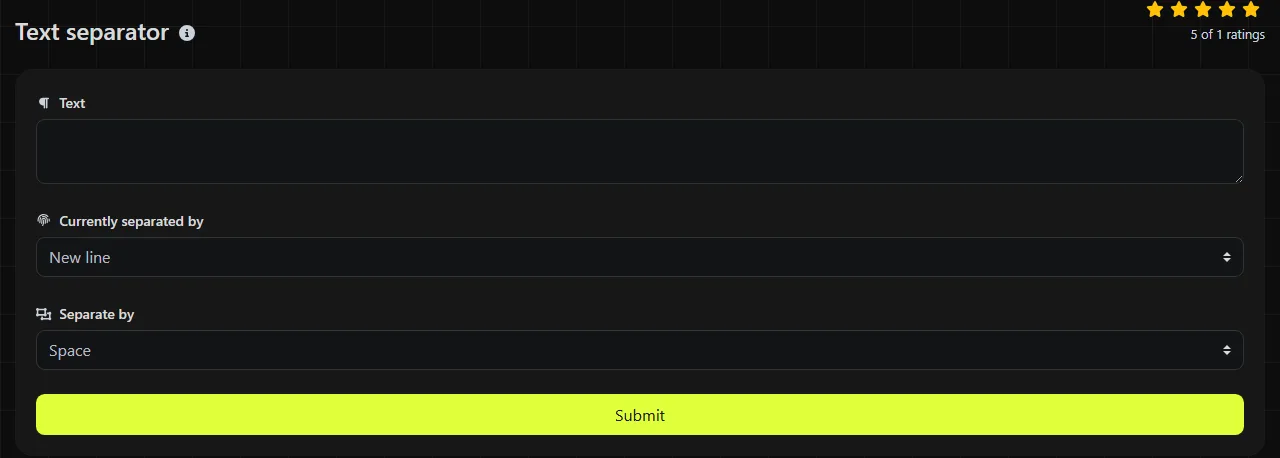
- Paste or enter the text you want to reorganize.
- Set Currently separated by to the existing delimiter, then set Separate by to the replacement. Choose New line or Space when appropriate.
- Submit the text and verify that the existing separator was replaced as intended before copying the result into the destination.
For example, the input apples|pears|plums with a pipe as the current separator and a comma as the replacement produces apples,pears,plums.
The input ORD-17.ORD-18.ORD-19 with a period as the current separator and a space as the replacement produces ORD-17 ORD-18 ORD-19.
Data cleanup in familiar workflows
Separator conversion is useful when two systems expect the same values in different layouts. Typical examples include:
- Turning a column copied from Microsoft Excel or Google Sheets into a comma-separated list for a search or filter field.
- Changing pipe-delimited SKU values from an inventory export into one SKU per line for a bulk lookup form.
- Putting campaign tags on separate lines so they are easier to inspect before a Mailchimp import.
- Converting a line-based product tag list into comma-separated values for a Shopify CSV workflow.
- Changing a comma-separated set of issue numbers into spaces for a plain-text message in Slack or Microsoft Teams.
Try two or three records before converting a large export. A small sample often reveals an unexpected comma inside an address or a period inside a product description before it affects the full list.

What can go wrong with punctuation and spaces?
A delimiter causes trouble when the same character also appears inside a value. If a comma separates records, Portland, OR is ambiguous because the comma may be part of the address rather than a record boundary.
Check these cases before using the result:
- Consecutive delimiters may indicate blank values in the source data.
- Spaces before or after a delimiter may belong to the original item. Review them rather than assuming they are formatting.
- Periods are a poor choice when values contain sentences, decimal numbers, domain names, or file extensions.
- CSV data may contain quoted commas and embedded line breaks. A simple separator change does not replace a proper CSV parser.
- Numeric-looking IDs can change after pasting into Excel or Google Sheets. Format the destination cells as text first if leading zeros matter.
Empty input has nothing to separate. For very long data sets, converting a column within a spreadsheet may be easier because you can inspect neighboring fields and undo changes.
Is pasted text processed only in your browser?
No. The text travels to the server over HTTPS, the work is performed there, and the input is not stored.
HTTPS protects data while it is in transit, but server-side processing may still conflict with rules for passwords, health information, customer records, or confidential company data. Follow the applicable data-handling policy before pasting sensitive material into the separator.
Questions people often ask
Can I use the result in an SQL IN clause?
The tool can arrange values with commas, but it does not add SQL quoting or escape unsafe characters. SQL character string literals generally need single quotes, but parameter values should not be manually quoted. Database input should use parameterized queries rather than pasted, untrusted data.
Can this tool find email addresses inside a paragraph?
No. Separator conversion works with an existing delimiter and does not identify email address patterns in mixed prose. Use Email extractor when the source contains sentences, signatures, or other surrounding text.
How do I remove repeated values after separating a list?
Separator changes do not identify duplicates. Convert the values to one item per line, inspect the output for unintended blank lines, and then use Duplicate lines remover.
Should I use commas or semicolons for spreadsheet data?
Comma-separated values are common in the United States, but some spreadsheet and regional settings use semicolons. Check the import dialog or the receiving system's documentation before choosing, especially when decimal commas appear in the data.
Before using the converted text, compare the item count with the source and inspect values that contain the old or new separator.
Popular tools
Create a WhatsApp chat link from a phone number, with an optional prefilled message.