Slug generator
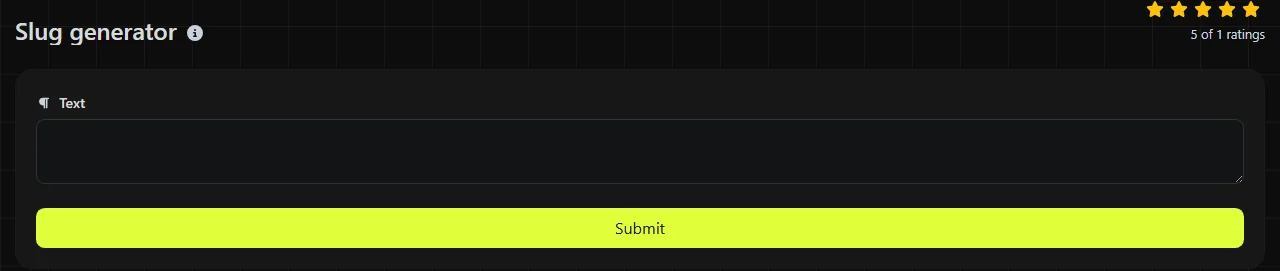
Generate a URL slug for any string input.

Slug generator is a free tool that converts a title or other text into a URL slug for use in web addresses.
What is a slug in a URL?
A slug is the readable part of a URL that identifies a specific page, product, article, or category. In a URL such as example.com/guides/planting-tomatoes, the slug is planting-tomatoes.
Slugs commonly use short descriptive words separated by hyphens. Spaces and some punctuation need special encoding in URLs, so replacing them with a consistent separator makes an address easier to read, type, and manage. A clear slug also tells visitors what to expect before they open the page.
Turning a title into a publishable path
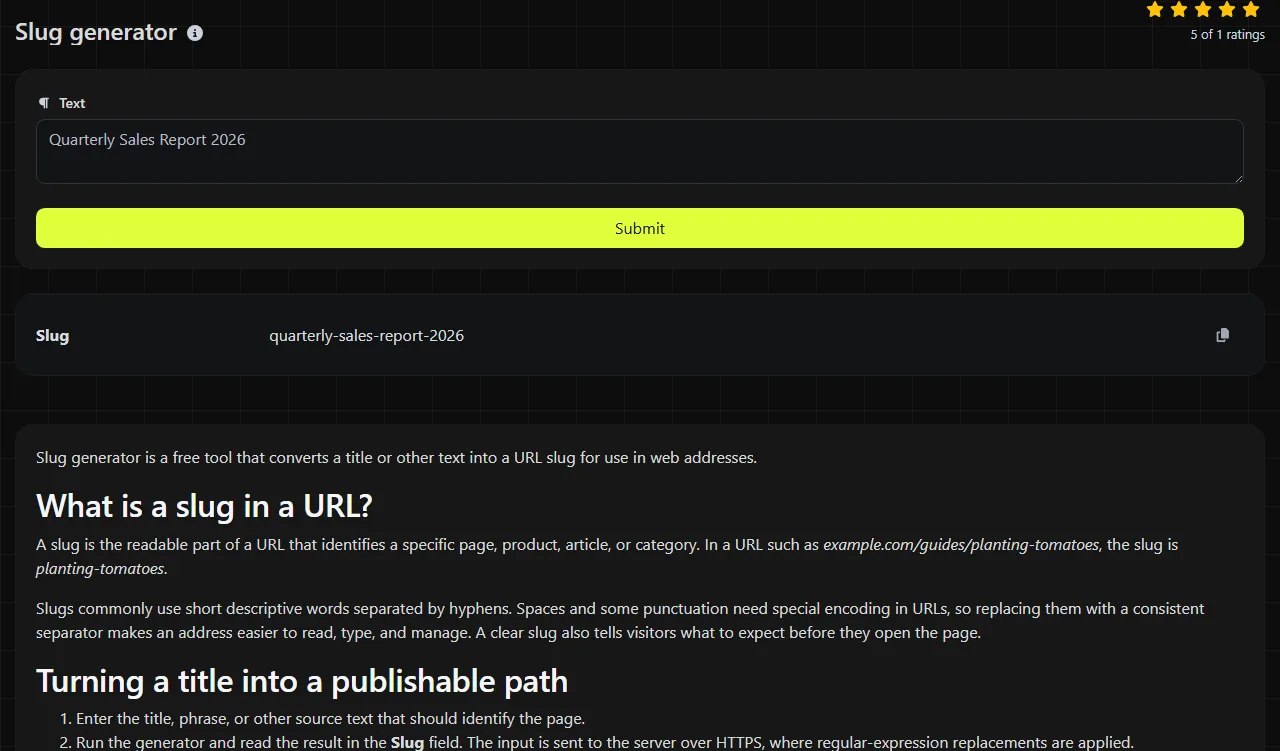
- Enter the title, phrase, or other source text that should identify the page.
- Run the generator and read the result in the Slug field. The input is sent to the server over HTTPS, where regular-expression replacements are applied.
- Review the generated slug for meaning, then copy it into the appropriate field in your publishing platform.
For example, a page titled 2026 Fall Menu (Downtown) could use 2026-fall-menu-downtown. A support article called Returns & Refunds for U.S. Orders could use returns-refunds-us-orders. These examples show useful target formats rather than guaranteeing how every punctuation mark will be treated automatically.
When does a slug generator save editing time?
A slug reduces repetitive editing when you create many pages from titles, product names, or imported records. It is especially useful when source text contains spaces, capitalization, and punctuation that you would otherwise clean by hand.
- Paste generated slugs into the permalink field in WordPress.
- Prepare URL handles for product and collection pages in Shopify.
- Standardize CMS entries in Webflow before publishing a batch of landing pages.
- Clean article names copied from a spreadsheet before a content migration.
- Create predictable documentation paths for GitHub Pages or another static site.
A practical habit is to generate all slugs before importing a spreadsheet, then scan the finished column for duplicates. Duplicate slugs are easier to fix before the CMS starts adding numeric suffixes or rejecting rows.
Which slug belongs in each publishing field?
Use only the final path segment when a platform asks for a slug or URL handle, and use the complete address only when it explicitly asks for a full URL. For example, enter winter-running-guide in a slug field rather than https://example.com/winter-running-guide.
WordPress may display the field as a permalink segment, while Shopify commonly uses a URL handle. Static-site systems may derive the path from a filename or front matter. Check whether the platform adds the surrounding folder, trailing slash, or file extension automatically.
There is no universal maximum slug length. If a CMS has a field limit, use Text size calculator to check the draft before importing it. If copied source text contains HTML markup, clean it with HTML tags remover first.
How should you review spaces, accents, and unusual input?
Review unusual input by comparing the generated slug with the words a person should see in the final address. Slug systems vary in how they transliterate accented letters, preserve non-Latin scripts, remove symbols, or handle repeated separators, so do not assume every CMS will produce the same result.
- Spaces and tabs: These commonly become separators because literal spaces otherwise appear as percent-encoded characters in a URL.
- Punctuation: Apostrophes, quotation marks, parentheses, and symbols often add no meaning and may be removed.
- Numbers: Keep numbers when they identify a year, model, version, or numbered procedure.
- Empty input: An empty slug does not provide a useful page identifier and may cause the platform to derive one from another field.
- Very long input: Remove repeated wording and details that do not help distinguish the page.
No generator can decide whether a word is factually useful, sensitive, or likely to change. Check names, dates, SKU values, and internal terms included in the slug before publishing.
Questions people ask about URL slugs
Can two pages use the same slug?
They can use the same final slug under different parent paths, such as /news/releases and /company/releases. Two pages cannot normally occupy the same complete URL, so a CMS may reject the duplicate or append a number.
What happens if I change a published slug?
Changing a published slug changes the page URL and can break bookmarks, backlinks, analytics continuity, and links elsewhere on your site. Configure a permanent redirect from the old URL to the new one whenever the platform supports redirects.
Can a slug include emoji?
URLs can represent emoji through percent-encoded UTF-8 bytes, but the resulting address may be long and difficult to copy between systems. Emoji can also create accessibility and compatibility problems, so descriptive words are usually a safer choice.
Are non-English words suitable for slugs?
Yes, modern URLs can represent Unicode characters, including non-Latin writing systems. Choose wording that matches the page language and intended audience, while checking how the CMS displays, encodes, and exports those characters.
Is the text entered into this tool stored?
No. The input travels to the server over HTTPS because processing occurs there, but it is not stored. Avoid placing confidential information in a public URL slug anyway, since the finished address may appear in browser history, analytics, search results, and server logs.
Final checks
Before publishing, confirm that the slug is descriptive, free of private information, and unique within its intended path. Preview the complete URL, verify any redirect needed for an existing page, and save the final slug alongside the content record used for imports or future updates.
Popular tools
Create a WhatsApp chat link from a phone number, with an optional prefilled message.