SHA-3/512 generator
Generate a SHA-3/512 hash for any string input.
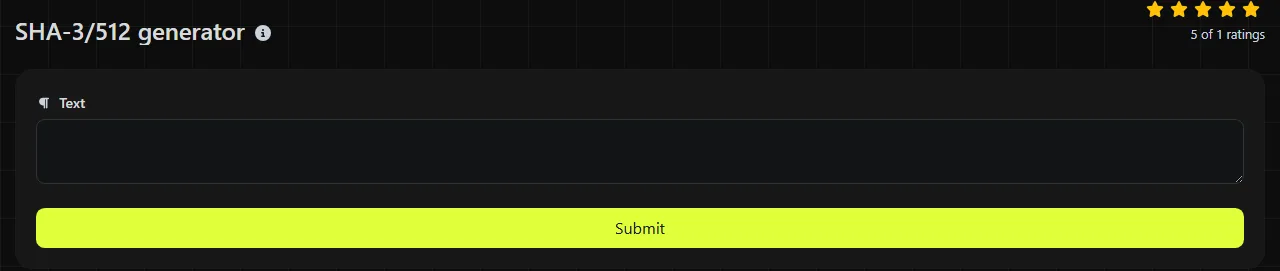
SHA-3/512 generator is a free tool that converts string input into a 512-bit SHA-3 cryptographic hash.
What does a SHA-3/512 digest tell you?
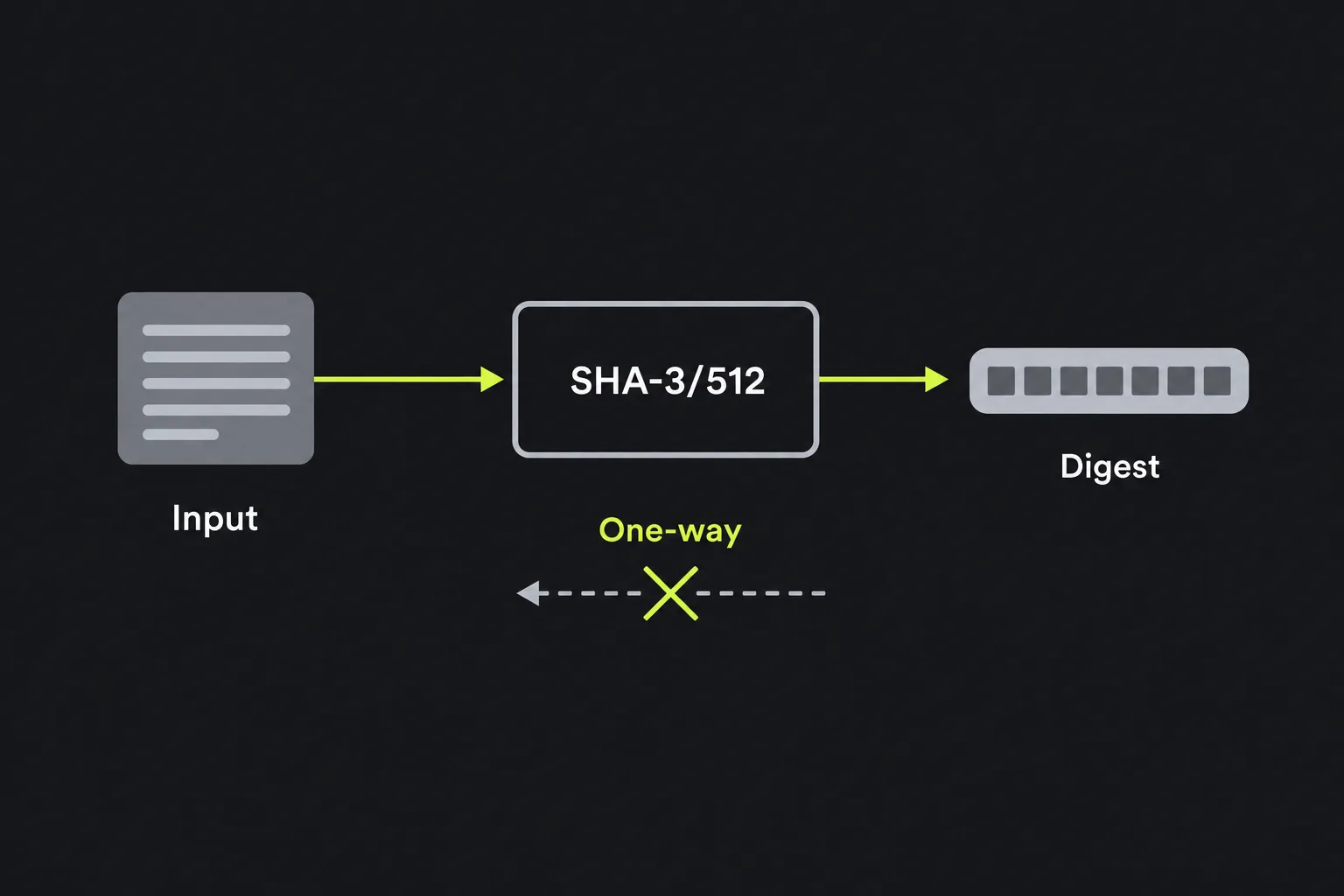
A SHA-3/512 digest is a fixed-length fingerprint of the input data. SHA-3/512 accepts data of almost any length and produces a fixed-length 512-bit result. SHA-3/512 is one-way, so its digest does not contain an encrypted copy of the original input.
SHA-3/512 cannot be decrypted or directly reversed. It is possible to guess an input, hash that guess, and compare the result, which is why hashes of short or predictable values can still be discovered through brute force or lookup databases. This does not amount to decrypting the digest.
SHA-3/512 produces 512 bits, or 64 bytes. It is commonly displayed as 128 hexadecimal characters because each byte requires two hexadecimal characters. With SHA-3/512, the same bytes produce the same digest, while even a one-byte change normally produces a very different result.
Why did NIST standardize SHA-3/512?
NIST standardized SHA-3/512 in 2015 as part of FIPS 202, following a public cryptographic competition that selected Keccak in 2012. Keccak was designed by Guido Bertoni, Joan Daemen, Michaël Peeters, and Gilles Van Assche. SHA-3 gave applications a standardized hash family based on a different internal design from SHA-2.
SHA-3 uses a sponge construction, while SHA-512 from the SHA-2 family uses a different structure. Despite the similar names and identical 512-bit digest length, SHA-3/512 and SHA-512 produce unrelated results.
Standardized SHA-3 also differs from the original Keccak submission in its domain-separation and padding details. A value labeled Keccak-512 should not be compared with a SHA-3/512 value. They are separate algorithms.
Where is SHA-3/512 appropriate today?
SHA-3/512 is appropriate when a system specifically requires a 512-bit SHA-3 digest or when a new design calls for the SHA-3 family. It is still considered secure and is neither broken nor deprecated. Its design provides a 256-bit collision-security target and a 512-bit preimage-security target under the usual assumptions for an ideal hash.
Legitimate uses include:
- Comparing checksums to detect accidental changes to data
- Creating content identifiers for deduplication systems
- Maintaining compatibility with databases, APIs, or protocols that require SHA-3/512
- Building a cryptographic protocol whose specification explicitly names SHA-3/512
A plain SHA-3/512 digest does not prove who created the data. An attacker who can replace both the data and its published SHA-3/512 checksum can calculate a new SHA-3/512 checksum. Because plain SHA-3/512 is unkeyed, use a digital signature or a keyed message authentication code when authenticity matters.
Do not use SHA-3/512 by itself to store passwords. It is designed to process data efficiently, which also allows attackers to test password guesses quickly. Instead of SHA-3/512, password storage requires a salted, deliberately expensive password-hashing scheme. The Bcrypt generator is the relevant related tool when bcrypt is required.
Choosing a SHA-3 digest size
Choose SHA-3/512 when the protocol or storage format you need to support requires its 512-bit digest. SHA-3/512 returns the longest standard digest in the SHA-3 fixed-output family, but a longer value is not automatically the right choice for every application.
- SHA-3/256 generator produces a 256-bit digest represented by 64 hexadecimal characters. It fits systems that specify SHA-3/256 or need smaller stored identifiers.
- SHA-3/384 generator produces a 384-bit digest represented by 96 hexadecimal characters. Use it only when the receiving format expects that variant.
- SHA-3/512 generator produces a 512-bit digest represented by 128 hexadecimal characters. It fits specifications that explicitly request SHA-3/512.
The listed SHA-3 variants are not interchangeable with SHA-3/512. A SHA-3/256 digest is not simply the first 256 bits of a SHA-3/512 digest because each variant uses different sponge parameters.
How are spaces, Unicode, and empty input treated?
SHA-3/512 hashes the exact bytes supplied to it, so spaces, punctuation, encoding choices, and invisible characters affect the digest. This SHA-3/512 tool passes the supplied string bytes to PHP's hash implementation without trimming text, normalizing Unicode, or interpreting numbers.
- Input "order-1042" produces one 128-character hexadecimal digest. "Order-1042" produces another because letter case changed.
- Input "45" hashes the two character bytes representing 4 and 5 when it is supplied as text. It is different from hashing a binary integer value.
- A SHA-3/512 hash of input with a trailing space differs from the hash of the same visible text without that space.
- Empty input has a valid SHA-3/512 digest. It does not mean that no calculation occurred.
- SHA-3/512 hashes accented and non-Latin characters according to their byte encoding. Visually identical Unicode text can have different byte sequences if one version uses composed characters and another uses combining marks.
After the request is processed, the tool returns the SHA-3/512 Hash as a hexadecimal value. For matching results between systems, confirm that both sides use SHA-3/512, the same character encoding, and exactly the same input bytes.
Questions people often ask about SHA-3/512
Does SHA-3/512 include a salt?
No. SHA-3/512 is a general-purpose hash function and has no built-in salt field. This tool provides no option to add a salt or combine additional data with the input, and SHA-3/512 by itself is not a suitable password-storage scheme.
Is SHA-3/512 vulnerable to length-extension attacks?
SHA-3's sponge construction is not vulnerable to the classic length-extension attack that applies to some Merkle-Damgård hashes. This does not make an unkeyed SHA-3 digest an authentication code. Because an unkeyed SHA-3/512 digest cannot authenticate a sender, use a standardized keyed construction when a recipient must verify authenticity.
Can I shorten a SHA-3/512 digest?
Truncating the 512-bit SHA-3/512 output reduces its 256-bit collision-security and 512-bit preimage-security margins and can break compatibility. If a standard SHA-3/256 result is required, calculate SHA-3/256 directly rather than cutting a SHA-3/512 value in half.
Can two different inputs have the same SHA-3/512 hash?
Yes in theory, because infinitely many possible inputs map to a finite set of digests. Such an event in SHA-3/512 is called a collision. No practical collision attack is known against full SHA-3/512, but hash equality should still be treated as extremely strong evidence of matching data rather than mathematical proof.
Final checks
Before comparing values, confirm that both are labeled SHA-3/512, contain the expected 128 hexadecimal characters, use the same input encoding, and account for any hidden whitespace. This tool processes string input on the server. The input travels to the server over HTTPS and is not stored, so avoid submitting confidential material if server-side processing is not acceptable for your use case.
Popular tools
Create a WhatsApp chat link from a phone number, with an optional prefilled message.