SHA-224 generator
Generate a SHA-224 hash for any string input.
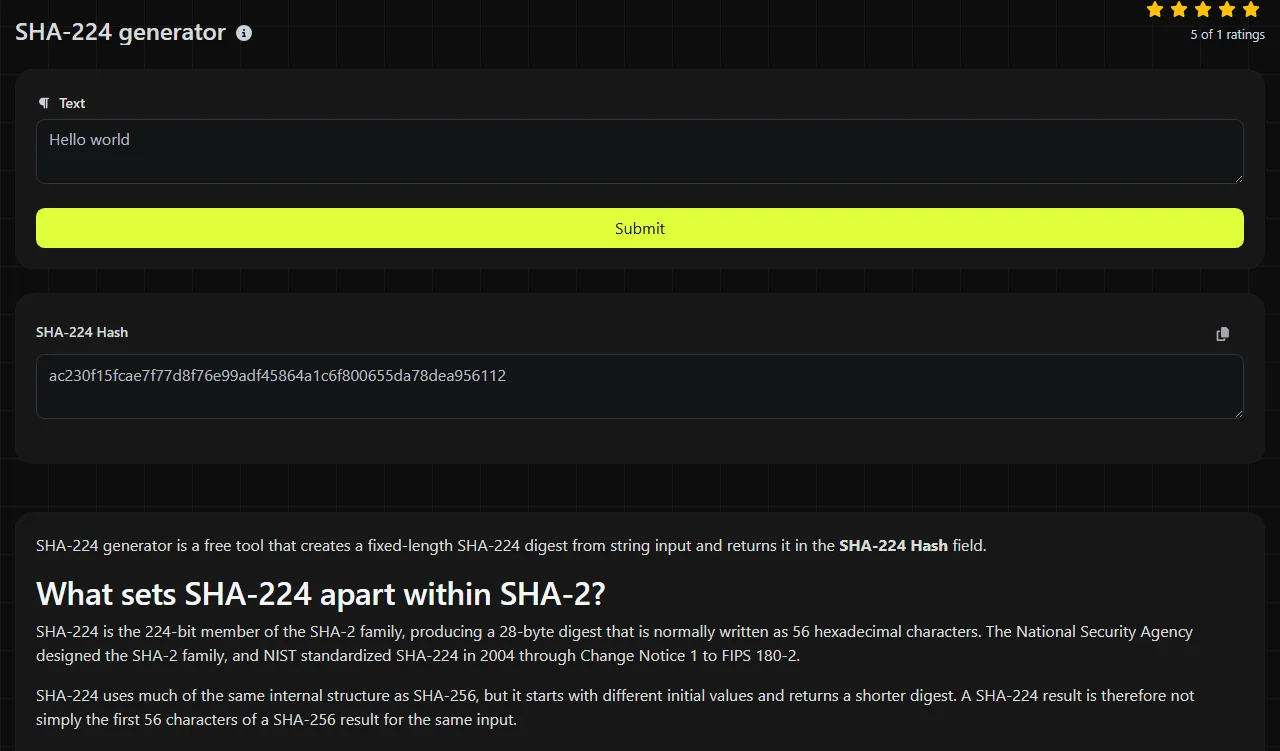
SHA-224 generator is a free tool that creates a fixed-length SHA-224 digest from string input and returns it in the SHA-224 Hash field.
What sets SHA-224 apart within SHA-2?
SHA-224 is the 224-bit member of the SHA-2 family, producing a 28-byte digest that is normally written as 56 hexadecimal characters. The National Security Agency designed the SHA-2 family, and NIST standardized SHA-224 in 2004 through Change Notice 1 to FIPS 180-2.
SHA-224 uses much of the same internal structure as SHA-256, but it starts with different initial values and returns a shorter digest. A SHA-224 result is therefore not simply the first 56 characters of a SHA-256 result for the same input.
Full SHA-224 is not considered broken. Its expected collision resistance is about 112 bits, compared with about 128 bits for SHA-256. SHA-224 remains suitable for many checksum and compatibility tasks, although SHA-256 is more widely supported and is generally the better choice when a 256-bit digest is accepted.
What happens after I submit an input?
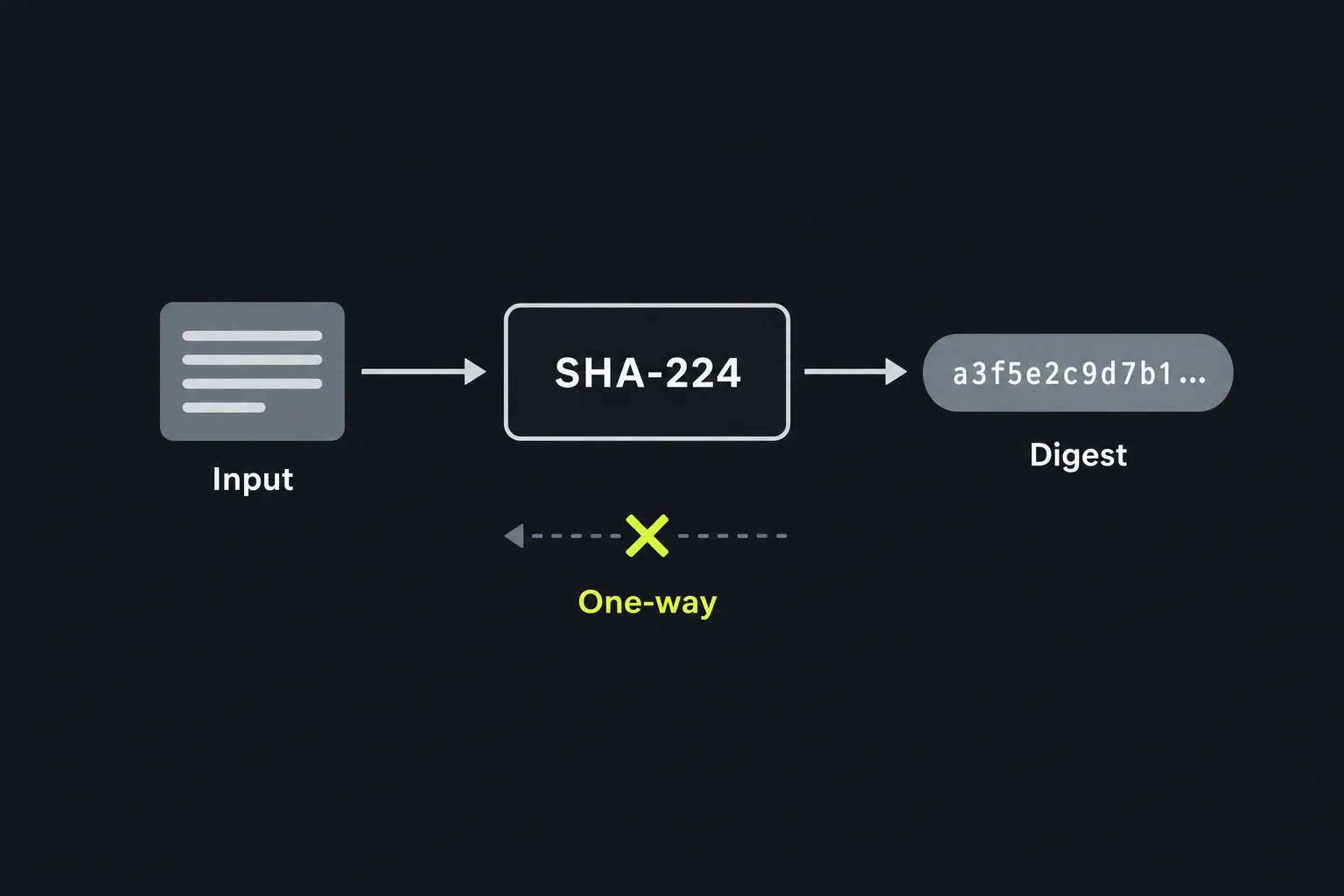
The tool sends the input to the server over HTTPS, where the PHP hash function calculates the SHA-224 digest. The input is not stored, but it does leave your device because the calculation takes place on the server.
SHA-224 converts data into a fixed-length 224-bit fingerprint. It is one-way, so it does not contain instructions for reconstructing the input, and inputs of different lengths still produce SHA-224 digests of exactly the same length. SHA-224 hashing is different from encryption because there is no decryption key.
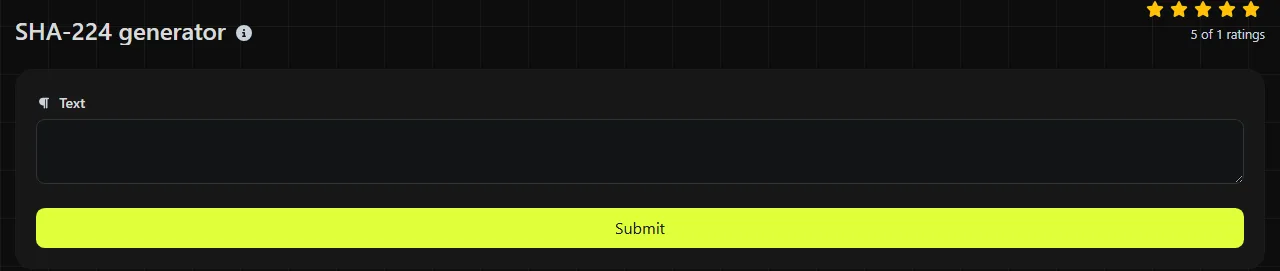
- Enter the string you want to hash with SHA-224.
- Submit the input for server-side SHA-224 processing.
- Copy the 56-character value from the SHA-224 Hash field.
- Record the algorithm name with the digest so another person does not mistake it for SHA-1 or SHA-256.
Do not submit passwords, private keys, access tokens, or regulated data to this SHA-224 generator if your policy prohibits sending that information to a server, even over HTTPS.
How should I read a SHA-224 digest?
A SHA-224 digest is a 224-bit value represented by 56 hexadecimal characters using the digits 0 through 9 and letters a through f. The digest does not directly encode the input's length, language, file type, or meaning.
SHA-224 cannot be decrypted or reversed in the way encrypted data can. If the original input comes from a small or predictable set, however, someone can hash likely candidates and compare the results. That is why an unsalted SHA-224 password digest can often be attacked with dictionaries or previously computed lists even though the hash function itself has no reverse operation.
Matching SHA-224 digests provide strong evidence that two inputs are the same, but a plain SHA-224 checksum does not prove who created the data. A SHA-224 checksum also does not prevent an attacker from replacing both a file and its published checksum.
Current uses and limitations
SHA-224 still appears where a shorter SHA-2 digest is required by an existing protocol, data format, device, or application. Its possible legitimate uses include:
- Checking whether downloaded or transferred data changed in transit.
- Finding probable duplicate records or content by comparing stored digests.
- Maintaining compatibility with systems that explicitly identify SHA-224.
- Creating compact content identifiers when 224 bits satisfy the system's security requirements.
Do not use plain SHA-224 to store passwords. SHA-224 is designed to run quickly, which also lets attackers test password guesses quickly. Instead of SHA-224, password storage should use a dedicated password-hashing scheme such as Argon2id, scrypt, or bcrypt with an appropriate salt and cost setting.
For a new checksum format with no SHA-224 requirement, SHA-256 is usually easier to integrate because platform and library support is broader. A SHA-256 generator fits that case. A SHA-1 generator may help with older compatibility checks, but SHA-1 has practical collision attacks and should not be selected for a new security design.
How do exact bytes affect the result?
SHA-224 hashes bytes exactly as supplied into a 224-bit digest, so spaces, punctuation, capitalization, line endings, and character encoding can change the digest. SHA-224 does not trim, normalize, or interpret the data at the algorithm level.
- invoice-1042 and Invoice-1042 are different inputs.
- 007 and 7 are different text representations of a number.
- A trailing space or final newline contributes bytes to the SHA-224 digest even when it is hard to see.
- Accented characters can have visually identical precomposed and decomposed Unicode forms that produce different SHA-224 digests.
- Non-Latin text can be hashed with SHA-224, but two applications must use the same character encoding to reproduce the digest.
The SHA-224 algorithm defines a digest for an empty byte sequence and can process long data incrementally. This page accepts string input.
Frequently asked questions
Is SHA-224 supported by the Web Crypto API?
No. The standard Web Crypto digest algorithms include SHA-256, SHA-384, and SHA-512, but not SHA-224. Browser applications that require SHA-224 generally need a separate vetted implementation or a server-side calculation.
Does changing a file name change its SHA-224 checksum?
Changing only the file name does not change a SHA-224 checksum calculated from the file's contents. Metadata embedded inside the file, such as a document title or image timestamp, is included among the bytes hashed by SHA-224 and can change the digest.
Can I calculate SHA-224 from the command line?
Yes. OpenSSL commonly supports the command openssl dgst -sha224 filename. Command availability depends on the installed OpenSSL build, so check its supported digest list if SHA-224 is rejected.
Does SHA-224 have a standard algorithm identifier?
Yes. The ASN.1 object identifier for SHA-224 is 2.16.840.1.101.3.4.2.4. Some certificate, signature, and protocol formats use that identifier instead of the written algorithm name.
Comparison checklist
Before comparing two SHA-224 values, confirm that both sides used SHA-224, the same character encoding, identical line endings, and the same treatment of spaces or trailing newlines. Expect 56 hexadecimal characters, and retain the original checksum source so you know what data it was intended to verify.
Popular tools
Create a WhatsApp chat link from a phone number, with an optional prefilled message.