Number to words converter
Convert a number to written, spelled out words.
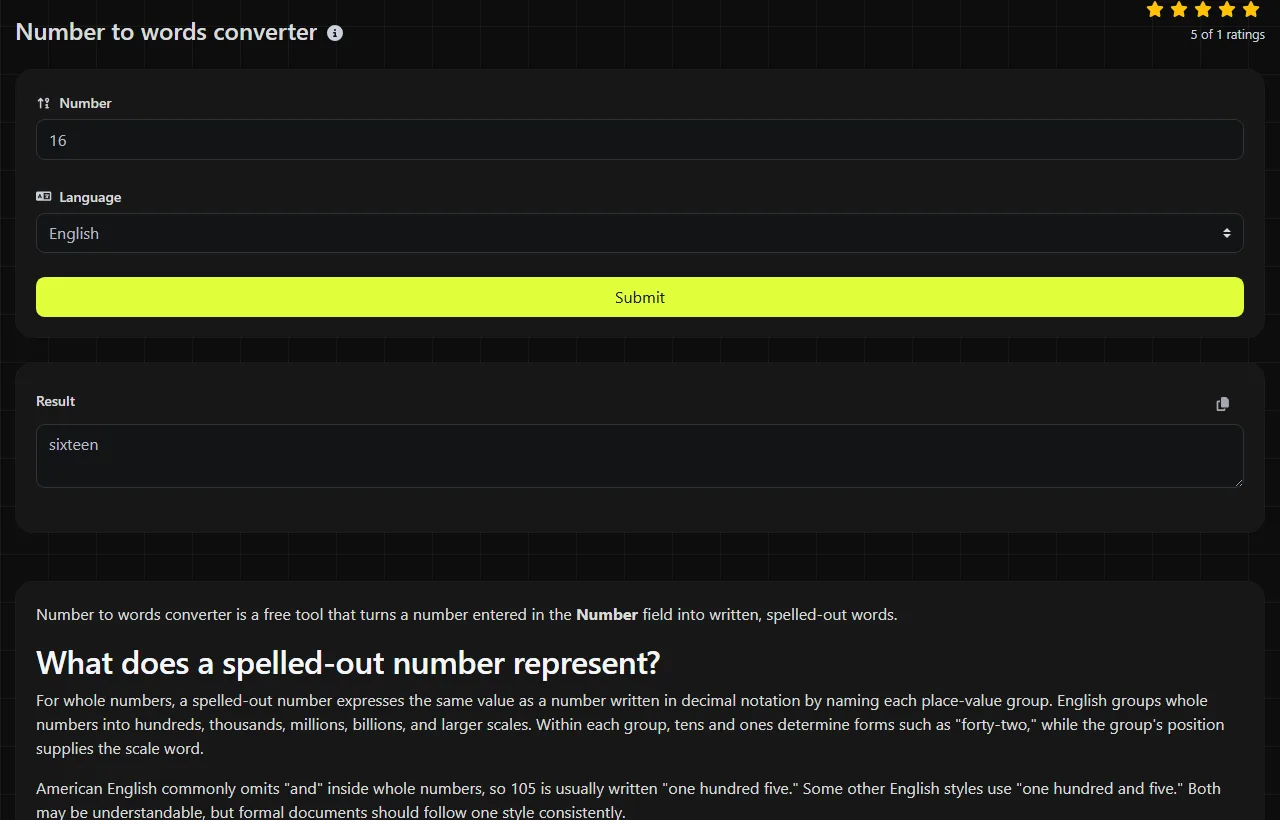
Number to words converter is a free tool that turns a number entered in the Number field into written, spelled-out words.
What does a spelled-out number represent?
For whole numbers, a spelled-out number expresses the same value as a number written in decimal notation by naming each place-value group. English groups whole numbers into hundreds, thousands, millions, billions, and larger scales. Within each group, tens and ones determine forms such as "forty-two," while the group's position supplies the scale word.
American English commonly omits "and" inside whole numbers, so 105 is usually written "one hundred five." Some other English styles use "one hundred and five." Both may be understandable, but formal documents should follow one style consistently.
| Value | Conventional American English wording |
|---|---|
| 0 | zero |
| 19 | nineteen |
| 40 | forty |
| 105 | one hundred five |
| 1,000,000 | one million |
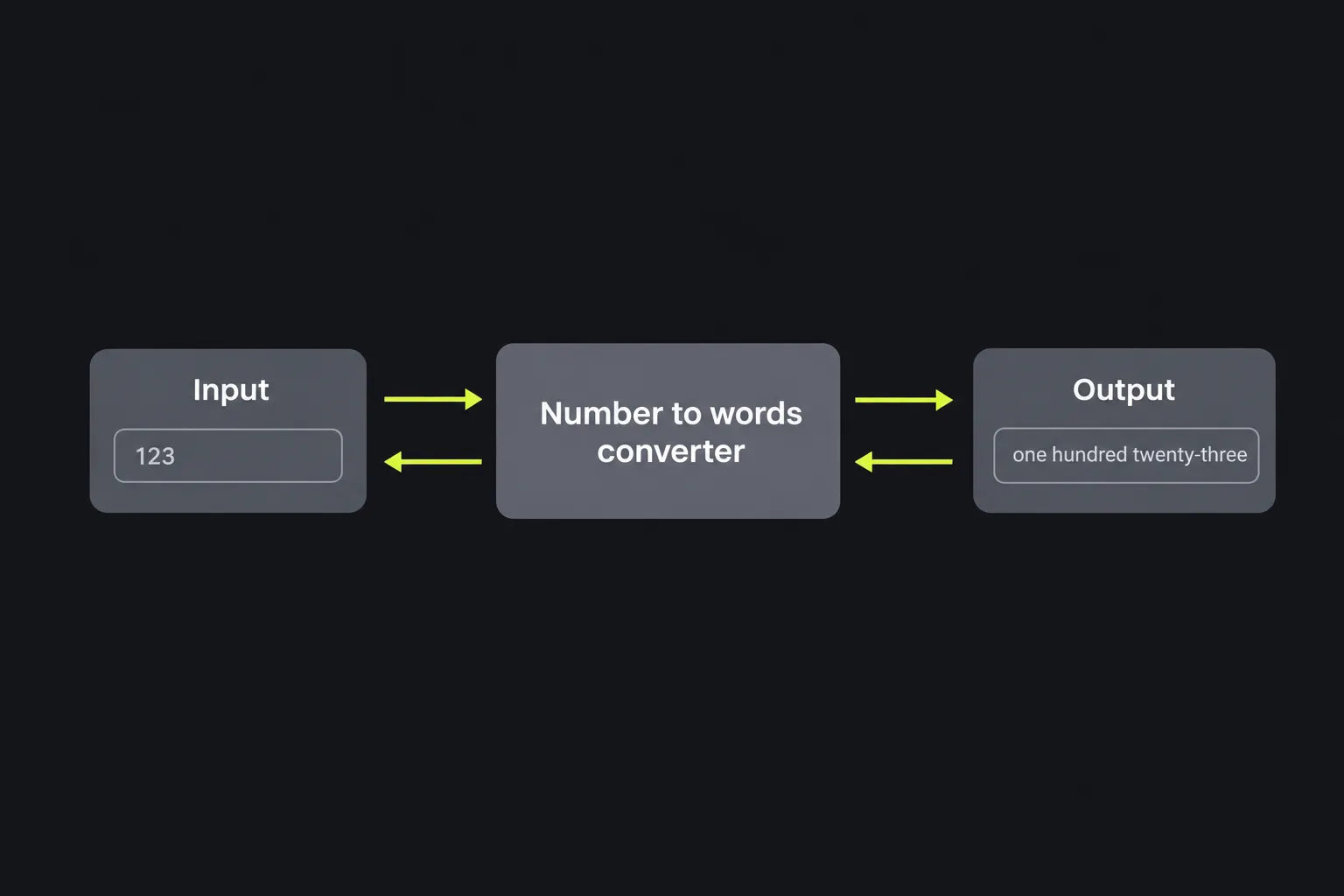
Converting by place value
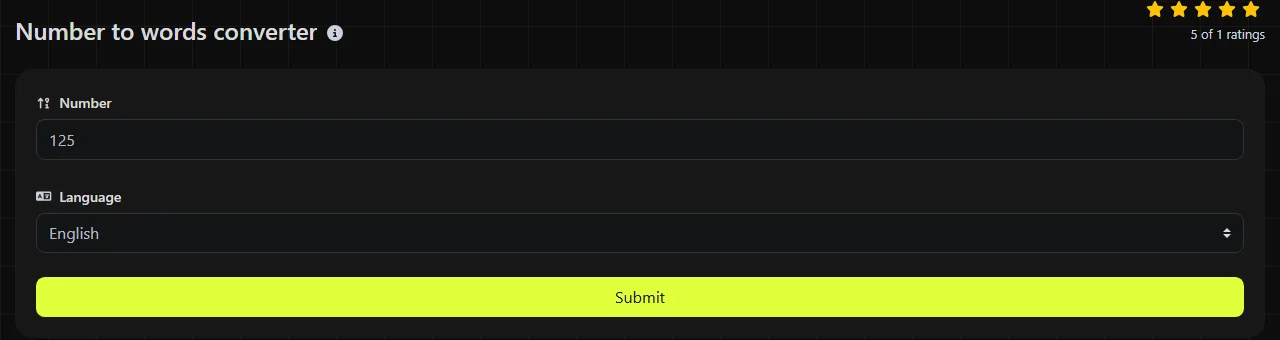
To use the tool, enter the value in the Number field. The conversion takes place on the server.
For one small worked example, split 48,306 into 48 thousand and 306. The conventional American English output is "forty-eight thousand three hundred six." The hyphen joins the tens and ones in "forty-eight," while the comma in the numeric form marks the thousands group and does not appear in the words.
A common hand-conversion mistake is losing a scale when a three-digit group contains zeros. Read the number in groups of three digits from the right, name each nonzero group, and then add its scale word. Do not read every digit separately unless the context specifically requires digit-by-digit speech.
Where do number words help prevent ambiguity?
Number words help when a value must be read aloud, checked by a person, or placed into prose rather than processed as raw numeric data.
- Programming documentation: Written numbers can make generated messages or explanatory text easier to read, but source code and configuration values generally require digits.
- Networking: IP addresses, ports, and subnet values are usually written as digits. When spoken, an address is commonly read by its individual parts rather than converted into one large cardinal number.
- Electronics: Component notes and assembly instructions may spell out quantities, while resistor values, tolerances, and measurements usually retain digits and unit symbols.
- Education: Converting digits into words demonstrates decimal place value and helps identify confusion between hundreds, thousands, and millions.
- Radio communication: Operators often read digits separately. Controlled radio procedures may use specialized pronunciations such as "niner," which ordinary number words do not provide.
What happens with punctuation or unusual input?
The input representation must be interpreted unambiguously before it can be converted to number words. Formatting characters and alternate numeral systems can make input interpretation uncertain.
- Commas in U.S. notation usually separate thousands, but a comma can mark a decimal in other locales.
- A period may indicate a decimal point. Decimal wording varies by purpose, with forms such as "point five" or "five tenths."
- Spaces, currency symbols, unit labels, and letters are not part of the number itself.
- Non-Latin digits and Unicode minus signs may look valid to a person but may not be accepted by every parser.
- An empty field has no numerical value, and extremely long values can produce impractically long wording.
The accepted syntax beyond a number is not documented, so remove grouping punctuation or extra labels if an entry is rejected. The converter does not replace validation for financial, legal, scientific, or software input formats.
How should you check the converted wording?
Check the scale words, hyphenation, and intended reading before copying the result into another document. Confirm that "million," "billion," and similar terms align with the digit groups, especially after manual editing.
Use digits for calculations, database fields, network addresses, and electronics specifications that software must interpret. Use words for prose or human review. If the task involves another representation rather than English wording, the Octal converter handles base-8 values, while the Morse converter translates supported characters into Morse code.
Common questions about number words
Should numbers from twenty-one through ninety-nine be hyphenated?
Yes, compound whole numbers from twenty-one through ninety-nine are normally hyphenated when they are not exact multiples of ten. The same rule applies inside larger values, as in "six hundred fifty-four."
How should a negative number be written?
Place "negative" before the magnitude in mathematical and technical writing, such as "negative twelve." People sometimes say "minus twelve," but "minus" can also describe the subtraction operation, so "negative" is clearer when naming a value.
Are number words safe to convert back into digits in software?
No, not without a parser designed for the expected language and style. Words can contain spelling differences, optional "and," hyphen variations, or ambiguous decimal phrasing. Store the original numeric value when software will need to calculate with it later.
Is sensitive numeric input processed in the browser?
No. Input travels to the server over HTTPS for processing and is not stored. Spelling out a number does not anonymize it, so avoid entering account numbers, card numbers, access codes, or other sensitive identifiers unless the task requires them.
How should scientific notation be written in words?
Scientific notation is usually read as an expression, such as "three times ten to the eighth power," rather than expanded into a long cardinal number. For technical work, retain the original notation beside any written version so the exponent remains clear.
Popular tools
Create a WhatsApp chat link from a phone number, with an optional prefilled message.