List alphabetizer
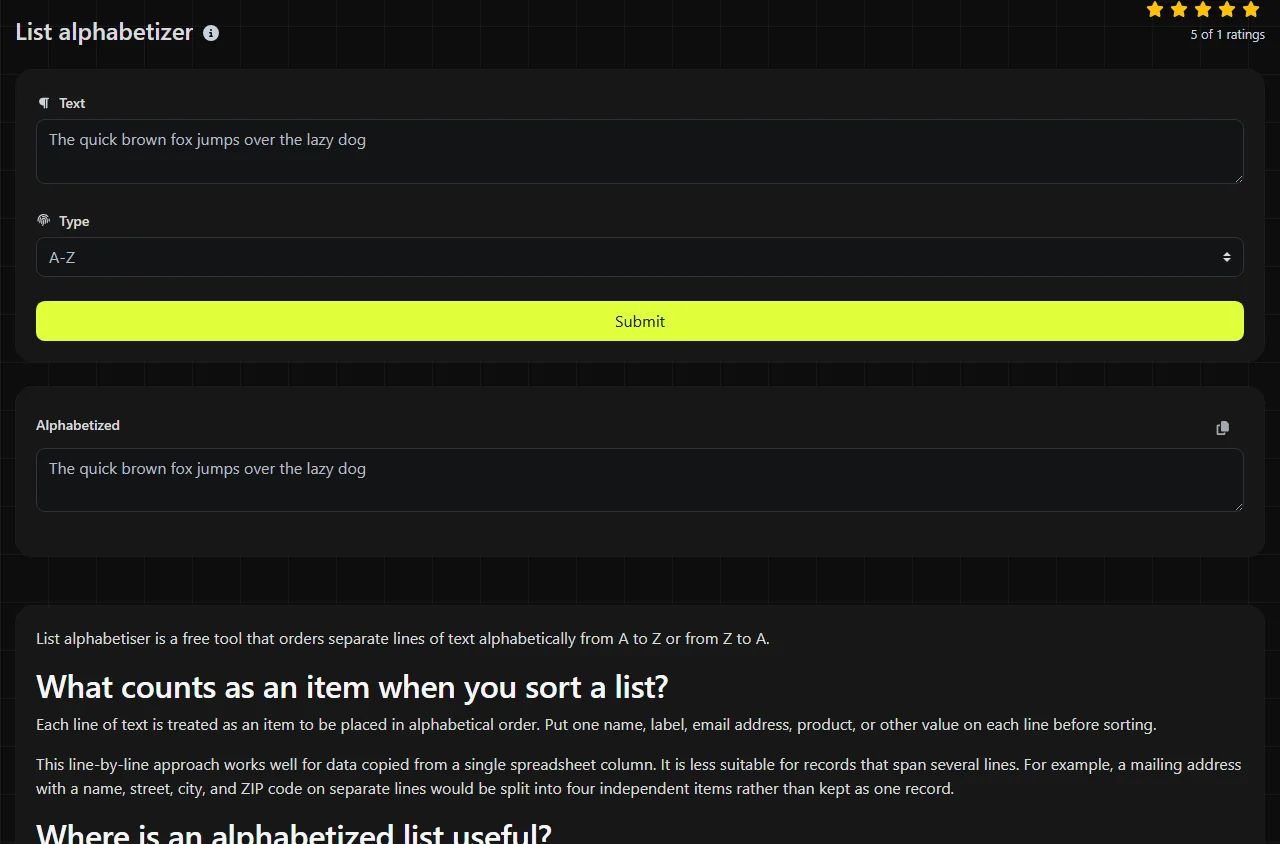
Order text lines in alphabetical order (A-Z or Z-A) with ease.

List alphabetiser is a free tool that orders separate lines of text alphabetically from A to Z or from Z to A.
What counts as an item when you sort a list?
Each line of text is treated as an item to be placed in alphabetical order. Put one name, label, email address, product, or other value on each line before sorting.
This line-by-line approach works well for data copied from a single spreadsheet column. It is less suitable for records that span several lines. For example, a mailing address with a name, street, city, and ZIP code on separate lines would be split into four independent items rather than kept as one record.
Where is an alphabetized list useful?
Alphabetical order makes labels easier to scan and can reveal entries that were added in the wrong place. Common uses include:
- Ordering answer choices before adding them to a Google Forms dropdown.
- Cleaning a column copied from Microsoft Excel or Google Sheets.
- Arranging department names for a Salesforce picklist or another CRM field.
- Preparing company names for a mail-merge source file.
- Organizing channel, project, or team names copied from Slack.
- Putting product categories or navigation labels into a consistent order before entering them in Shopify or a content management system.
A practical habit is to keep a copy of the unsorted list until you have checked the result. Sorting changes position, and that can break relationships if the lines were meant to stay aligned with a second spreadsheet column.
A quick A-Z and Z-A example
Suppose the input contains these lines:
pear
apple
fig
banana
An A-Z result is:
apple
banana
fig
pear
A Z-A result is:
pear
fig
banana
apple
Choose A-Z for directories, menus, dropdown choices, and reference lists that people usually scan from the beginning of the alphabet. Choose Z-A when reviewing entries from the end or when a descending alphabetical list is specifically required. Z-A is different from Reverse list, which reverses the existing line sequence rather than alphabetizing it.
How should I prepare the text before sorting?
Place one complete item on each line, choose the required direction, and then review the returned list.
- Paste or enter the list you want to alphabetize, with one item per line.
- Select alphabetical order from A to Z or Z to A.
- Copy the result from Alphabetised and check the first and last few entries.
Remove unwanted leading spaces before sorting because they may affect how a value is compared. Also check punctuation, accented letters, and non-Latin scripts. Alphabetical collation varies by language and implementation, so a list containing entries such as "Åland," "Éclair," and "Zulu" may not follow the dictionary order expected for every locale.
Numbers need similar attention. Text sorting commonly compares characters from left to right, which can place "item 10" before "item 2." Add leading zeros, such as "item 02," when you need numeric-looking labels to follow numerical order. The tool's published information does not specify natural-number sorting or locale-specific collation.
Server processing and practical limits
The sorting work is done on the server. Your input travels to the server over HTTPS and is not stored.
This tool orders lines, but it is not a spreadsheet database or record-aware sorter. Do not use it on several related columns pasted as independent lines if the rows must remain connected. An empty input has no items to arrange.
Review blank lines, repeated entries, capitalization, and punctuation after sorting rather than assuming they were cleaned. If text contains decorative Unicode characters, an Emoji remover may help with unwanted emoji before you alphabetize, but it will not replace general data cleaning.
Common questions about list sorting
Can I alphabetize email addresses by domain name?
Not directly when each line begins with the username. A line-by-line alphabetical sort starts from the beginning of each address, so place the domain first in a temporary spreadsheet column if domain grouping is required.
Can I sort a list by last name?
Prepare each line as "Last name, First name" before sorting. A basic list alphabetizer does not identify which part of a full name is the surname, especially with compound names, suffixes, or different naming conventions.
Will HTML list markup affect the order?
It can. If every line begins with the same tag, later characters may still determine the order, but attributes or different tags can change the comparison. Sorting the visible labels first and adding HTML afterward is safer.
Should I alphabetize data before a mail merge?
Only if the sending or printing order matters. Keep each recipient's fields together in the spreadsheet and sort whole rows there. Copying a single column into this tool and pasting it back can assign names, addresses, or account details to the wrong records.
How do I handle blank lines between groups?
Sort each group separately if the blank lines represent meaningful sections. A general alphabetical operation does not understand that a blank line is intended as a category boundary, so verify section breaks before using the result.
Popular tools
Create a WhatsApp chat link from a phone number, with an optional prefilled message.