File MIME type checker
Get file details, including the MIME type and last modified date.
| Name | |
| Size | |
| Type | |
| Last modified date |
File MIME type checker is a free tool that reports a selected file's MIME type, size, name, and last modified date.
Why check file metadata before an upload or deployment?
Checking file metadata helps diagnose upload failures and files that arrived with an unexpected name or type, and its reported type can be compared with a separately inspected response header. It is a quick first step when an API, content management system, storage service, or browser rejects a file.
A MIME type, also called a media type, is a label such as image/png or application/json. The first part identifies the broad category, while the subtype identifies the specific format. Servers commonly send this value in the HTTP Content-Type header, and upload APIs may use it when deciding how to handle a file.
Useful checks include:
- Confirming that an image selected for a web page is labeled as an image type.
- Reviewing third-party downloads before importing them into an internal system.
- Comparing a file name with its reported type when an upload endpoint returns an unsupported-media-type error.
- Checking whether a generated asset has the expected name and modification date before deployment.
- Recording the size of a file that exceeds an API or content management system upload limit.
A MIME label is evidence, but it is not a complete security or integrity check. Renaming a file, incorrect operating system associations, or incomplete metadata can produce a label that does not match the actual bytes.
What do the returned fields mean?
The returned fields describe the selected file and provide several independent clues about what it is. Read them together rather than treating Type as definitive proof of the file format.
- File identifies the file supplied to the checker.
- Type is the MIME type associated with the file, such as text/csv, image/webp, or application/pdf.
- Size reports how large the file is. This is useful when investigating rejected uploads or unexpectedly large build artifacts.
- Name shows the file name, including its extension when one is present.
- Last modified date shows the modification timestamp associated with the file metadata.
Look for disagreement among the file name, extension, reported media type, size, or modification date. A file named quarterly-report.pdf with an image MIME type deserves further inspection. An empty or generic type can mean that the available metadata does not identify a specific format. The checker does not establish that a file is safe, valid, or uncorrupted.
A compact debugging workflow
- Select the exact file that failed in the target system. Avoid testing a renamed or re-exported copy because that copy may have different metadata.
- Compare Name and Type. The extension and MIME subtype commonly correspond, although neither guarantees the actual content.
- Review Size against the receiving system's documented limit.
- Check Last modified date if the problem may involve a stale build artifact, cached download, or outdated export.
- If the fields appear reasonable, inspect the file signature or parse the content with a format-aware library. Parsing or signature-checking the selected file can detect malformed or mislabeled data.
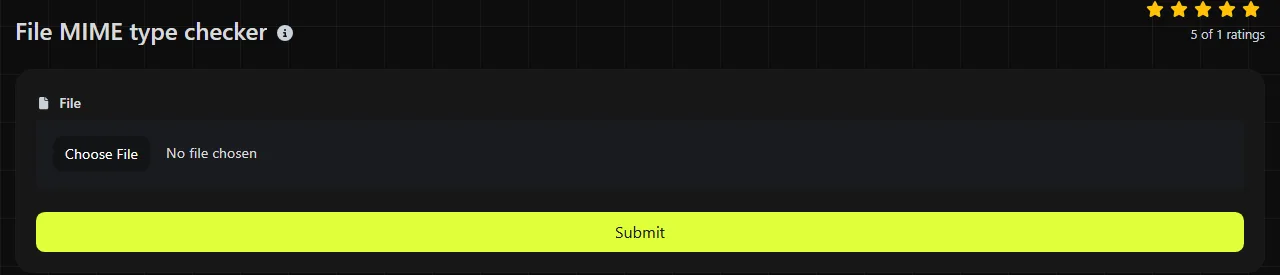
For a small plain-text example, consider an input file named settings.json. A typical matching type is application/json. If the type is empty or unrelated to JSON, check how the file was created and how the receiving application determines media types.
As another example, an input named brand-mark.svg commonly has the type image/svg+xml. Treat text/plain or a blank value as a reason to investigate, not as proof that the SVG content is invalid.
How do unusual names and file contents affect the result?
Unusual file names can complicate interpretation, while the underlying file metadata may still be valid. Spaces, many punctuation characters, accented letters, and non-Latin characters are allowed in file names on common operating systems, although restrictions vary by operating system and downstream APIs may impose their own naming rules.
Names with several periods require care. In backup.2026.09.tar.gz, the meaningful extension is commonly .gz, while the full name suggests a compressed tar archive. A file with no extension may still have a MIME type, and a file with a familiar extension may have an empty or incorrect type.
Numbers in the name do not change the MIME type. Empty files can retain a name and type even though they contain no payload, while very large files may be impractical to inspect further in tools that read the full contents. This checker reports file details.
When is a MIME metadata check unnecessary?
A MIME metadata check is usually unnecessary when a controlled pipeline already assigns and verifies the type and no file-handling problem is under investigation. Rechecking every unchanged artifact adds little when the build output, server configuration, and receiving API are already deterministic.
It is also the wrong operation when the question concerns file validity or safety. Use a JSON parser to find syntax errors in JSON, an image decoder to confirm that an image can be opened, or an archive utility to test a ZIP file. Malware scanning, checksum verification, and file-signature analysis answer different questions and are not listed among this tool's returned details.
When debugging a download rather than a local file, a URL parser can help separate the path, query parameters, and file-looking suffix. For timestamp investigation, Unix Timestamp to Date can help interpret numeric timestamps found in logs or API responses.
Frequently asked questions
Can a MIME type be blank?
Yes. A blank value means no media type was reported. Fall back to controlled content inspection rather than assuming the file is invalid.
Do uppercase letters matter in a MIME type?
The type and subtype in a MIME type are case-insensitive, although lowercase forms are conventional and are used in registered examples. Normalizing only the type and subtype to lowercase can prevent avoidable matching failures in application code; do not lowercase parameter values, which can be case-sensitive.
Why does the last modified date look newer than the original file?
Copying, downloading, exporting, or extracting a file can replace its original modification timestamp with a newer value. Time zone conversion and display formatting can also change how the same instant appears, so compare timestamps with their source and time zone in mind.
Can this check prove that a file is not malicious?
No. A MIME type and file name do not reveal every executable payload, embedded script, or malformed structure. Use security scanning and format-specific validation before accepting untrusted uploads.
Does the checker generate a checksum?
No checksum field is included in the listed output. If you need to confirm that two files contain identical bytes, calculate a cryptographic hash such as SHA-256 and compare the complete hash values.
Before acting on the result, compare the reported details with the requirements of the actual server, API, browser, or deployment pipeline. Escalate mismatches to content inspection rather than fixing only the file extension.
Popular tools
Create a WhatsApp chat link from a phone number, with an optional prefilled message.